

Sooty-faced Finch

Sooty-faced Finch

Arremon crassirostris

Silhouette: Juan Camilo Cepeda-Duque · PhyloPic

LCLeast ConcernNTVUENCR
Daily sighting probability <5% · Rare
at Tapantí-Macizo de la Muerte National Park

In 3 days <5% in a week ~10%

118 Verified sightings at Tapantí-Macizo de la Muerte National Park From 2019 to 2026
1,380 In all 8 parks
May Best month
☀️ Diurnal When it's spotted

About the Sooty-faced Finch

The sooty-faced finch (Arremon crassirostris) is a species of bird in the family Emberizidae, the New World sparrows. It is found in Colombia, Costa Rica, and Panama. The sooty-faced finch has a complicated taxonomic history. It was formally described in 1865 with the binomial Buarremon crassirostris. In 1898 Robert Ridgway erected a new genus for it, Lysurus. He also assigned what is now the olive finch (then Buarremon castaneiceps, now Arremon castaneiceps) to the new genus. In 2008 taxonomists began merging Lysurus into Arremon. The sooty-faced and olive finches are now treated as sister species.

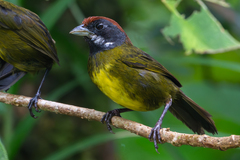
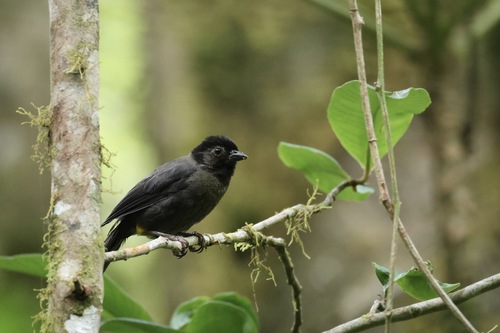
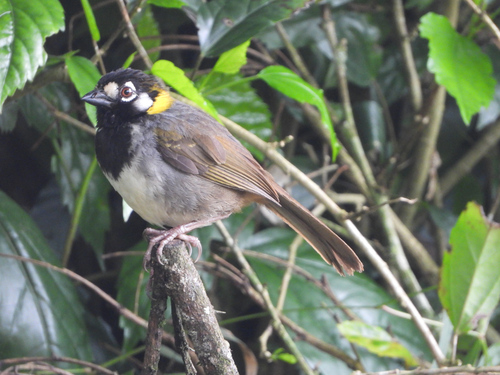
The sooty-faced finch is monotypic. The sooty-faced finch is 15 to 17 cm (5.9 to 6.7 in) long and weighs 37 to 40.5 g (1.3 to 1.4 oz). The sexes have the same plumage. Adults have a rusty crown and a white down-sweeping "moustache" on an otherwise blackish gray head and nape. Their upperparts are dark olive-green and their wings and tail a slightly browner olive-green. Their upper breast, sides, and flanks are dark olive-green and their lower breast and belly yellow. They have a dark brown or chocolate-brown iris, a dark gray maxilla, a pale... Wikipedia →

Sounds

Call0:40

Panama · 2021

© Pedro Luis Castillo · XC674477 · CC BY-NC-SA 4.0

Song0:17

Panama · 2015

© Peter Boesman · XC271075 · CC BY-NC-ND 4.0

Call0:11

Costa Rica · 2019

© Hans Matheve · XC518496 · CC BY-NC-ND 4.0

Global Distribution

Parks Where Found

# Park Country Daily sighting probability
1 Monteverde Cloud Forest Reserve 🇨🇷 Costa Rica
<5%
2 Arenal Volcano National Park 🇨🇷 Costa Rica
<5%
3 Braulio Carrillo National Park 🇨🇷 Costa Rica
<5%
4 Poás Volcano National Park 🇨🇷 Costa Rica
<5%
5 Tapantí-Macizo de la Muerte National Park 🇨🇷 Costa Rica
<5%
6 Chirripó National Park 🇨🇷 Costa Rica
<5%
7 Los Quetzales National Park 🇨🇷 Costa Rica
<5%
8 La Amistad International Park (Panama) 🇵🇦 Panama
<5%

Before you go

What are the chances of seeing a Sooty-faced Finch in Tapantí-Macizo de la Muerte National Park?

Rare

Under 5% of wildlife watchers report a Sooty-faced Finch sighting in Tapantí-Macizo de la Muerte National Park on a given day, based on 118 verified sightings from GBIF citizen-science data from 2019 to 2026. It is the 313th most-seen of the 467 birds we can rate there. Over three days the chance rises to under 5%, and over a week to about 10%, if each day is a fresh chance.

When is the best time to see a Sooty-faced Finch in Tapantí-Macizo de la Muerte National Park?

Any time of year

In every month with enough records, under 5% of wildlife watchers report a Sooty-faced Finch in Tapantí-Macizo de la Muerte National Park on a given day, so our monthly data shows no clear season.

What time of day is best to see a Sooty-faced Finch?

Between 10 am and 1 pm

Across all the parks we cover, that three-hour window holds the most Sooty-faced Finch sightings with a recorded time, and about 8 in 10 of them come between 6 am and 6 pm: it is a daytime animal.

Is Tapantí-Macizo de la Muerte National Park the best place to see a Sooty-faced Finch?

Among the best

Of the 8 parks where we can rate Sooty-faced Finch sightings, Tapantí-Macizo de la Muerte National Park ranks 5th at under 5%, level with the leaders once rounded. The best odds are in Monteverde Cloud Forest Reserve (Costa Rica, under 5%), Arenal Volcano National Park (Costa Rica, under 5%) and Braulio Carrillo National Park (Costa Rica, under 5%).

Where does the Sooty-faced Finch sighting chance come from?

GBIF citizen-science records

It is estimated from how often the Sooty-faced Finch is recorded against all the birds logged in Tapantí-Macizo de la Muerte National Park (118 verified sightings from 2019 to 2026), calibrated against known sighting rates. Figures are rounded to the nearest 10% because citizen-science data supports honest approximations, not decimals, and months with records from fewer than five people show "—". How it works.

← Back to Tapantí-Macizo de la Muerte National Park