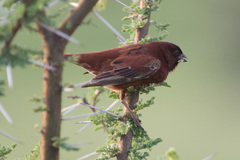
Chestnut Sparrow

Chestnut Sparrow

Passer eminibey

Silhouette: Andrew Butko (modified) · PhyloPic

LCLeast ConcernNTVUENCR
Daily sighting probability ~10% · With luck
at Tarangire National Park

In 3 days ~20% in a week ~40%

75 Verified sightings at Tarangire National Park From 2019 to 2026
1,226 In all 14 parks
March Best month
☀️ Diurnal When it's spotted

About the Chestnut Sparrow

The chestnut sparrow (Passer eminibey) is a species of passerine bird in the sparrow family Passeridae. It is the smallest member of the sparrow family, at about 11 cm (4.3 in) long. The breeding male has deep chestnut plumage and the female and juvenile are coloured a duller grey with some chestnut markings. Like its closest relatives in the genus Passer, the Arabian golden sparrow and the Sudan golden sparrow, it is gregarious and found in arid areas. Ranging through the east of Africa from Darfur in Sudan to Tanzania, it is found in dry savanna, papyrus swamps, and near human habitation. Adults and juveniles both feed mostly on grass seeds, and fly in flocks, often with other species of birds, to find food. It nests in trees, building its own domed nests, and also usurping the more elaborate nests of weavers.

This species was first described in 1880, by Gustav Hartlaub in the Journal für Ornithologie, as Sorella Emini Bey. Hartlaub gave it the specific name Emini Bey in honour of the explorer Emin Pasha, who collected the type specimen in modern South Sudan or Uganda near Lado, and it is occasionally given the eponymous common name Emin Bey's sparrow... Wikipedia →

Sounds

Call0:24

Tanzania · 2021

© isaac kilusu · XC635368 · CC BY-NC-SA 4.0

Call0:28

Tanzania · 2019

© Peter Boesman · XC510296 · CC BY-NC-ND 4.0

Call0:10

Tanzania · 2017

© Frank Lambert · XC449613 · CC BY-NC-ND 4.0

Global Distribution

Parks Where Found

# Park Country Daily sighting probability
1 Samburu National Reserve 🇰🇪 Kenya
~30%
2 Tsavo West National Park 🇰🇪 Kenya
~10%
3 Serengeti National Park 🇹🇿 Tanzania
~10%
4 Ngorongoro Conservation Area 🇹🇿 Tanzania
~10%
5 Amboseli National Park 🇰🇪 Kenya
~10%
6 Meru National Park 🇰🇪 Kenya
~10%
7 Tarangire National Park 🇹🇿 Tanzania
~10%
8 Lake Manyara National Park 🇹🇿 Tanzania
<5%
9 Nairobi National Park 🇰🇪 Kenya
<5%
10 Arusha National Park 🇹🇿 Tanzania
<5%
11 Tsavo East National Park 🇰🇪 Kenya
<5%
12 Lake Nakuru National Park 🇰🇪 Kenya
<5%
13 Masai Mara National Reserve 🇰🇪 Kenya
<5%
14 Murchison Falls National Park 🇺🇬 Uganda
<5%

Before you go

What are the chances of seeing a Chestnut Sparrow in Tarangire National Park?

With luck

About 10% of wildlife watchers report a Chestnut Sparrow sighting in Tarangire National Park on a given day, based on 75 verified sightings from GBIF citizen-science data from 2019 to 2026. It is the 200th most-seen of the 411 birds we can rate there. Over three days the chance rises to about 20%, and over a week to about 40%, if each day is a fresh chance.

When is the best time to see a Chestnut Sparrow in Tarangire National Park?

February–May and October–December

In those months about 10% of wildlife watchers report a Chestnut Sparrow in Tarangire National Park on a given day, against under 5% in January and June–September, the lowest months.

What time of day is best to see a Chestnut Sparrow?

Between 9 am and noon

Across all the parks we cover, that three-hour window holds the most Chestnut Sparrow sightings with a recorded time, and about 8 in 10 of them come between 6 am and 6 pm: it is a daytime animal.

Which relatives of the Chestnut Sparrow live in Tarangire National Park?

Same genus: Passer

The closest relatives of the Chestnut Sparrow that you can see in Tarangire National Park (genus Passer, True Sparrows) are Swahili Sparrow (about 30%) and Northern Grey-headed Sparrow (about 20%), with each one's daily chance of a sighting.

Where does the Chestnut Sparrow sighting chance come from?

GBIF citizen-science records

It is estimated from how often the Chestnut Sparrow is recorded against all the birds logged in Tarangire National Park (75 verified sightings from 2019 to 2026), calibrated against known sighting rates. Figures are rounded to the nearest 10% because citizen-science data supports honest approximations, not decimals, and months with records from fewer than five people show "—". How it works.

← Back to Tarangire National Park