
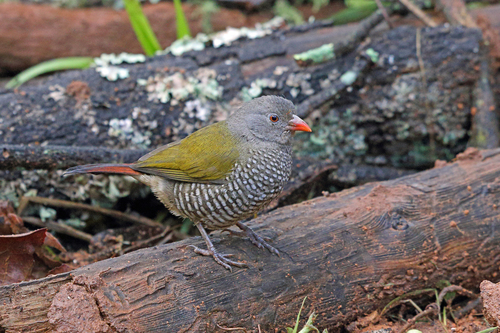
Purple Grenadier

Purple Grenadier

Uraeginthus ianthinogaster

Silhouette: Jim Bendon (photography) and T. Michael Keesey (vectorization) · PhyloPic

Daily sighting probability ~10% · With luck
at Tarangire National Park

In 3 days ~40% in a week ~70%

197 Verified sightings at Tarangire National Park From 2019 to 2026
4,314 In all 15 parks
May Best month
☀️ Diurnal When it's spotted

About the Purple Grenadier

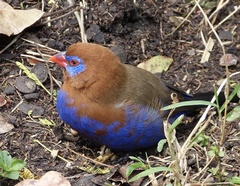
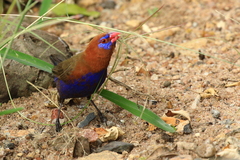
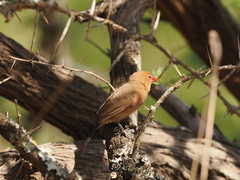
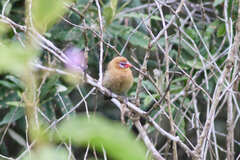
The purple grenadier (Granatina ianthinogaster) is a common species of estrildid finch found in eastern Africa. The length averages 13.3 cm (5.2 in). All ages and sexes have a black tail, and adults have a red bill. The male has a cinnamon-colored head and neck with a blue patch surrounding the eye. The rump is purplish blue and the underparts are violet-blue with variable rufous patches. The female is smaller and mostly cinnamon brown with white barring on the underparts and silver-blue eyepatches. Juveniles are like females, but mostly unbarred tawny-brown with a reddish-brown bill.

The song (in Kenya) is described as "a high, thin chit-cheet tsereea-ee-ee tsit-tsit, or cheerer cheet tsee-tsee sur-chit." It is found in subtropical and tropical (lowland) dry shrubland in Ethiopia, Kenya, Somalia, South Sudan, Tanzania and Uganda, an estimated global extent of occurrence of 1,500,000 km2 (580,000 sq mi). The status of the species is evaluated as Least Concern. Wikipedia →

Global Distribution

Parks Where Found

# Park Country Daily sighting probability
1 Nairobi National Park 🇰🇪 Kenya
~50%
2 Masai Mara National Reserve 🇰🇪 Kenya
~40%
3 Mkomazi National Park 🇹🇿 Tanzania
~30%
4 Serengeti National Park 🇹🇿 Tanzania
~30%
5 Ngorongoro Conservation Area 🇹🇿 Tanzania
~20%
6 Tsavo West National Park 🇰🇪 Kenya
~20%
7 Tarangire National Park 🇹🇿 Tanzania
~10%
8 Lake Nakuru National Park 🇰🇪 Kenya
~10%
9 Awash National Park 🇪🇹 Ethiopia
~10%
10 Aberdare National Park 🇰🇪 Kenya
~10%
11 Lake Manyara National Park 🇹🇿 Tanzania
~10%
12 Kidepo Valley National Park 🇺🇬 Uganda
~10%
13 Tsavo East National Park 🇰🇪 Kenya
<5%
14 Samburu National Reserve 🇰🇪 Kenya
<5%
15 Amboseli National Park 🇰🇪 Kenya
<5%

Cities Where Found

# City Country Daily sighting probability
1 Nairobi 🇰🇪 Kenya
~10%

Zoos & Centres Where Found

# Zoo / Centre Country
1 San Diego Zoo 🇺🇸 United States In captivity
2 Pairi Daiza 🇧🇪 Belgium In captivity
3 San Diego Zoo Safari Park 🇺🇸 United States In captivity

Before you go

What are the chances of seeing a Purple Grenadier in Tarangire National Park?

With luck

About 10% of wildlife watchers report a Purple Grenadier sighting in Tarangire National Park on a given day, based on 197 verified sightings from GBIF citizen-science data from 2019 to 2026. It is the 133rd most-seen of the 411 birds we can rate there. Over three days the chance rises to about 40%, and over a week to about 70%, if each day is a fresh chance.

When is the best time to see a Purple Grenadier in Tarangire National Park?

April and May

In those months about 30% of wildlife watchers report a Purple Grenadier in Tarangire National Park on a given day, against under 5% in February and December, the lowest months. Those are among Tarangire National Park's wettest months, with about 100 mm of rain a month against almost none in September.

What time of day is best to see a Purple Grenadier?

Between noon and 3 pm

Across all the parks we cover, that three-hour window holds the most Purple Grenadier sightings with a recorded time, and about 8 in 10 of them come between 6 am and 6 pm: it is a daytime animal.

Which relatives of the Purple Grenadier live in Tarangire National Park?

Same genus: Uraeginthus

The closest relatives of the Purple Grenadier that you can see in Tarangire National Park (genus Uraeginthus, Cordonbleus) are Red-cheeked Cordon-bleu (about 40%) and Blue-capped Cordonbleu (about 30%), with each one's daily chance of a sighting.

Where does the Purple Grenadier sighting chance come from?

GBIF citizen-science records

It is estimated from how often the Purple Grenadier is recorded against all the birds logged in Tarangire National Park (197 verified sightings from 2019 to 2026), calibrated against known sighting rates. Figures are rounded to the nearest 10% because citizen-science data supports honest approximations, not decimals, and months with records from fewer than five people show "—". How it works.

← Back to Tarangire National Park