Formosan Rock Macaque

Formosan Rock Macaque

Macaca cyclopis

Silhouette: PhyloPic

LCLeast ConcernNTVUENCR Endemic
Daily sighting probability ~70% · Very likely
at Taroko National Park

In 3 days >90%

181 Verified sightings at Taroko National Park From 2019 to 2026
181 In 1 park
December Best month
🌅 Crepuscular When it's spotted

About the Formosan Rock Macaque

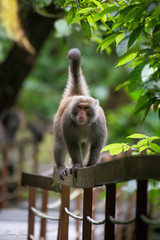
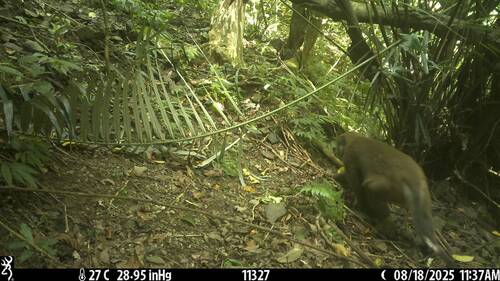
The Formosan rock macaque (Macaca cyclopis), also known as the Formosan rock monkey or Taiwanese macaque, is a macaque endemic to the island of Taiwan, which has also been introduced to Japan. Besides humans, Formosan rock macaques are the only native primates living in Taiwan. The species was first described by Robert Swinhoe in 1862.

Rock macaques measure 50–60 cm and weigh 5–12 kg, generally females are smaller. Their tails are moderately long and measure 26–45 cm. The Formosan rock macaque is brown or gray in color. Like all other macaques, it has specialized pouch-like cheeks, allowing it to temporarily hoard its food. The gathered morsels are eaten sometime later, in safe surroundings.

Among the 22 species of the genus Macaca that are found in southern and eastern Asia as well as northwestern Africa, the Formosan macaque is the only species endemic to the island of Taiwan. Formosan rock macaques live in mixed coniferous-hardwood temperate forest, as well as bamboo and grassland at 100–3600m (328–11,812 ft). The social structure of macaques is generally characterized as often occurring as a large stable multimale-multifemale... Wikipedia →
Sounds

Recording0:11

Taiwan · 2024

© 歐陽秀華 · iNaturalist · CC BY-NC 4.0

Recording0:38

Taiwan · 2023

© Cheng-Te Hsu · iNaturalist · CC BY 4.0

Recording0:43

Taiwan · 2020

© mingun · iNaturalist · CC BY-NC 4.0

Global Distribution

Parks Where Found

# Park Country Daily sighting probability
1 Taroko National Park 🇹🇼 Taiwan
~70%

More parks will be added in future updates.

Cities Where Found

# City Country Daily sighting probability
1 Kaohsiung 🇹🇼 Taiwan
~50%
2 Taipei 🇹🇼 Taiwan
~10%

Zoos & Centres Where Found

# Zoo / Centre Country
1 Taipei Zoo 🇹🇼 Taiwan In captivity
2 Leofoo Village Theme Park 🇹🇼 Taiwan In captivity
3 Espace zoologique de Saint-Martin-la-Plaine 🇫🇷 France In captivity
4 新光動物園 🇹🇼 Taiwan In captivity
5 Hsinchu Zoo 🇹🇼 Taiwan In captivity

Before you go

What are the chances of seeing a Formosan Rock Macaque in Taroko National Park?

Very likely

About 70% of wildlife watchers report a Formosan Rock Macaque sighting in Taroko National Park on a given day, based on 181 verified sightings from GBIF citizen-science data from 2019 to 2026. It is the most-seen of the 12 mammals we can rate there. Over three days the chance rises to over 90%, if each day is a fresh chance.

When is the best time to see a Formosan Rock Macaque in Taroko National Park?

March and November–December

In those months about 80% of wildlife watchers report a Formosan Rock Macaque in Taroko National Park on a given day, against about 50% in May and September, the lowest months.

What time of day is best to see a Formosan Rock Macaque?

Between 3 and 6 am

Across all the parks we cover, that three-hour window holds the most Formosan Rock Macaque sightings with a recorded time, and about half of them come between 6 am and 6 pm: it is most active around dawn and dusk.

Where else can you see a Formosan Rock Macaque?

Only Taroko National Park, in our data

Taroko National Park is the only park on Wallace's Line with enough records to rate Formosan Rock Macaque sightings: about 70% of wildlife watchers there report one on a given day.

Where does the Formosan Rock Macaque sighting chance come from?

GBIF citizen-science records

It is estimated from how often the Formosan Rock Macaque is recorded against all the mammals logged in Taroko National Park (181 verified sightings from 2019 to 2026), calibrated against known sighting rates. Figures are rounded to the nearest 10% because citizen-science data supports honest approximations, not decimals, and months with records from fewer than five people show "—". How it works.

← Back to Taroko National Park