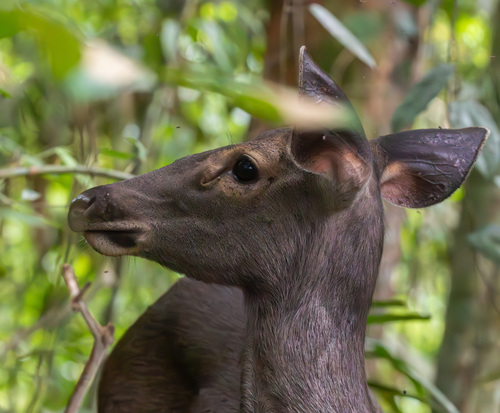
Great Roundleaf Bat

Great Roundleaf Bat

Hipposideros armiger

Silhouette: T. Michael Keesey · PhyloPic

LCLeast ConcernNTVUENCR
Daily sighting probability ~20% · Possible
at Taroko National Park

In 3 days ~40% in a week ~70%

12 Verified sightings at Taroko National Park From 2019 to 2026
12 In 1 park
April Best month
☀️ Diurnal When it's spotted

About the Great Roundleaf Bat

The great roundleaf bat, also known as the great Himalayan leaf-nosed bat (Hipposideros armiger) is a species of bat in the family Hipposideridae found in South Asia, Southeast Asia, and China. It gives birth to two young a year. It has been assessed as a least concern species by the IUCN.

There are four recognised subspecies of the bat. H. a. traninhensis The great roundleaf bat is similar in appearance to the closely related intermediate roundleaf bat (H. larvatus). However, the great roundleaf bat is larger and possesses four, not three, lateral accessory leaflets on each side of the main noseleaf. This bat has a forearm length up to 9.8 cm, and weighs up to 60 g. After an experiment published by Kathryn Knight, in which they painted the accessory leaflets and the ears and videotaped them, it was concluded that when they clicked, the leaflets closed and their ears bent down. When listening to the clicking they opened their noseleaf and their ears.

It breeds once a year and gives birth to two young. Females have been found pregnant from January to early May... Wikipedia →
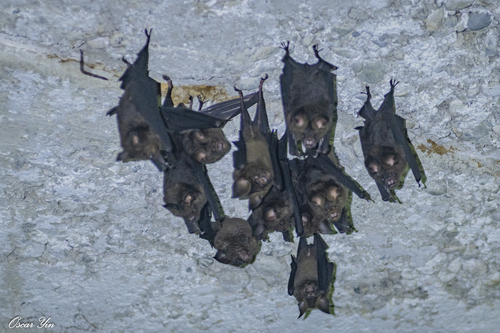
Sounds

Recording0:45

Taiwan · 2023

© abujudy · iNaturalist · CC BY-NC 4.0

Recording0:37

Thailand · 2023

Светлана Царахова · iNaturalist · CC0

Recording0:36

Taiwan · 2025

© 陳界良 · iNaturalist · CC BY-NC 4.0

Global Distribution

Parks Where Found

# Park Country Daily sighting probability
1 Taroko National Park 🇹🇼 Taiwan
~20%

More parks will be added in future updates.

Cities Where Found

# City Country Daily sighting probability
1 Taipei 🇹🇼 Taiwan
<5%
2 Hong Kong 🇨🇳 China
<5%

Before you go

What are the chances of seeing a Great Roundleaf Bat in Taroko National Park?

Possible

About 20% of wildlife watchers report a Great Roundleaf Bat sighting in Taroko National Park on a given day, based on 12 verified sightings from GBIF citizen-science data from 2019 to 2026. It is the 6th most-seen of the 12 mammals we can rate there. Over three days the chance rises to about 40%, and over a week to about 70%, if each day is a fresh chance.

When is the best time to see a Great Roundleaf Bat in Taroko National Park?

March–April and November

In those months about 30% of wildlife watchers report a Great Roundleaf Bat in Taroko National Park on a given day, against under 5% in August–September and December–February, the lowest months.

What time of day is best to see a Great Roundleaf Bat?

Between 9 am and noon

Across all the parks we cover, that three-hour window holds the most Great Roundleaf Bat sightings with a recorded time, and about 8 in 10 of them come between 6 am and 6 pm: it is a daytime animal.

Where else can you see a Great Roundleaf Bat?

Only Taroko National Park, in our data

Taroko National Park is the only park on Wallace's Line with enough records to rate Great Roundleaf Bat sightings: about 20% of wildlife watchers there report one on a given day.

Where does the Great Roundleaf Bat sighting chance come from?

GBIF citizen-science records

It is estimated from how often the Great Roundleaf Bat is recorded against all the mammals logged in Taroko National Park (12 verified sightings from 2019 to 2026), calibrated against known sighting rates. Figures are rounded to the nearest 10% because citizen-science data supports honest approximations, not decimals, and months with records from fewer than five people show "—". How it works.

← Back to Taroko National Park