Formosan Serow

Formosan Serow

Capricornis swinhoei

Silhouette: [unknown] · PhyloPic

LCLeast ConcernNTVUENCR Endemic
Daily sighting probability ~40% · Likely
at Taroko National Park

In 3 days ~80% in a week >90%

274 Verified sightings at Taroko National Park From 2019 to 2026
274 In 1 park
October Best month
🌅 Crepuscular When it's spotted

About the Formosan Serow

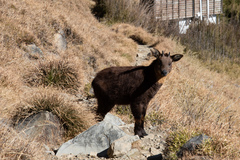
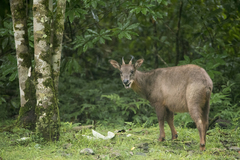
The Taiwanese serow (Capricornis swinhoei) also known as the Formosan serow, is a small species of bovid that is endemic to Taiwan. Its torso length is 80–114 cm (31–45 in) and weight 25–35 kg (55–77 lb). Its tail is short, measuring about 6.5 cm (2.6 in). Its color is dark tan with yellow spots on the jaw, throat and nape.

Both sexes bear horns that curve slightly backward and measure 10–20 cm (3.9–7.9 in) in length. The horns are conical in shape and are never shed. The Formosan serow is the only native bovid of Taiwan. They are highly vigilant and not easy to observe. However, their feces are commonly found in Yushan National Park. At dawn and dusk, they graze and browse in the woods alone or in small numbers. They generally eat the leaves below the shoulder height, or vines, ferns, shrubs, or herbs on the ground. In addition, they need to absorb salt and they can be observed licking minerals deposited on cliffs or rocks.

Taiwan serows can jump as high as 2 m (6 ft 7 in) and run as fast as 55 km/h (34 mph) and large males can weigh up to 100 kg (220 lb). Among all mammals in Taiwan, they are the best high jumpers. They can... Wikipedia →

Sounds

Recording1:55

Taiwan · 2022

© Kuan-Chieh (Chuck) Hung · iNaturalist · CC BY-NC-SA 4.0

Recording0:33

Taiwan · 2023

© 呂一起(Lu i-chi) · iNaturalist · CC BY 4.0

Global Distribution

Parks Where Found

# Park Country Daily sighting probability
1 Taroko National Park 🇹🇼 Taiwan
~40%

More parks will be added in future updates.

Zoos & Centres Where Found

# Zoo / Centre Country
1 Taipei Zoo 🇹🇼 Taiwan In captivity

Before you go

What are the chances of seeing a Formosan Serow in Taroko National Park?

Likely

About 40% of wildlife watchers report a Formosan Serow sighting in Taroko National Park on a given day, based on 274 verified sightings from GBIF citizen-science data from 2019 to 2026. It is the 2nd most-seen of the 12 mammals we can rate there. Over three days the chance rises to about 80%, and over a week to over 90%, if each day is a fresh chance.

When is the best time to see a Formosan Serow in Taroko National Park?

January, March and September–October

In those months about 50% of wildlife watchers report a Formosan Serow in Taroko National Park on a given day, against about 20% in April, the lowest month.

What time of day is best to see a Formosan Serow?

Between 6 and 9 am

Across all the parks we cover, that three-hour window holds the most Formosan Serow sightings with a recorded time, and about 6 in 10 of them come between 6 am and 6 pm: it is most active around dawn and dusk.

Where else can you see a Formosan Serow?

Only Taroko National Park, in our data

Taroko National Park is the only park on Wallace's Line with enough records to rate Formosan Serow sightings: about 40% of wildlife watchers there report one on a given day.

Which relatives of the Formosan Serow live in Taroko National Park?

Same order: Artiodactyla

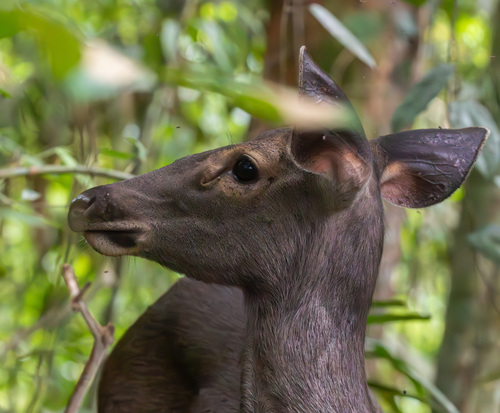
The closest relatives of the Formosan Serow that you can see in Taroko National Park (order Artiodactyla, Even-toed Ungulates and Cetaceans) are Reeves's Muntjac (about 30%), Sambar (about 10%) and Wild Boar (about 10%), with each one's daily chance of a sighting.

Where does the Formosan Serow sighting chance come from?

GBIF citizen-science records

It is estimated from how often the Formosan Serow is recorded against all the mammals logged in Taroko National Park (274 verified sightings from 2019 to 2026), calibrated against known sighting rates. Figures are rounded to the nearest 10% because citizen-science data supports honest approximations, not decimals, and months with records from fewer than five people show "—". How it works.

← Back to Taroko National Park