Reeves's Muntjac

Reeves's Muntjac

Muntiacus reevesi

Silhouette: Steven Traver · PhyloPic

LCLeast ConcernNTVUENCR
Daily sighting probability ~30% · Possible
at Taroko National Park

In 3 days ~60% in a week ~90%

43 Verified sightings at Taroko National Park From 2019 to 2026
43 In 1 park
July Best month
🌅 Crepuscular When it's spotted

About the Reeves's Muntjac

Reeves's muntjac (Muntiacus reevesi), also known as the Chinese muntjac, is a species of muntjac found widely in south-eastern China (from Gansu to Yunnan) and Taiwan. It has also been introduced in the United Kingdom, Ireland, the Netherlands, Belgium, and Japan. It takes its name from John Reeves, a naturalist employed by the British East India Company in the 19th century.

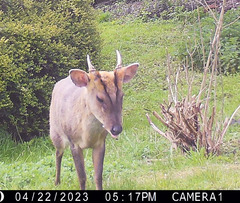
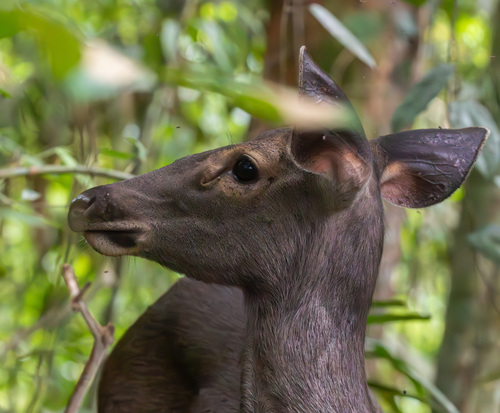
Reeves's muntjac grows to 0.5 m (1 ft 8 in) high at the shoulder and 0.95 m (3 ft 1 in) in length, plus a short tail up to 4 in (10 cm) long. It weighs between 10 and 18 kg (22 and 40 lb) when fully grown. It is reddish-brown in appearance with striped markings on its face. The belly is creamy-white, with lighter fur extending to the neck, chin, and the underside of the tail. The males have short antlers, usually 4 in (10 cm) or less, and long upper canines (tusks), usually about 2 in (5.1 cm) long. Females have bony lumps on their foreheads and localised black spots. The Taiwanese subspecies (M. r. micrurus), commonly known as the Formosan Reeves's muntjac, is darker than other subspecies.

Reeves's muntjac feeds on herbs, blossoms, succulent shoots, fungi, berries, grasses,... Wikipedia →

Sounds

Alarm call0:10

China · 2026

© Albert Lastukhin · XC1138731 · CC BY-NC-ND 4.0

Call0:38

Taiwan · 2014

© Frank Lambert · XC1031572 · CC BY-NC-ND 4.0

Recording0:23

Taiwan · 2024

© 歐陽秀華 · iNaturalist · CC BY-NC 4.0

Global Distribution

Parks Where Found

# Park Country Daily sighting probability
1 Taroko National Park 🇹🇼 Taiwan
~30%

More parks will be added in future updates.

Cities Where Found

# City Country Daily sighting probability
1 Hefei 🇨🇳 China
~30%
2 Fuzhou 🇨🇳 China
~20%
3 Birmingham 🇬🇧 United Kingdom
~10%
4 Taipei 🇹🇼 Taiwan
~10%
5 London 🇬🇧 United Kingdom
~10%
6 Kaohsiung 🇹🇼 Taiwan
~10%

Zoos & Centres Where Found

# Zoo / Centre Country
1 Disney's Animal Kingdom 🇺🇸 United States In captivity
2 Busch Gardens Tampa 🇺🇸 United States In captivity
3 Pairi Daiza 🇧🇪 Belgium In captivity
4 Prague Zoo 🇨🇿 Czechia In captivity
5 Basel Zoo 🇨🇭 Switzerland In captivity
6 ZooParc de Beauval 🇫🇷 France In captivity
7 Barcelona Zoo 🇪🇸 Spain In captivity
8 Zoo de Doué 🇫🇷 France In captivity
9 Silver Springs 🇺🇸 United States In captivity
10 Knuthenborg Safaripark 🇩🇰 Denmark In captivity
11 Wildpark Schloss Tambach 🇩🇪 Germany In captivity
12 Beijing Wildlife Park 🇨🇳 China In captivity
13 Taipei Zoo 🇹🇼 Taiwan In captivity
14 Columbus Zoo and Aquarium 🇺🇸 United States In captivity
15 Ramat Gan Safari 🇮🇱 Israel In captivity
16 Bratislava Zoo 🇸🇰 Slovakia In captivity
17 Beijing Zoo 🇨🇳 China In captivity
18 Shanghai Zoo 🇨🇳 China In captivity
19 Omaha’s Henry Doorly Zoo and Aquarium 🇺🇸 United States In captivity
20 Shenzhen Safari Park 🇨🇳 China In captivity
21 Zoo Gdańsk 🇵🇱 Poland In captivity
22 Nanjing Hongshan Forest Zoo 🇨🇳 China In captivity
23 Parc zoologique de Lisieux 🇫🇷 France In captivity
24 Toledo Zoo 🇺🇸 United States In captivity
25 Cape May County Park & Zoo 🇺🇸 United States In captivity
26 Chongqing Zoo 🇨🇳 China In captivity
27 Guadalajara Zoo 🇲🇽 Mexico In captivity
28 Dakota Zoo 🇺🇸 United States In captivity
29 Safari de Peaugres Circuit Auto 🇫🇷 France In captivity
30 Guangzhou Zoo 🇨🇳 China In captivity
31 Hellabrunn Zoo 🇩🇪 Germany In captivity
32 Oklahoma City Zoo and Botanical Garden 🇺🇸 United States In captivity
33 Kyiv Zoo 🇺🇦 Ukraine In captivity
34 Dierenpark Hoenderdaell 🇳🇱 Netherlands In captivity
35 Brevard Zoo 🇺🇸 United States In captivity
36 Franklin Park Zoo 🇺🇸 United States In captivity
37 ZooTampa 🇺🇸 United States In captivity
38 Indianapolis Zoo 🇺🇸 United States In captivity
39 Lisbon Zoo 🇵🇹 Portugal In captivity
40 Kunming Zoo 🇨🇳 China In captivity
41 Europaradise Park 🇵🇹 Portugal In captivity
42 Zoo Aquarium de Madrid 🇪🇸 Spain In captivity
43 Tierpark Hagenbeck 🇩🇪 Germany In captivity
44 Cologne Zoological Garden 🇩🇪 Germany In captivity
45 Zoologischer Garten Magdeburg 🇩🇪 Germany In captivity
46 Mesker Park Zoo and Botanic Garden 🇺🇸 United States In captivity
47 Safari North Wildlife Park 🇺🇸 United States In captivity
48 Wanpi World Zoo 🇹🇼 Taiwan In captivity
49 Budapest Zoo & Botanical Garden 🇭🇺 Hungary In captivity
50 Zoom di Cumiana 🇮🇹 Italy In captivity

Before you go

What are the chances of seeing a Reeves's Muntjac in Taroko National Park?

Possible

About 30% of wildlife watchers report a Reeves's Muntjac sighting in Taroko National Park on a given day, based on 43 verified sightings from GBIF citizen-science data from 2019 to 2026. It is the 3rd most-seen of the 12 mammals we can rate there. Over three days the chance rises to about 60%, and over a week to about 90%, if each day is a fresh chance.

When is the best time to see a Reeves's Muntjac in Taroko National Park?

July and October–November

In those months about 40% of wildlife watchers report a Reeves's Muntjac in Taroko National Park on a given day, against about 10% in June, the lowest month.

What time of day is best to see a Reeves's Muntjac?

Between 4 and 7 pm

Across all the parks we cover, that three-hour window holds the most Reeves's Muntjac sightings with a recorded time, and about 6 in 10 of them come between 6 am and 6 pm: it is most active around dawn and dusk.

Where else can you see a Reeves's Muntjac?

Only Taroko National Park, in our data

Taroko National Park is the only park on Wallace's Line with enough records to rate Reeves's Muntjac sightings: about 30% of wildlife watchers there report one on a given day.

Where does the Reeves's Muntjac sighting chance come from?

GBIF citizen-science records

It is estimated from how often the Reeves's Muntjac is recorded against all the mammals logged in Taroko National Park (43 verified sightings from 2019 to 2026), calibrated against known sighting rates. Figures are rounded to the nearest 10% because citizen-science data supports honest approximations, not decimals, and months with records from fewer than five people show "—". How it works.

← Back to Taroko National Park