Mugimaki Flycatcher

Mugimaki Flycatcher

Ficedula mugimaki

Silhouette: Rachael Joakim · PhyloPic

LCLeast ConcernNTVUENCR
Daily sighting probability <5% · Rare
at Taroko National Park

In 3 days <5% in a week ~10%

12 Verified sightings at Taroko National Park From 2019 to 2026
361 In all 9 parks
December Best month
☀️ Diurnal When it's spotted

About the Mugimaki Flycatcher

The mugimaki flycatcher (Ficedula mugimaki) is a small passerine bird of eastern Asia belonging to the genus Ficedula in the Old World flycatcher family, Muscicapidae. The name "mugimaki" comes from Japanese and means "wheat-sower". The bird is also known as the robin flycatcher.

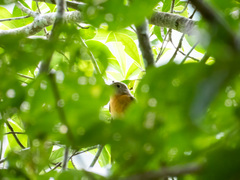
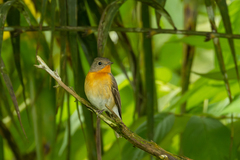
The mugimaki flycatcher is 13 to 13.5 centimetres long. It has a rattling call and often flicks its wings and tail. The adult male has blackish upperparts with a short white supercilium behind the eye, a white wing-patch, white edges to the tertials and white at the base of the outer tail-feathers. The breast and throat are orange-red while the belly and undertail-coverts are white. The female is grey-brown above with a pale orange-brown breast and throat. She lacks white in the tail, has one or two pale wingbars rather than a white wing-patch and has a supercilium that is either faint or absent entirely. Young males are similar to the female but have a brighter orange breast, white in the tail and a more obvious supercilium.

It breeds in eastern Siberia and north-east China. Migrating birds pass through eastern China, Korea and Japan in spring and autumn. The... Wikipedia →

Sounds

Call0:41

Thailand · 2025

© Peter Ericsson · XC981466 · CC BY-NC-SA 4.0

Subsong1:00

China · 2023

© Bo Shunqi 薄顺奇 · XC804840 · CC BY-NC-SA 4.0

Alarm call0:46

Russian Federation · 2011

© Geoff Carey · XC742607 · CC BY-NC-SA 4.0

Global Distribution

Parks Where Found

# Park Country Daily sighting probability
1 Kinabalu Park 🇲🇾 Malaysia
~10%
2 Kerinci Seblat National Park 🇮🇩 Indonesia
<5%
3 Khao Yai National Park 🇹🇭 Thailand
<5%
4 Cuc Phuong National Park 🇻🇳 Vietnam
<5%
5 Khao Sok National Park 🇹🇭 Thailand
<5%
6 Khao Luang National Park 🇹🇭 Thailand
<5%
7 Taroko National Park 🇹🇼 Taiwan
<5%
8 Taman Negara National Park 🇲🇾 Malaysia
<5%
9 Kaeng Krachan National Park 🇹🇭 Thailand
<5%

Cities Where Found

# City Country Daily sighting probability
1 Ningbo 🇨🇳 China
~10%
2 Jinhua 🇨🇳 China
~10%
3 Suzhou 🇨🇳 China
~10%
4 Hangzhou 🇨🇳 China
~10%
5 Nanjing 🇨🇳 China
~10%
6 Shanghai 🇨🇳 China
<5%
7 Wuhan 🇨🇳 China
<5%
8 Seoul 🇰🇷 South Korea
<5%
9 Guangzhou 🇨🇳 China
<5%
10 Singapore 🇸🇬 Singapore
<5%

Before you go

What are the chances of seeing a Mugimaki Flycatcher in Taroko National Park?

Rare

Under 5% of wildlife watchers report a Mugimaki Flycatcher sighting in Taroko National Park on a given day, based on 12 verified sightings from GBIF citizen-science data from 2019 to 2026. It is the 127th most-seen of the 147 birds we can rate there. Over three days the chance rises to under 5%, and over a week to about 10%, if each day is a fresh chance.

When is the best time to see a Mugimaki Flycatcher in Taroko National Park?

Any time of year

In every month with enough records, under 5% of wildlife watchers report a Mugimaki Flycatcher in Taroko National Park on a given day, so our monthly data shows no clear season.

What time of day is best to see a Mugimaki Flycatcher?

Between 8 and 11 am

Across all the parks we cover, that three-hour window holds the most Mugimaki Flycatcher sightings with a recorded time, and about 9 in 10 of them come between 6 am and 6 pm: it is a daytime animal.

Is Taroko National Park the best place to see a Mugimaki Flycatcher?

7th of 9

Of the 9 parks where we can rate Mugimaki Flycatcher sightings, Taroko National Park ranks 7th at under 5%. The best odds are in Kinabalu Park (Malaysia, about 10%), Kerinci Seblat National Park (Indonesia, under 5%) and Khao Yai National Park (Thailand, under 5%).

Where does the Mugimaki Flycatcher sighting chance come from?

GBIF citizen-science records

It is estimated from how often the Mugimaki Flycatcher is recorded against all the birds logged in Taroko National Park (12 verified sightings from 2019 to 2026), calibrated against known sighting rates. Figures are rounded to the nearest 10% because citizen-science data supports honest approximations, not decimals, and months with records from fewer than five people show "—". How it works.

← Back to Taroko National Park