Colombian Four-eyed Frog

Colombian Four-eyed Frog

Pleurodema brachyops

Silhouette: Edwin Price · PhyloPic

LCLeast ConcernNTVUENCR
Daily sighting probability ~30% · Possible
at Tayrona National Natural Park

In 3 days ~60% in a week ~90%

14 Verified sightings at Tayrona National Natural Park From 2019 to 2026
14 In 1 park
May Best month
🌙 Nocturnal When it's spotted

About the Colombian Four-eyed Frog

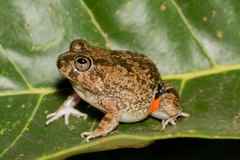
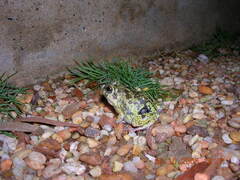
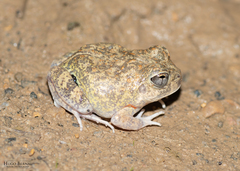
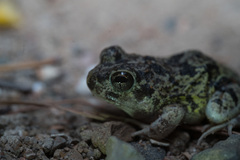
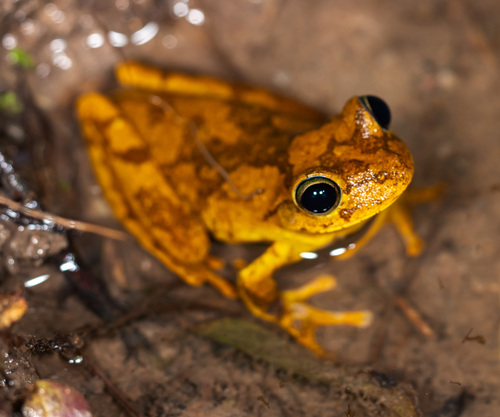
The Colombian four-eyed frog (Pleurodema brachyops; in Spanish: sapito lipon) is a species of frog in the family Leptodactylidae. It is found in an area stretching from Guyana and northern Brazil (Roraima state) through Venezuela (including Isla Margarita) and Colombia into Panama as well as the Dutch Caribbean.

The common name "four-eyed frog" refers to two inguinal poison glands that resemble eyes. When threatened, the frog lowers its head and raises its rear. When the frog adopts this posture, the poison glands are also raised toward the predator. The predator may also confuse the frog's raised posterior for the head of a larger animal.

The natural habitat of the Colombian four-eyed frog is open savanna and grassland and has been found in some modified habitats. Scientists have seen it between 0 and 500 m (0 and 1,640 ft) above sea level and have reported it in protected areas.

When the seasonal rains begin, the frogs emerge from the sand. They can breed in ephemeral and permanent pools of water. The adult frog makes a foam nest for the eggs. The IUCN classifies this species as least concern of extinction... Wikipedia →

Sounds

Recording0:20

Brazil · 2024

© Augustin Bussac · XC929085 · CC BY-NC-SA 4.0

Recording0:41

Caribbean Netherlands · 2022

© Emmasny · iNaturalist · CC BY-NC 4.0

Global Distribution

Parks Where Found

# Park Country Daily sighting probability
1 Tayrona National Natural Park 🇨🇴 Colombia
~30%

More parks will be added in future updates.

Before you go

What are the chances of seeing a Colombian Four-eyed Frog in Tayrona National Natural Park?

Possible

About 30% of wildlife watchers report a Colombian Four-eyed Frog sighting in Tayrona National Natural Park on a given day, based on 14 verified sightings from GBIF citizen-science data from 2019 to 2026. It is the 9th most-seen of the 14 amphibians we can rate there. Over three days the chance rises to about 60%, and over a week to about 90%, if each day is a fresh chance.

When is the best time to see a Colombian Four-eyed Frog in Tayrona National Natural Park?

May

In that month about 80% of wildlife watchers report a Colombian Four-eyed Frog in Tayrona National Natural Park on a given day, against under 5% in June to April, the lowest months.

What time of day is best to see a Colombian Four-eyed Frog?

Between 7 and 10 pm

Across all the parks we cover, that three-hour window holds the most Colombian Four-eyed Frog sightings with a recorded time, and about 8 in 10 of them come between 6 pm and 6 am: it is mostly seen at night.

Where else can you see a Colombian Four-eyed Frog?

Only Tayrona National Natural Park, in our data

Tayrona National Natural Park is the only park on Wallace's Line with enough records to rate Colombian Four-eyed Frog sightings: about 30% of wildlife watchers there report one on a given day.

Which relatives of the Colombian Four-eyed Frog live in Tayrona National Natural Park?

Same family: Leptodactylidae

The closest relatives of the Colombian Four-eyed Frog that you can see in Tayrona National Natural Park (family Leptodactylidae, Southern Frogs) are Guayaquil Dwarf Frog (about 50%), Spotted Foam-nest Frog (about 40%) and Savage's Thin-toed Frog (about 30%), with each one's daily chance of a sighting.

Where does the Colombian Four-eyed Frog sighting chance come from?

GBIF citizen-science records

It is estimated from how often the Colombian Four-eyed Frog is recorded against all the amphibians logged in Tayrona National Natural Park (14 verified sightings from 2019 to 2026), calibrated against known sighting rates. Figures are rounded to the nearest 10% because citizen-science data supports honest approximations, not decimals, and months with records from fewer than five people show "—". How it works.

← Back to Tayrona National Natural Park