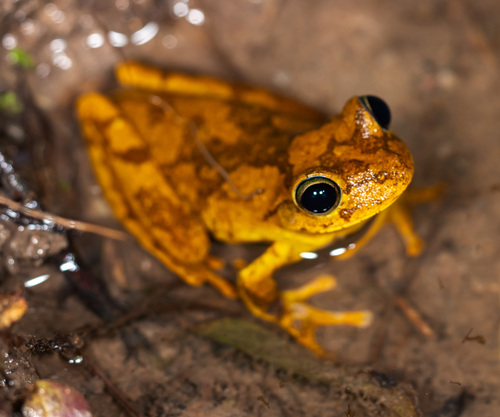
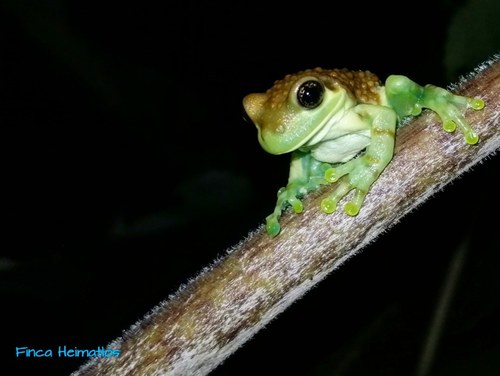
Magdalena Rocket Frog

Magdalena Rocket Frog

Colostethus ruthveni

Silhouette: Steven Traver · PhyloPic

LCNTNear ThreatenedVUENCR
Daily sighting probability ~30% · Possible
at Tayrona National Natural Park

In 3 days ~60% in a week ~90%

50 Verified sightings at Tayrona National Natural Park From 2019 to 2026
50 In 1 park
December Best month
☀️ Diurnal When it's spotted

About the Magdalena Rocket Frog

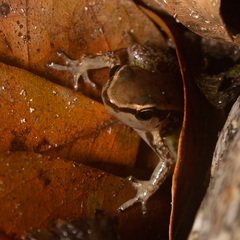
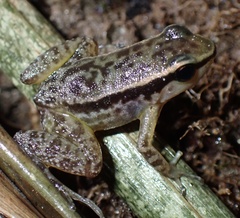
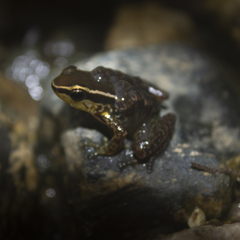
"Colostethus" ruthveni is a species of frog with unresolved relationships within its family Dendrobatidae; it is found only in the mountains of northeastern Magdalena Department in northern Colombia. The specific name ruthveni honors Alexander Grant Ruthven, an American herpetologist.

This frog is endemic to the lower slopes of the north-western portion of the Sierra Nevada de Santa Marta. Its natural habitats are tropical dry forests and cloud forests where it occurs near streams at altitudes above 450 m and up to 2100 m AMSL, and is threatened by habitat loss. Males of this species on average have a snout-vent length of 18.9–20.1 millimetres (0.74–0.79 in) whereas females average about 19.8–24.1 millimetres (0.78–0.95 in).

This species was scientifically described in 1997 and placed in genus Colostethus, which was that time a "wastebasket taxon" uniting various unrelated lineages of non-aposematic drab-coloured dendrobatoid frogs. However, "C." ruthveni is almost certainly not a true Colostethus ("rocket frog") nor a Hyloxalus which contains the bulk of the former "Colostethus", but more closely related to the "typical" bright-colored poison-dart frogs of subfamily Dendrobatinae. It forms a cryptic species complex with slightly different frogs, not scientifically described as of 2019, which are found on the northern/northeastern and the southern slopes of the Santa Marta massif, in La Guajira and Cesar Departments, respectively. Beyond these, its relationships remain elusive as of the 2020s, despite having been studied in some detail. From their reproductive behavior (as far as is known) and the anatomy of their tadpoles, this endemic lineage of Santa Marta frogs seems to be an early branch of dendrobatines, barely more advanced than the very archaic Phyllobates, and might constitute a distinct genus. Wikipedia →

Sounds

Recording1:03

Colombia · 2022

© Orlando Acevedo-Charry · iNaturalist · CC BY-NC 4.0

Recording0:21

Colombia · 2023

Gabriel Laufer · iNaturalist · CC0

Global Distribution

Parks Where Found

# Park Country Daily sighting probability
1 Tayrona National Natural Park 🇨🇴 Colombia
~30%

More parks will be added in future updates.

Before you go

What are the chances of seeing a Magdalena Rocket Frog in Tayrona National Natural Park?

Possible

About 30% of wildlife watchers report a Magdalena Rocket Frog sighting in Tayrona National Natural Park on a given day, based on 50 verified sightings from GBIF citizen-science data from 2019 to 2026. It is the 10th most-seen of the 14 amphibians we can rate there. Over three days the chance rises to about 60%, and over a week to about 90%, if each day is a fresh chance.

When is the best time to see a Magdalena Rocket Frog in Tayrona National Natural Park?

December

In that month about 40% of wildlife watchers report a Magdalena Rocket Frog in Tayrona National Natural Park on a given day, against under 5% in August and October, the lowest months. That is one of Tayrona National Natural Park's driest months, with about 35 mm of rain against 180 mm in October.

What time of day is best to see a Magdalena Rocket Frog?

Between 2 and 5 pm

Across all the parks we cover, that three-hour window holds the most Magdalena Rocket Frog sightings with a recorded time, and about 8 in 10 of them come between 6 am and 6 pm: it is a daytime animal.

Where else can you see a Magdalena Rocket Frog?

Only Tayrona National Natural Park, in our data

Tayrona National Natural Park is the only park on Wallace's Line with enough records to rate Magdalena Rocket Frog sightings: about 30% of wildlife watchers there report one on a given day.

Where does the Magdalena Rocket Frog sighting chance come from?

GBIF citizen-science records

It is estimated from how often the Magdalena Rocket Frog is recorded against all the amphibians logged in Tayrona National Natural Park (50 verified sightings from 2019 to 2026), calibrated against known sighting rates. Figures are rounded to the nearest 10% because citizen-science data supports honest approximations, not decimals, and months with records from fewer than five people show "—". How it works.

← Back to Tayrona National Natural Park