Banana Tree Dwelling Frog

Banana Tree Dwelling Frog

Boana platanera

Silhouette: Andy Wilson · PhyloPic

LCLeast ConcernNTVUENCR
Daily sighting probability ~30% · Possible
at Tayrona National Natural Park

In 3 days ~60% in a week ~90%

15 Verified sightings at Tayrona National Natural Park From 2019 to 2026
37 In all 3 parks
September Best month
☀️🌙 Day & Night When it's spotted

About the Banana Tree Dwelling Frog

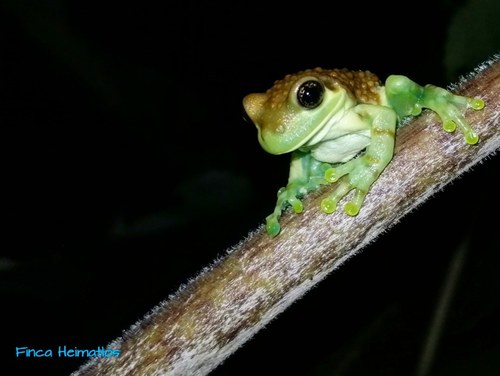
Boana platanera, commonly known as the banana tree dwelling frog, is a species of tree frog in the family Hylidae. It is distributed within Venezuela, Colombia, Panama, and Trinidad and Tobago. Boana platanera was described in 2021, and individuals of the species were previously classified as Boana crepitans or Boana xerophylla.

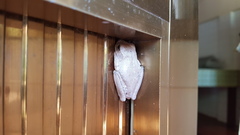
In Colombia and Venezuela, Boana platanera is, together with Boana pugnax, known by the Spanish name rana platanera. The specific name platanera was borrowed from this colloquial name, and it can be translated as "from the plantain". This refers to the banana trees on which these frogs are often seen in the daytime. Rana platanera can thus be translated as "banana tree dwelling frog", which is the English name suggested by the describers.

Boana platanera is the sister species of Boana xerophylla, from which it was separated in 2021. Both species are present in Venezuela, but Boana platanera lives north of the Orinoco river and Boana xerophylla south of the river. This classification is fairly recent, as Boana xerophylla was resurrected in 2017 and Boana platanera was described in 2021. For decades prior to the resurrection, both... Wikipedia →
Sounds

Advertisement call0:32

Costa Rica · 2023

© Chris Harrison · XC941183 · CC BY-NC-SA 4.0

Recording0:38

Colombia · 2026

© duber alexis pamplona · iNaturalist · CC BY-NC 4.0

Recording0:55

Venezuela · 2019

© Rafael Gianni-Zurita · iNaturalist · CC BY-NC 4.0

Global Distribution

Parks Where Found

# Park Country Daily sighting probability
1 Main Ridge Forest Reserve 🇹🇹 Trinidad and Tobago
~40%
2 Tayrona National Natural Park 🇨🇴 Colombia
~30%
3 Farallones de Cali National Natural Park 🇨🇴 Colombia
~10%

Cities Where Found

# City Country Daily sighting probability
1 Valencia 🇻🇪 Venezuela
~40%
2 Cali 🇨🇴 Colombia
~20%
3 Caracas 🇻🇪 Venezuela
~10%

Before you go

What are the chances of seeing a Banana Tree Dwelling Frog in Tayrona National Natural Park?

Possible

About 30% of wildlife watchers report a Banana Tree Dwelling Frog sighting in Tayrona National Natural Park on a given day, based on 15 verified sightings from GBIF citizen-science data from 2019 to 2026. It is the 7th most-seen of the 14 amphibians we can rate there. Over three days the chance rises to about 60%, and over a week to about 90%, if each day is a fresh chance.

When is the best time to see a Banana Tree Dwelling Frog in Tayrona National Natural Park?

September

In that month about 60% of wildlife watchers report a Banana Tree Dwelling Frog in Tayrona National Natural Park on a given day, against under 5% in February, June–August and October–November, the lowest months.

What time of day is best to see a Banana Tree Dwelling Frog?

Between 7 and 10 pm

Across all the parks we cover, that three-hour window holds the most Banana Tree Dwelling Frog sightings with a recorded time, and about 6 in 10 of them come between 6 am and 6 pm: it is seen both by day and at night.

Is Tayrona National Natural Park the best place to see a Banana Tree Dwelling Frog?

2nd of 3

Of the 3 parks where we can rate Banana Tree Dwelling Frog sightings, Tayrona National Natural Park ranks 2nd at about 30%. The best odds are in Main Ridge Forest Reserve (Trinidad and Tobago, about 40%).

Where does the Banana Tree Dwelling Frog sighting chance come from?

GBIF citizen-science records

It is estimated from how often the Banana Tree Dwelling Frog is recorded against all the amphibians logged in Tayrona National Natural Park (15 verified sightings from 2019 to 2026), calibrated against known sighting rates. Figures are rounded to the nearest 10% because citizen-science data supports honest approximations, not decimals, and months with records from fewer than five people show "—". How it works.

← Back to Tayrona National Natural Park