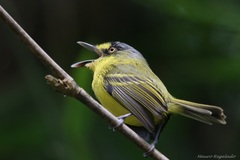

Gray-headed Tody-Flycatcher

Gray-headed Tody-Flycatcher

Todirostrum poliocephalum

Silhouette: Emily Willoughby · PhyloPic

LCLeast ConcernNTVUENCR Endemic
Daily sighting probability ~50% · Likely
at Tijuca National Park

In 3 days ~80% in a week >90%

1,368 Verified sightings at Tijuca National Park From 2019 to 2026
2,494 In all 4 parks
December Best month
☀️ Diurnal When it's spotted

About the Gray-headed Tody-Flycatcher

The yellow-lored tody-flycatcher, or gray-headed tody-flycatcher, (Todirostrum poliocephalum) is a species of bird in the family Tyrannidae, the tyrant flycatchers. It is endemic to Brazil. The yellow-lored tody-flycatcher was originally described by Prince Maximilian of Wied-Neuwied in 1831 as Todus poliocephalus. He called it "Der grauköpfige Plattschanbel" which roughly translates to "grey-headed flatbill". It was later moved to genus Triccus and still later to its current Todirostrum.

The yellow-lored tody-flycatcher is monotypic. The yellow-lored tody-flycatcher is 8.8 to 10.2 cm (3.5 to 4.0 in) long and weighs about 5 to 6 g (0.18 to 0.21 oz). The sexes have the same plumage. Adults have a slate-gray crown and nape, large lemon yellow or sulphur yellow patches on the lores with a black stripe below them, and greenish cheeks. Their back, rump, and uppertail coverts are "siskin-green" (Wied's term) or olive. Their wings are black-brown with yellow-green edges on the flight feathers and yellow or olive edges on the coverts; the last show as two wing bars. Their tail is dark grayish brown with olive-green edges on the feathers. Their... Wikipedia →

Sounds

Call0:34

Brazil · 2026

© JAYRSON ARAUJO DE OLIVEIRA · XC1150271 · CC BY-NC-SA 4.0

Song0:18

Brazil · 2025

© Joost van Bruggen · XC1050671 · CC BY-NC-ND 4.0

Canto1:28

Brazil · 2019

© Caio Brito · XC556641 · CC BY-NC-SA 4.0

Global Distribution

Parks Where Found

# Park Country Daily sighting probability
1 Serra dos Órgãos National Park 🇧🇷 Brazil
~50%
2 Tijuca National Park 🇧🇷 Brazil
~50%
3 Itatiaia National Park 🇧🇷 Brazil
~40%
4 Serra da Canastra National Park 🇧🇷 Brazil
~10%

Cities Where Found

# City Country Daily sighting probability
1 Rio de Janeiro 🇧🇷 Brazil
~40%
2 Niterói 🇧🇷 Brazil
~30%
3 Santos 🇧🇷 Brazil
~10%
4 Belo Horizonte 🇧🇷 Brazil
<5%
5 Campinas 🇧🇷 Brazil
<5%
6 São Paulo 🇧🇷 Brazil
<5%

Before you go

What are the chances of seeing a Gray-headed Tody-Flycatcher in Tijuca National Park?

Likely

About 50% of wildlife watchers report a Gray-headed Tody-Flycatcher sighting in Tijuca National Park on a given day, based on 1,368 verified sightings from GBIF citizen-science data from 2019 to 2026. It is the 19th most-seen of the 214 birds we can rate there. Over three days the chance rises to about 80%, and over a week to over 90%, if each day is a fresh chance.

When is the best time to see a Gray-headed Tody-Flycatcher in Tijuca National Park?

September–October and December

In those months about 60% of wildlife watchers report a Gray-headed Tody-Flycatcher in Tijuca National Park on a given day, against about 30% in January to April, the lowest months.

What time of day is best to see a Gray-headed Tody-Flycatcher?

Between 8 and 11 am

Across all the parks we cover, that three-hour window holds the most Gray-headed Tody-Flycatcher sightings with a recorded time, and about 9 in 10 of them come between 6 am and 6 pm: it is a daytime animal.

Is Tijuca National Park the best place to see a Gray-headed Tody-Flycatcher?

Among the best

Of the 4 parks where we can rate Gray-headed Tody-Flycatcher sightings, Tijuca National Park ranks 2nd at about 50%, level with the leaders once rounded. The best odds are in Serra dos Órgãos National Park (Brazil, about 50%).

Where does the Gray-headed Tody-Flycatcher sighting chance come from?

GBIF citizen-science records

It is estimated from how often the Gray-headed Tody-Flycatcher is recorded against all the birds logged in Tijuca National Park (1,368 verified sightings from 2019 to 2026), calibrated against known sighting rates. Figures are rounded to the nearest 10% because citizen-science data supports honest approximations, not decimals, and months with records from fewer than five people show "—". How it works.

← Back to Tijuca National Park