Pin-tailed Manakin

Pin-tailed Manakin

Ilicura militaris

Silhouette: Edwin Price · PhyloPic

LCLeast ConcernNTVUENCR
Daily sighting probability ~10% · With luck
at Tijuca National Park

In 3 days ~20% in a week ~40%

207 Verified sightings at Tijuca National Park From 2019 to 2026
632 In all 4 parks
June Best month
☀️ Diurnal When it's spotted

About the Pin-tailed Manakin

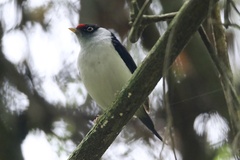
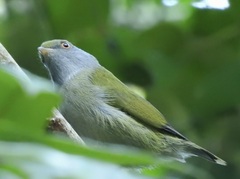
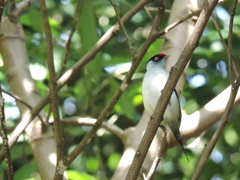
The pin-tailed manakin (Ilicura militaris) is a suboscine species of bird within the manakin family, Pipridae. This species is endemic to the Eastern coast of Brazil within the humid Atlantic Forest, and its range extends from the State of Bahia to the State of Rio Grande Do Sul. The pin-tailed manakin is monotypic within the genus Ilicura, and has no known subspecies. It is a relatively small species that has pronounced sexual dimorphism. Male birds of this species have a bright white neck, chest, auriculars, and flanks. They have black and dark-green wings, with a signature pin shape tail that has a small fork near the tip, helping to give it its common name in English. The males are most easily identified by their characteristically vibrant red fore-crown and rump. The females of this species are a muted green, except for their neck and auriculars—which are light grey, and their cream-colored chest. Both male and female birds of this species share a slightly elongated head shape that gives them a distinguished raised forehead. The pin-tailed manakin's vocalizations are quiet, but resemble a high-pitched "see-see-see" in descending tones.

There has been very little research conducted on this species of manakin, and it especially lacks information on its ecology and breeding habits. The pin-tailed manakin is a primary frugivore, but it has been recorded consuming small amounts of insects on occasion. The diet is relatively unknown, but is hypothesized to be able to transform the keto-carotenoids found within its diet into rhodoxanthin, a rare pigment in animals, that gives this bird its signature red color. The pin-tailed manakin has an elaborate courtship ritual called lekking, and is suspected to breed sometime between November and February. This bird is non-migratory, and its conservation status is currently least concern, but its population numbers are hypothesized to be in decline. Wikipedia →

Sounds

Song0:04

Brazil · 2026

© JAYRSON ARAUJO DE OLIVEIRA · XC1150872 · CC BY-NC-SA 4.0

Call1:07

Brazil · 2025

© Joost van Bruggen · XC1050443 · CC BY-NC-ND 4.0

Canto0:05

Brazil · 2019

© Caio Brito · XC556369 · CC BY-NC-SA 4.0

Global Distribution

Parks Where Found

# Park Country Daily sighting probability
1 Serra dos Órgãos National Park 🇧🇷 Brazil
~20%
2 Itatiaia National Park 🇧🇷 Brazil
~10%
3 Serra da Canastra National Park 🇧🇷 Brazil
~10%
4 Tijuca National Park 🇧🇷 Brazil
~10%

Cities Where Found

# City Country Daily sighting probability
1 Belo Horizonte 🇧🇷 Brazil
<5%
2 Rio de Janeiro 🇧🇷 Brazil
<5%

Before you go

What are the chances of seeing a Pin-tailed Manakin in Tijuca National Park?

With luck

About 10% of wildlife watchers report a Pin-tailed Manakin sighting in Tijuca National Park on a given day, based on 207 verified sightings from GBIF citizen-science data from 2019 to 2026. It is the 69th most-seen of the 214 birds we can rate there. Over three days the chance rises to about 20%, and over a week to about 40%, if each day is a fresh chance.

When is the best time to see a Pin-tailed Manakin in Tijuca National Park?

November to September

In those months about 10% of wildlife watchers report a Pin-tailed Manakin in Tijuca National Park on a given day, against under 5% in October, the lowest month.

What time of day is best to see a Pin-tailed Manakin?

Between 8 and 11 am

Across all the parks we cover, that three-hour window holds the most Pin-tailed Manakin sightings with a recorded time, and nearly all of them come between 6 am and 6 pm: it is a daytime animal.

Which relatives of the Pin-tailed Manakin live in Tijuca National Park?

Same family: Pipridae

The closest relatives of the Pin-tailed Manakin that you can see in Tijuca National Park (family Pipridae, Manakins) are Blue Manakin (about 10%) and White-bearded Manakin (about 10%), with each one's daily chance of a sighting.

Where does the Pin-tailed Manakin sighting chance come from?

GBIF citizen-science records

It is estimated from how often the Pin-tailed Manakin is recorded against all the birds logged in Tijuca National Park (207 verified sightings from 2019 to 2026), calibrated against known sighting rates. Figures are rounded to the nearest 10% because citizen-science data supports honest approximations, not decimals, and months with records from fewer than five people show "—". How it works.

← Back to Tijuca National Park