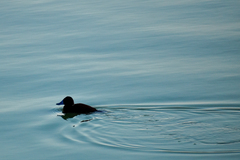
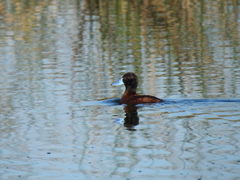
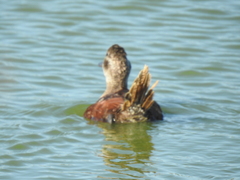

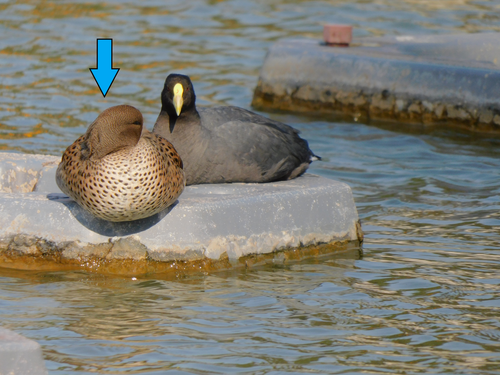
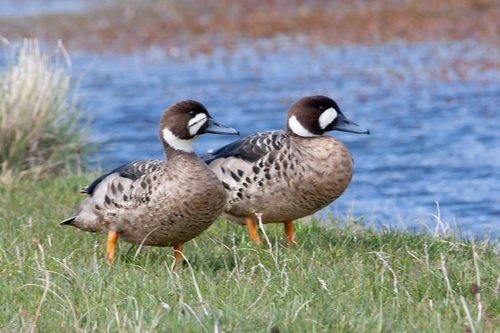
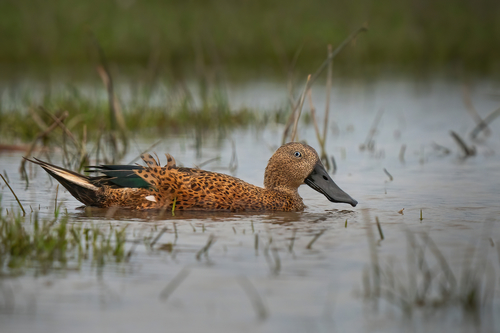
Argentine Blue-bill

Argentine Blue-bill

Oxyura vittata

Silhouette: Sheatherius · PhyloPic

LCLeast ConcernNTVUENCR
Daily sighting probability ~10% · With luck
at Torres del Paine National Park

In 3 days ~30% in a week ~60%

184 Verified sightings at Torres del Paine National Park From 2019 to 2026
184 In 1 park
November Best month
☀️ Diurnal When it's spotted

About the Argentine Blue-bill

The lake duck (Oxyura vittata) is a small, South American stiff-tailed duck. It is also called the Argentine blue-bill, Argentine blue-billed duck, Argentine lake duck, or Argentine ruddy duck. The lake duck grows to 36–46 centimetres (14–18 in). Females weigh 510–700 grams (18–25 oz) and males 600–850 grams (21–30 oz). Males can be distinguished from Andean duck (Oxyura ferruginea), a similar species, by being smaller and having a flatter head.

The lake duck holds the Guinness World Record for having the largest avian reproductive organ, from a specimen in Córdoba, Argentina that had a penis measuring 42.5 centimetres (16.7 in). It also has the longest penis of any vertebrate in relation to body length. The penis, which is typically coiled up in flaccid state, can reach about the same length as the animal itself when fully erect, but more commonly is about half the bird's length. It has a soft tip and spiny base. It is theorized that the size of their spiny penises with bristled tips may have evolved in response to competitive pressure in these highly promiscuous birds, removing sperm from previous matings in the manner of a bottle brush.

Although most... Wikipedia →

Sounds

Alarm call0:12

Argentina · 2008

© Bernabe Lopez-Lanus · XC44471 · CC BY-NC-SA 3.0

Global Distribution

Parks Where Found

# Park Country Daily sighting probability
1 Torres del Paine National Park 🇨🇱 Chile
~10%

More parks will be added in future updates.

Cities Where Found

# City Country Daily sighting probability
1 Buenos Aires 🇦🇷 Argentina
~10%
2 Montevideo 🇺🇾 Uruguay
<5%
3 Cordoba 🇦🇷 Argentina
<5%
4 Santiago 🇨🇱 Chile
<5%

Zoos & Centres Where Found

# Zoo / Centre Country
1 Dresden Zoo 🇩🇪 Germany In captivity
2 Parc des oiseaux 🇫🇷 France In captivity
3 Sedgwick County Zoo 🇺🇸 United States In captivity
4 Oklahoma City Zoo and Botanical Garden 🇺🇸 United States In captivity
5 Franklin Park Zoo 🇺🇸 United States In captivity
6 Houston Zoo 🇺🇸 United States In captivity
7 Cologne Zoological Garden 🇩🇪 Germany In captivity
8 Heidelberg Zoo 🇩🇪 Germany In captivity
9 Zoologischer Garten Halle 🇩🇪 Germany In captivity
10 Cologne Zoo Aquarium 🇩🇪 Germany In captivity

Before you go

What are the chances of seeing an Argentine Blue-bill in Torres del Paine National Park?

With luck

About 10% of wildlife watchers report an Argentine Blue-bill sighting in Torres del Paine National Park on a given day, based on 184 verified sightings from GBIF citizen-science data from 2019 to 2026. It is the 52nd most-seen of the 106 birds we can rate there. Over three days the chance rises to about 30%, and over a week to about 60%, if each day is a fresh chance.

When is the best time to see an Argentine Blue-bill in Torres del Paine National Park?

July and November

In those months about 20% of wildlife watchers report an Argentine Blue-bill in Torres del Paine National Park on a given day, against under 5% in April, the lowest month.

What time of day is best to see an Argentine Blue-bill?

Between 9 am and noon

Across all the parks we cover, that three-hour window holds the most Argentine Blue-bill sightings with a recorded time, and about 9 in 10 of them come between 6 am and 6 pm: it is a daytime animal.

Where else can you see an Argentine Blue-bill?

Only Torres del Paine National Park, in our data

Torres del Paine National Park is the only park on Wallace's Line with enough records to rate Argentine Blue-bill sightings: about 10% of wildlife watchers there report one on a given day.

Where does the Argentine Blue-bill sighting chance come from?

GBIF citizen-science records

It is estimated from how often the Argentine Blue-bill is recorded against all the birds logged in Torres del Paine National Park (184 verified sightings from 2019 to 2026), calibrated against known sighting rates. Figures are rounded to the nearest 10% because citizen-science data supports honest approximations, not decimals, and months with records from fewer than five people show "—". How it works.

← Back to Torres del Paine National Park