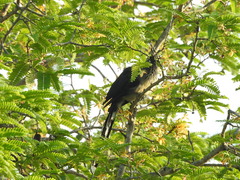
Blue-faced Malkoha

Blue-faced Malkoha

Rhopodytes viridirostris

LCLeast ConcernNTVUENCR
Daily sighting probability ~50% · Likely
at Udawalawe National Park

In 3 days ~80% in a week >90%

225 Verified sightings at Udawalawe National Park From 2019 to 2026
1,069 In all 8 parks
December Best month
☀️ Diurnal When it's spotted

About the Blue-faced Malkoha

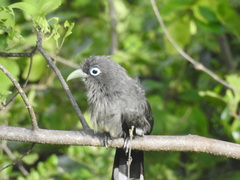
The blue-faced malkoha (Phaenicophaeus viridirostris) or small green-billed malkoha, is a non-parasitic cuckoo found in the scrub and deciduous forests of peninsular India and Sri Lanka. It has a waxy, dark, blue-grey plumage on its upperparts and has a long tail with graduated white-tipped feathers. The throat and chin are dark with spiny pale feathers that are branched. The lower belly is a dull creamy to rufous colour. The bill is apple green, and a naked patch of blue skin surrounds the eye. The sexes are alike. The blue-faced malkoha is a bird of open forests and scrub jungle.

A largish species at 39 cm, its back and head are dark grey with an oily green or blue gloss, and the dark tail has graduated feathers tipped with white. The belly is pale ochre to grey. The feathers of the chin and throat are branched (unlike in Phaenicophaeus tristis) with the branched tips being pointed and slightly yellowish giving the throat a streaked and spiny appearance. There is a large blue patch around the eye, with a white fringed red iris, and the bill is apple green. The sexes are indistinguishable by external appearance. Birds from Sri Lanka have a broader white tip to the... Wikipedia →

Sounds

Flight call0:11

India · 2021

© Mandar Bhagat · XC658267 · CC BY-NC-SA 4.0

Call0:17

Sri Lanka · 2017

© Eric S. J. Tan · XC392158 · CC BY-NC-SA 4.0

Global Distribution

Parks Where Found

# Park Country Daily sighting probability
1 Udawalawe National Park 🇱🇰 Sri Lanka
~50%
2 Yala National Park 🇱🇰 Sri Lanka
~30%
3 Wilpattu National Park 🇱🇰 Sri Lanka
~30%
4 Nagarhole National Park 🇮🇳 India
~10%
5 Minneriya National Park 🇱🇰 Sri Lanka
~10%
6 Bandipur National Park 🇮🇳 India
~10%
7 Mudumalai National Park 🇮🇳 India
~10%
8 Periyar National Park 🇮🇳 India
<5%

Cities Where Found

# City Country Daily sighting probability
1 Tiruchirappalli 🇮🇳 India
~20%
2 Coimbatore 🇮🇳 India
~10%
3 Thrissur 🇮🇳 India
~10%
4 Mysuru 🇮🇳 India
<5%
5 Hyderabad 🇮🇳 India
<5%
6 Tiruppur 🇮🇳 India
<5%
7 Chennai 🇮🇳 India
<5%
8 Bengaluru 🇮🇳 India
<5%
9 Kozhikode 🇮🇳 India
<5%
10 Madurai 🇮🇳 India
<5%

Before you go

What are the chances of seeing a Blue-faced Malkoha in Udawalawe National Park?

Likely

About 50% of wildlife watchers report a Blue-faced Malkoha sighting in Udawalawe National Park on a given day, based on 225 verified sightings from GBIF citizen-science data from 2019 to 2026. It is the 33rd most-seen of the 166 birds we can rate there. Over three days the chance rises to about 80%, and over a week to over 90%, if each day is a fresh chance.

When is the best time to see a Blue-faced Malkoha in Udawalawe National Park?

June, September and November–February

In those months about 50% of wildlife watchers report a Blue-faced Malkoha in Udawalawe National Park on a given day, against about 30% in May and October, the lowest months.

What time of day is best to see a Blue-faced Malkoha?

Between 7 and 10 am

Across all the parks we cover, that three-hour window holds the most Blue-faced Malkoha sightings with a recorded time, and about 9 in 10 of them come between 6 am and 6 pm: it is a daytime animal.

Is Udawalawe National Park the best place to see a Blue-faced Malkoha?

Yes

Of the 8 parks where we can rate Blue-faced Malkoha sightings, Udawalawe National Park has the highest daily chance: about 50%. Next come Yala National Park (Sri Lanka, about 30%) and Wilpattu National Park (Sri Lanka, about 30%).

Which relatives of the Blue-faced Malkoha live in Udawalawe National Park?

Same family: Cuculidae

The closest relatives of the Blue-faced Malkoha that you can see in Udawalawe National Park (family Cuculidae, Cuckoos) are Greater Coucal (about 40%), Asian Koel (about 40%) and Jacobin Cuckoo (about 30%), with each one's daily chance of a sighting.

Where does the Blue-faced Malkoha sighting chance come from?

GBIF citizen-science records

It is estimated from how often the Blue-faced Malkoha is recorded against all the birds logged in Udawalawe National Park (225 verified sightings from 2019 to 2026), calibrated against known sighting rates. Figures are rounded to the nearest 10% because citizen-science data supports honest approximations, not decimals, and months with records from fewer than five people show "—". How it works.

← Back to Udawalawe National Park