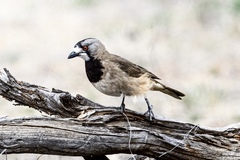
Crested Bellbird

Crested Bellbird

Oreoica gutturalis

Silhouette: Sheatherius · PhyloPic

LCLeast ConcernNTVUENCR Endemic
Daily sighting probability ~20% · Possible
at Uluru-Kata Tjuta National Park

In 3 days ~40% in a week ~70%

77 Verified sightings at Uluru-Kata Tjuta National Park From 2019 to 2026
1,028 In all 4 parks
June Best month
☀️ Diurnal When it's spotted

About the Crested Bellbird

The crested bellbird (Oreoica gutturalis) is a medium-sized passerine bird in the family Oreoicidae. It is native to drier parts of Australia where its typical habitats are acacia scrublands, eucalypt woodlands, spinifex and saltbush plains, and dunes. The male is about 20 cm (8 in) long and has a grey head, a black crest and breast, and a grey or olive brown body. The female and juvenile are similar but the colours are more muted and the black breast is lacking. The distinctive call is a high pitched bell-like sound, audible at some distance. Sometimes a pair of birds duet.

The crested bellbird feeds on seeds and small invertebrates, foraging on the ground or in low bushes. The deep, cup-shaped nest is usually within a couple of metres of the ground, built in the fork of a branch or in a crevice in a stump. It is made from small twigs and bark and lined with finer material. Up to four eggs are laid and these are incubated by both parents. Overall this bird is quite common, but in some regions, such as Victoria, it is threatened by fragmentation of its habitat

This bird has been placed in the Old World warbler family Sylviidae, at the time a "wastebasket... Wikipedia →

Sounds

Song0:33

Australia · 2023

© Peter Boesman · XC859990 · CC BY-NC-ND 4.0

Recording0:08

Australia · 2020

© Drew Davison · XC604126 · CC BY-NC-SA 4.0

Call0:18

Australia · 2017

© Greg McLachlan · XC393300 · CC BY-NC-SA 4.0

Global Distribution

Parks Where Found

# Park Country Daily sighting probability
1 Hattah-Kulkyne National Park 🇦🇺 Australia
~50%
2 Uluru-Kata Tjuta National Park 🇦🇺 Australia
~20%
3 Cape Range 🇦🇺 Australia
~10%
4 Ningaloo Marine Park 🇦🇺 Australia
~10%

Zoos & Centres Where Found

# Zoo / Centre Country
1 Alice Springs Desert Park 🇦🇺 Australia In captivity
2 Adelaide Zoo 🇦🇺 Australia In captivity
3 Featherdale Sydney Wildlife Park 🇦🇺 Australia In captivity

Before you go

What are the chances of seeing a Crested Bellbird in Uluru-Kata Tjuta National Park?

Possible

About 20% of wildlife watchers report a Crested Bellbird sighting in Uluru-Kata Tjuta National Park on a given day, based on 77 verified sightings from GBIF citizen-science data from 2019 to 2026. It is the 28th most-seen of the 84 birds we can rate there. Over three days the chance rises to about 40%, and over a week to about 70%, if each day is a fresh chance.

When is the best time to see a Crested Bellbird in Uluru-Kata Tjuta National Park?

June

In that month about 30% of wildlife watchers report a Crested Bellbird in Uluru-Kata Tjuta National Park on a given day, against about 10% in April, July, September and November–February, the lowest months.

What time of day is best to see a Crested Bellbird?

Between 9 am and noon

Across all the parks we cover, that three-hour window holds the most Crested Bellbird sightings with a recorded time, and about 9 in 10 of them come between 6 am and 6 pm: it is a daytime animal.

Is Uluru-Kata Tjuta National Park the best place to see a Crested Bellbird?

2nd of 4

Of the 4 parks where we can rate Crested Bellbird sightings, Uluru-Kata Tjuta National Park ranks 2nd at about 20%. The best odds are in Hattah-Kulkyne National Park (Australia, about 50%).

Which relatives of the Crested Bellbird live in Uluru-Kata Tjuta National Park?

Same order: Passeriformes

The closest relatives of the Crested Bellbird that you can see in Uluru-Kata Tjuta National Park (order Passeriformes, Perching Birds) are White-plumed Honeyeater (about 90%), Willie Wagtail (about 80%) and Zebra Finch (about 70%), with each one's daily chance of a sighting.

Where does the Crested Bellbird sighting chance come from?

GBIF citizen-science records

It is estimated from how often the Crested Bellbird is recorded against all the birds logged in Uluru-Kata Tjuta National Park (77 verified sightings from 2019 to 2026), calibrated against known sighting rates. Figures are rounded to the nearest 10% because citizen-science data supports honest approximations, not decimals, and months with records from fewer than five people show "—". How it works.

← Back to Uluru-Kata Tjuta National Park