Gray Seal

Gray Seal

Halichoerus grypus

Silhouette: Margot Michaud · PhyloPic

LCLeast ConcernNTVUENCR
Daily sighting probability ~20% · Possible
at Vatnajokull National Park

In 3 days ~40% in a week ~70%

12 Verified sightings at Vatnajokull National Park From 2019 to 2026
1,181 In all 5 parks
August Best month
☀️ Diurnal When it's spotted

About the Gray Seal

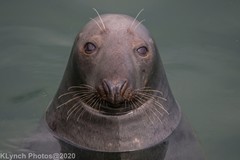
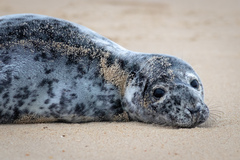
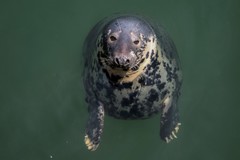
The grey seal (Halichoerus grypus), or gray seal in the United States, is a large seal of the family Phocidae, which are commonly referred to as "true seals" or "earless seals". The only species classified in the genus Halichoerus, it is found on both shores of the North Atlantic Ocean. In Latin, Halichoerus grypus means "hook-nosed sea pig". It is also known as the horsehead seal, owing to its large head.

The grey seal is large and heavy, with individuals from the eastern Atlantic being 1.6–2.3 m (5 ft 3 in – 7 ft 7 in) long and weighing 100–310 kg (220–680 lb), while individuals from the western Atlantic are up to 2.7 m (8 ft 10 in) long, and can reach a weight of as much as 400 kg (880 lb). It is found widely across the northern Atlantic, ranging from the US to Russia, and occasionally as far south as Portugal. It can be divided into two subspecies: the Baltic grey seal (Halichoerus grypus grypus), found in the Baltic Sea, and the Atlantic grey seal (Halichoerus grypus atlantica), found everywhere else. The largest populations are in Canada and the UK.

Grey seals have a varied diet, feeding mostly on fish, and occasionally on invertebrates such as octopuses and lobsters. Their main predators are orcas, and they are also prey to sharks. The pups main predator is often eagles and gulls. Wikipedia →

Sounds

Recording1:00

United Kingdom · 2019

© David de la Haye · iNaturalist · CC BY-NC 4.0

Recording0:31

Canada · 2022

© kaikens · iNaturalist · CC BY-NC 4.0

Recording0:19

Isle of Man · 2024

© Andrew Jacobs · iNaturalist · CC BY-NC 4.0

Global Distribution

Parks Where Found

# Park Country Daily sighting probability
1 Cape Breton Highlands National Park 🇨🇦 Canada
~30%
2 Wadden Sea National Park 🇩🇪 Germany
~30%
3 Acadia National Park 🇺🇸 United States
~30%
4 Vatnajokull National Park 🇮🇸 Iceland
~20%
5 Snowdonia National Park 🇬🇧 United Kingdom
~10%

Cities Where Found

# City Country Daily sighting probability
1 Rotterdam [The Hague] 🇳🇱 Netherlands
~10%
2 Dublin 🇮🇪 Ireland
~10%
3 Helsinki 🇫🇮 Finland
~10%
4 Liverpool 🇬🇧 United Kingdom
~10%
5 Stockholm 🇸🇪 Sweden
~10%
6 London 🇬🇧 United Kingdom
~10%
7 Lisbon 🇵🇹 Portugal
<5%
8 New York City 🇺🇸 United States
<5%

Zoos & Centres Where Found

# Zoo / Centre Country
1 Moscow Zoo 🇷🇺 Russia In captivity
2 National Zoological Park 🇺🇸 United States In captivity
3 Copenhagen Zoo 🇩🇰 Denmark In captivity
4 Skansen 🇸🇪 Sweden In captivity
5 Oceanarium in Saint Petersburg 🇷🇺 Russia In captivity
6 Fota Wildlife Park 🇮🇪 Ireland In captivity
7 Chomutov Zoo 🇨🇿 Czechia In captivity
8 Kaliningrad Zoo 🇷🇺 Russia In captivity
9 Brookfield Zoo 🇺🇸 United States In captivity
10 Zoo Gdańsk 🇵🇱 Poland In captivity
11 Parque Zoológico de León - Zooleón 🇲🇽 Mexico In captivity
12 Louisville Zoo 🇺🇸 United States In captivity
13 Warsaw Zoo 🇵🇱 Poland In captivity
14 Kyiv Zoo 🇺🇦 Ukraine In captivity
15 Indianapolis Zoo 🇺🇸 United States In captivity
16 Zoo Aquarium de Madrid 🇪🇸 Spain In captivity
17 Hanover Zoo 🇩🇪 Germany In captivity
18 Ueno Zoo 🇯🇵 Japan In captivity
19 bioparco 🇮🇹 Italy In captivity
20 Lincoln Park Zoo 🇺🇸 United States In captivity
21 Plock Zoo 🇵🇱 Poland In captivity
22 Parque de las Leyendas 🇵🇪 Peru In captivity
23 Aalborg Zoo 🇩🇰 Denmark In captivity
24 L'Oceanogràfic 🇪🇸 Spain In captivity
25 Leningrad Zoo 🇷🇺 Russia In captivity
26 Cornish Seal Sanctuary 🇬🇧 United Kingdom In captivity
27 Oceanopolis 🇫🇷 France In captivity
28 Long Island Aquarium and Exhibition Center 🇺🇸 United States In captivity
29 Castellar Zoo 🇪🇸 Spain In captivity
30 Ecomare 🇳🇱 Netherlands In captivity
31 Seehundstation Friedrichskoog 🇩🇪 Germany In captivity
32 The Seal Sanctuary 🇬🇧 United Kingdom In captivity
33 Kattegatcenter 🇩🇰 Denmark In captivity
34 Seehundstation Norddeich 🇩🇪 Germany In captivity
35 Dolphinarium in Klaipėda 🇱🇹 Lithuania In captivity
36 Aquarium de Biarritz 🇫🇷 France In captivity
37 Seal Sanctuary in Hel 🇵🇱 Poland In captivity
38 Aquarium of Niagara 🇺🇸 United States In captivity
39 Baltic Sea Science Center 🇸🇪 Sweden In captivity
40 herpetarium warszawskiego ZOO 🇵🇱 Poland In captivity
41 A Seal 🇳🇱 Netherlands In captivity
42 akwarium warszawskiego ZOO 🇵🇱 Poland In captivity
43 Parque Marino de La Magdalena 🇪🇸 Spain In captivity

Before you go

What are the chances of seeing a Gray Seal in Vatnajokull National Park?

Possible

About 20% of wildlife watchers report a Gray Seal sighting in Vatnajokull National Park on a given day, based on 12 verified sightings from GBIF citizen-science data from 2019 to 2026. Over three days the chance rises to about 40%, and over a week to about 70%, if each day is a fresh chance.

When is the best time to see a Gray Seal in Vatnajokull National Park?

April to August

In those months about 20% of wildlife watchers report a Gray Seal in Vatnajokull National Park on a given day, against under 5% in January, March and September–November, the lowest months.

What time of day is best to see a Gray Seal?

Between noon and 3 pm

Across all the parks we cover, that three-hour window holds the most Gray Seal sightings with a recorded time, and about 8 in 10 of them come between 6 am and 6 pm: it is a daytime animal.

Where does the Gray Seal sighting chance come from?

GBIF citizen-science records

It is estimated from how often the Gray Seal is recorded against all the mammals logged in Vatnajokull National Park (12 verified sightings from 2019 to 2026), calibrated against known sighting rates. Figures are rounded to the nearest 10% because citizen-science data supports honest approximations, not decimals, and months with records from fewer than five people show "—". How it works.

← Back to Vatnajokull National Park