White-throated Hawk

White-throated Hawk

Buteo albigula

Silhouette: Lauren Anderson · PhyloPic

LCLeast ConcernNTVUENCR
Daily sighting probability <5% · Rare
at Vicente Pérez Rosales National Park

In 3 days ~10% in a week ~30%

22 Verified sightings at Vicente Pérez Rosales National Park From 2019 to 2026
127 In all 4 parks
November Best month
☀️ Diurnal When it's spotted

About the White-throated Hawk

The white-throated hawk (Buteo albigula) is a bird of prey in subfamily Buteoninae, the "soaring" hawks, of family Accipitridae. It is found in Argentina, Bolivia, Chile, Colombia, Ecuador, Peru, and Venezuela. The white-throated hawk has at various times been considered a dubious taxon, a subspecies of short-tailed hawk (B. brachyurus), or a sister species with the short-tailed. None of these treatments are currently (2022) accepted. The white-throated hawk is monotypic.

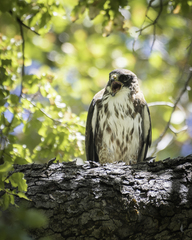
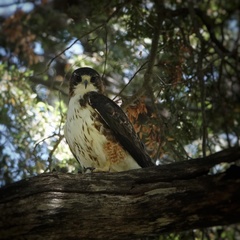
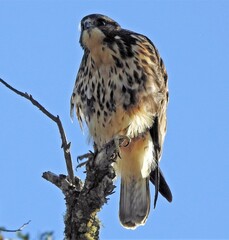
The white-throated hawk is 38 to 48 cm (15 to 19 in) long with an 84 to 102 cm (33 to 40 in) wingspan. Females are up to 20% larger than males and both sexes have the same plumage. Adults have a brownish black face and upperparts. Their tail has a dark brown upper surface and a grayish lower surface with up to 10 narrow dark bands. Their chin, throat, and underparts are white with brown streaking on the breast and belly and rufous barring on the thighs. Their eye is brown and their cere, legs, and feet yellow. Juveniles are similar to adults but with heavy blackish streaking on the breast and flanks, streaked cheeks, and buff thighs with brown bars. Wikipedia →

Sounds

Alarm call0:16

Chile · 2019

© Gonzalo Labarrera Valdivieso · XC500696 · CC BY-NC-SA 4.0

Whistle0:22

Argentina

© Bernabe Lopez-Lanus · XC48444 · CC BY-NC-SA 3.0

Call0:18

Argentina · 2003

© Frank Lambert · XC34875 · CC BY-NC-ND 4.0

Global Distribution

Parks Where Found

# Park Country Daily sighting probability
1 Vicente Pérez Rosales National Park 🇨🇱 Chile
<5%
2 Nahuel Huapi National Park 🇦🇷 Argentina
<5%
3 Podocarpus National Park 🇪🇨 Ecuador
<5%
4 Los Nevados National Natural Park 🇨🇴 Colombia
<5%

Cities Where Found

# City Country Daily sighting probability
1 Quito 🇪🇨 Ecuador
<5%

Zoos & Centres Where Found

# Zoo / Centre Country
1 Parque Cóndor 🇪🇨 Ecuador In captivity

Before you go

What are the chances of seeing a White-throated Hawk in Vicente Pérez Rosales National Park?

Rare

Under 5% of wildlife watchers report a White-throated Hawk sighting in Vicente Pérez Rosales National Park on a given day, based on 22 verified sightings from GBIF citizen-science data from 2019 to 2026. It is the 54th most-seen of the 70 birds we can rate there. Over three days the chance rises to about 10%, and over a week to about 30%, if each day is a fresh chance.

When is the best time to see a White-throated Hawk in Vicente Pérez Rosales National Park?

November to January

In those months about 10% of wildlife watchers report a White-throated Hawk in Vicente Pérez Rosales National Park on a given day, against under 5% in February to October, the lowest months. Those are among Vicente Pérez Rosales National Park's driest months, with about 150 mm of rain a month against 490 mm in June.

What time of day is best to see a White-throated Hawk?

Between 10 am and 1 pm

Across all the parks we cover, that three-hour window holds the most White-throated Hawk sightings with a recorded time, and about 8 in 10 of them come between 6 am and 6 pm: it is a daytime animal.

Is Vicente Pérez Rosales National Park the best place to see a White-throated Hawk?

Yes

Of the 4 parks where we can rate White-throated Hawk sightings, Vicente Pérez Rosales National Park has the highest daily chance: under 5%. Next come Nahuel Huapi National Park (Argentina, under 5%) and Podocarpus National Park (Ecuador, under 5%).

Where does the White-throated Hawk sighting chance come from?

GBIF citizen-science records

It is estimated from how often the White-throated Hawk is recorded against all the birds logged in Vicente Pérez Rosales National Park (22 verified sightings from 2019 to 2026), calibrated against known sighting rates. Figures are rounded to the nearest 10% because citizen-science data supports honest approximations, not decimals, and months with records from fewer than five people show "—". How it works.

← Back to Vicente Pérez Rosales National Park