Green Hylia

Green Hylia

Hylia prasina

Silhouette: Sheatherius · PhyloPic

LCLeast ConcernNTVUENCR
Daily sighting probability <5% · Rare
at Virunga National Park

In 3 days ~10% in a week ~20%

14 Verified sightings at Virunga National Park From 2019 to 2026
1,175 In all 8 parks
June Best month
☀️ Diurnal When it's spotted

About the Green Hylia

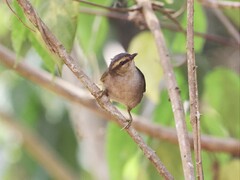
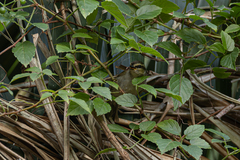
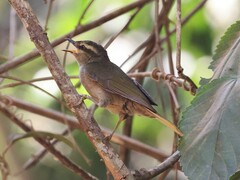
The green hylia (Hylia prasina) is a monotypic genus widespread in tropical Africa, where it mostly inhabits the understory and mid-stratum of moist forest. It is a canopy insectivore which had been tentatively placed within the family of Cettiidae warblers, but in 2019 its assignment to a new family, the Hyliidae, was strongly supported.

Hylia prasina is a monotypic songbird that has proven difficult to place within the phylogenetic tree. Connections between Hylia and other genera have been attempted by comparing DNA sequences, physical similarities and even behavioural characteristics. None of these links have been sufficiently proven to allow definite classification of the green hylia.

The green hylia belongs to the order Passeriformes and the superfamily Sylvioidea, however the classification at family level is under dispute. The species is often attributed to the family Cettiidae (bush warblers) along with Scotocerca, Erythrocercus, Tesia, Cettia and Abroscopus. Investigation into indels does not support a strong relationship between Hylia and the Cettiidae.

Anatomically, the green hylia has similarities to sunbirds and warblers. Characteristics shared with sunbirds... Wikipedia →

Sounds

Call0:32

Gabon · 2024

© Paul Lenrumé · XC939861 · CC BY-NC-SA 4.0

Song0:31

Uganda · 2022

© Peter Boesman · XC739708 · CC BY-NC-ND 4.0

Alarm call0:07

Ivory Coast · 2018

© Étienne Leroy · XC499948 · CC BY-NC-SA 4.0

Global Distribution

Parks Where Found

# Park Country Daily sighting probability
1 Semuliki National Park 🇺🇬 Uganda
~40%
2 Kibale National Park 🇺🇬 Uganda
~30%
3 Bwindi Impenetrable National Park 🇺🇬 Uganda
~20%
4 Taï National Park 🇨🇮 Ivory Coast
~10%
5 Virunga National Park 🇨🇩 Democratic Republic of the Congo
<5%
6 Volcanoes National Park 🇷🇼 Rwanda
<5%
7 Queen Elizabeth National Park 🇺🇬 Uganda
<5%
8 Lake Mburo National Park 🇺🇬 Uganda
<5%

Cities Where Found

# City Country Daily sighting probability
1 Kampala 🇺🇬 Uganda
<5%

Before you go

What are the chances of seeing a Green Hylia in Virunga National Park?

Rare

Under 5% of wildlife watchers report a Green Hylia sighting in Virunga National Park on a given day, based on 14 verified sightings from GBIF citizen-science data from 2019 to 2026. It is the 224th most-seen of the 316 birds we can rate there. Over three days the chance rises to about 10%, and over a week to about 20%, if each day is a fresh chance.

When is the best time to see a Green Hylia in Virunga National Park?

May–June and September

In those months about 10% of wildlife watchers report a Green Hylia in Virunga National Park on a given day, against under 5% in July–August and October–April, the lowest months.

What time of day is best to see a Green Hylia?

Between 8 and 11 am

Across all the parks we cover, that three-hour window holds the most Green Hylia sightings with a recorded time, and about 9 in 10 of them come between 6 am and 6 pm: it is a daytime animal.

Which relatives of the Green Hylia live in Virunga National Park?

Same order: Passeriformes

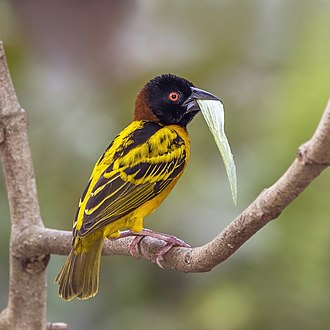
The closest relatives of the Green Hylia that you can see in Virunga National Park (order Passeriformes, Perching Birds) are Common Bulbul (about 70%), Black-headed Gonolek (about 40%) and Streaky Seedeater (about 40%), with each one's daily chance of a sighting.

Where does the Green Hylia sighting chance come from?

GBIF citizen-science records

It is estimated from how often the Green Hylia is recorded against all the birds logged in Virunga National Park (14 verified sightings from 2019 to 2026), calibrated against known sighting rates. Figures are rounded to the nearest 10% because citizen-science data supports honest approximations, not decimals, and months with records from fewer than five people show "—". How it works.

← Back to Virunga National Park