Glaucous Gull

Glaucous Gull

Larus hyperboreus

Silhouette: Sharon Wegner-Larsen · PhyloPic

LCLeast ConcernNTVUENCR
Daily sighting probability <5% · Rare
at Wadden Sea National Park

In 3 days <5%

22 Verified sightings at Wadden Sea National Park From 2019 to 2026
2,721 In all 8 parks
January Best month
☀️ Diurnal When it's spotted

About the Glaucous Gull

The glaucous gull (Larus hyperboreus) is a large gull, the second-largest gull in the world. The genus name is from Latin larus, which appears to have referred to a gull or other large seabird. The specific name hyperboreus is Latin for "northern" from the Ancient Greek Huperboreoi people from the far north "Glaucous" is from Latin glaucus and denotes the grey colour of the gull. An older English name for this species is burgomaster.

This gull breeds in Arctic regions of the Northern Hemisphere and winters south to shores of the Holarctic. It is migratory, wintering from in the North Atlantic and North Pacific Oceans as far south as the British Isles and northernmost states of the United States, also on the Great Lakes. A few birds sometimes reach the southern USA and northern Mexico.

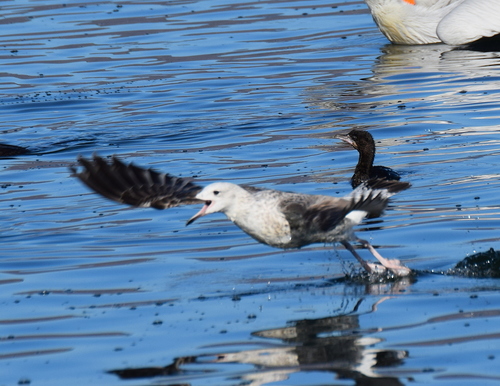
This is a large and powerful gull, second-largest of all gull species and very pale in all plumage, with no black on either the wings or the tail. Adults are pale grey above, with a thick, yellow bill. Juveniles are very pale grey with a pink and black bill. This species is considerably larger, bulkier, and thicker-billed than the similar Iceland gull, and can sometimes... Wikipedia →

Sounds

Call0:08

Norway · 2026

© Mats Rellmar · XC1173210 · CC BY-NC-SA 4.0

Alarm call0:40

Denmark · 2018

© Timo Janhonen · XC514048 · CC BY-NC-SA 4.0

Song0:26

United States · 2017

© Patrik Åberg · XC406443 · CC BY-NC-SA 4.0

Global Distribution

Parks Where Found

# Park Country Daily sighting probability
1 Svalbard 🇳🇴 Norway
~90%
2 Vatnajokull National Park 🇮🇸 Iceland
~10%
3 Merritt Island National Wildlife Refuge 🇺🇸 United States
~10%
4 Gros Morne National Park 🇨🇦 Canada
<5%
5 Redwood National Park 🇺🇸 United States
<5%
6 Great Bear Rainforest 🇨🇦 Canada
<5%
7 Wadden Sea National Park 🇩🇪 Germany
<5%
8 Point Pelee National Park 🇨🇦 Canada
<5%

Cities Where Found

# City Country Daily sighting probability
1 Montreal 🇨🇦 Canada
<5%
2 Moscow 🇷🇺 Russia
<5%
3 Dallas 🇺🇸 United States
<5%
4 Birmingham 🇬🇧 United Kingdom
<5%
5 Vancouver 🇨🇦 Canada
<5%
6 Toronto 🇨🇦 Canada
<5%
7 Calgary 🇨🇦 Canada
<5%
8 Seoul 🇰🇷 South Korea
<5%
9 New York City 🇺🇸 United States
<5%
10 Tokyo 🇯🇵 Japan
<5%

Zoos & Centres Where Found

# Zoo / Centre Country
1 Caldwell Zoo 🇺🇸 United States In captivity

Before you go

What are the chances of seeing a Glaucous Gull in Wadden Sea National Park?

Rare

Under 5% of wildlife watchers report a Glaucous Gull sighting in Wadden Sea National Park on a given day, based on 22 verified sightings from GBIF citizen-science data from 2019 to 2026. It is the 276th most-seen of the 285 birds we can rate there. Over three days the chance rises to under 5%, if each day is a fresh chance.

When is the best time to see a Glaucous Gull in Wadden Sea National Park?

Any time of year

In every month with enough records, under 5% of wildlife watchers report a Glaucous Gull in Wadden Sea National Park on a given day, so our monthly data shows no clear season.

What time of day is best to see a Glaucous Gull?

Between 10 am and 1 pm

Across all the parks we cover, that three-hour window holds the most Glaucous Gull sightings with a recorded time, and about 7 in 10 of them come between 6 am and 6 pm: it is a daytime animal.

Which relatives of the Glaucous Gull live in Wadden Sea National Park?

Same genus: Larus

The closest relatives of the Glaucous Gull that you can see in Wadden Sea National Park (genus Larus, Large White-headed Gulls) are European Herring Gull (about 70%), Common Gull (about 50%) and Great Black-backed Gull (about 40%), with each one's daily chance of a sighting.

Where does the Glaucous Gull sighting chance come from?

GBIF citizen-science records

It is estimated from how often the Glaucous Gull is recorded against all the birds logged in Wadden Sea National Park (22 verified sightings from 2019 to 2026), calibrated against known sighting rates. Figures are rounded to the nearest 10% because citizen-science data supports honest approximations, not decimals, and months with records from fewer than five people show "—". How it works.

← Back to Wadden Sea National Park