Red-naped Trogon

Red-naped Trogon

Harpactes kasumba

Silhouette: Keith Murdock (photo), John E. McCormack, Michael G. Harvey, Brant C. Faircloth, Nicholas G. Crawford, Travis C. Glenn, Robb T. Brumfield & T. Michael Keesey · PhyloPic

LCNTNear ThreatenedVUENCR
Daily sighting probability ~30% · Possible
at Way Kambas National Park

In 3 days ~60% in a week ~90%

104 Verified sightings at Way Kambas National Park From 2019 to 2026
872 In all 6 parks
May Best month
☀️ Diurnal When it's spotted

About the Red-naped Trogon

The red-naped trogon (Harpactes kasumba) is a species of bird in the family Trogonidae. It is found in Brunei, Indonesia, Malaysia, and Thailand. Its natural habitat is subtropical or tropical moist lowland forests. It is threatened by habitat loss.

Latin - Harpactes kasumba French – Couroucou a masque rouge German – Rotnacken-Trogon Spanish – Trogon kasumba Dutch - Roodnektrogon The red-naped trogon was discovered in 1822 by Sir Stamford Raffles, a military and British naturalist (1781-1826) best known for having founded Singapore in 1817.

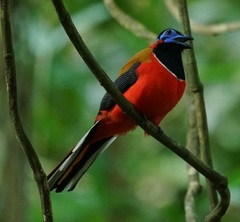
The red-naped trogon is a strongly sexually dimorphic species, with the females generally being duller than the males. The male red-naped trogon is physically defined by a black head and upper breast, blue bill and eye ring with a bright blue coloured face. He has yellow-brown upperparts and upper tail with black outlines, a white breast-line, bright red underparts and the under-tail is black and white. The most defining physical characteristic of the red-naped trogon is a band of bright red feathers around the back of the head, which gives the species its name. The... Wikipedia →

Sounds

Song1:08

Malaysia · 2026

© Ding Li Yong · XC1077532 · CC BY-NC-ND 4.0

Call0:26

Malaysia · 2023

© Kim Chuah Lim · XC828589 · CC BY-NC-SA 4.0

Song0:28

Malaysia · 2023

© Joshua Chong · XC830904 · CC BY-NC-SA 4.0

Global Distribution

Parks Where Found

# Park Country Daily sighting probability
1 Way Kambas National Park 🇮🇩 Indonesia
~30%
2 Danum Valley Conservation Area 🇲🇾 Malaysia
~20%
3 Sepilok 🇲🇾 Malaysia
~10%
4 Taman Negara National Park 🇲🇾 Malaysia
~10%
5 Tanjung Puting National Park 🇮🇩 Indonesia
~10%
6 Kinabatangan Wildlife Sanctuary 🇲🇾 Malaysia
<5%

Before you go

What are the chances of seeing a Red-naped Trogon in Way Kambas National Park?

Possible

About 30% of wildlife watchers report a Red-naped Trogon sighting in Way Kambas National Park on a given day, based on 104 verified sightings from GBIF citizen-science data from 2019 to 2026. It is the 52nd most-seen of the 205 birds we can rate there. Over three days the chance rises to about 60%, and over a week to about 90%, if each day is a fresh chance.

When is the best time to see a Red-naped Trogon in Way Kambas National Park?

May

In that month about 50% of wildlife watchers report a Red-naped Trogon in Way Kambas National Park on a given day, against about 10% in October, the lowest month. November to February have too few records to rate.

What time of day is best to see a Red-naped Trogon?

Between 9 am and noon

Across all the parks we cover, that three-hour window holds the most Red-naped Trogon sightings with a recorded time, and about 8 in 10 of them come between 6 am and 6 pm: it is a daytime animal.

Is Way Kambas National Park the best place to see a Red-naped Trogon?

Yes

Of the 6 parks where we can rate Red-naped Trogon sightings, Way Kambas National Park has the highest daily chance: about 30%. Next come Danum Valley Conservation Area (Malaysia, about 20%) and Sepilok (Malaysia, about 10%).

Which relatives of the Red-naped Trogon live in Way Kambas National Park?

Same genus: Harpactes

The closest relatives of the Red-naped Trogon that you can see in Way Kambas National Park (genus Harpactes, Asian Trogons) are Scarlet-rumped Trogon (about 30%) and Diard's Trogon (about 30%), with each one's daily chance of a sighting.

Where does the Red-naped Trogon sighting chance come from?

GBIF citizen-science records

It is estimated from how often the Red-naped Trogon is recorded against all the birds logged in Way Kambas National Park (104 verified sightings from 2019 to 2026), calibrated against known sighting rates. Figures are rounded to the nearest 10% because citizen-science data supports honest approximations, not decimals, and months with records from fewer than five people show "—". How it works.

← Back to Way Kambas National Park

