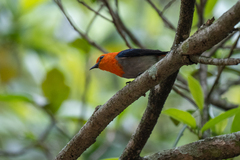
Scarlet-headed Flowerpecker

Scarlet-headed Flowerpecker

Dicaeum trochileum

Silhouette: Rachael Joakim · PhyloPic

LCLeast ConcernNTVUENCR
Daily sighting probability ~30% · Possible
at Way Kambas National Park

In 3 days ~70% in a week ~90%

79 Verified sightings at Way Kambas National Park From 2019 to 2026
493 In all 2 parks
October Best month
🌅 Crepuscular When it's spotted

About the Scarlet-headed Flowerpecker

The scarlet-headed flowerpecker (Dicaeum trochileum) is a bird species in the family of Dicaeidae. It is a species endemic to Indonesia. This flowerpecker inhabits a few islands of the archipelago of Indonesia. It is mainly observed in open wooden areas, gardens, and mangroves.

As of today, D. trochileum population is stable. The IUCN has classified its conservation status to Least Concern. This species is not well studied. The scarlet-headed flowerpecker body length can reach up to eight to nine centimeters after maturity.

The red to orange upper body of the males is the main characteristic that distinguishes them from the females. Their red plumage covers their head, their back, their rump and their throat. Their wings are black with blue pigmentation. Their legs are black, and their beak is grey. The tip of their tail is black.

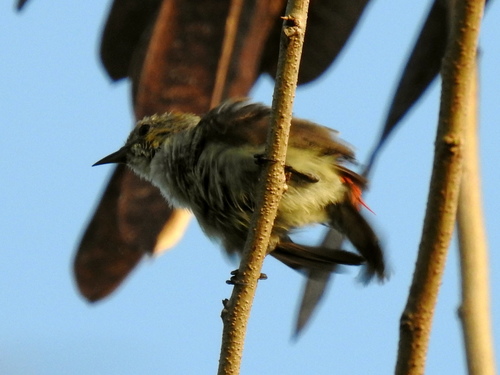
The females have a light grey to brown head and back. Their orange to red rumps characterize the females' morphology. Similarly to the males, their legs are black, their beak is grey, and the tip of their tail is black. Their wings are lighter than the male's wings colour, and they are missing the blue coloration.

The morphology of the juveniles... Wikipedia →
Sounds

Call0:45

Indonesia · 2017

© Ross Gallardy · XC410367 · CC BY-NC-SA 4.0

Song0:25

Indonesia · 2012

© Frank Lambert · XC166502 · CC BY-NC-ND 4.0

Call0:42

Indonesia · 2015

© Bruno Durand · XC287078 · CC BY-NC-SA 4.0

Global Distribution

Parks Where Found

# Park Country Daily sighting probability
1 Bali Barat National Park 🇮🇩 Indonesia
~40%
2 Way Kambas National Park 🇮🇩 Indonesia
~30%

Cities Where Found

# City Country Daily sighting probability
1 Jakarta 🇮🇩 Indonesia
~60%
2 Yogyakarta 🇮🇩 Indonesia
~60%
3 Denpasar 🇮🇩 Indonesia
~30%
4 Semarang 🇮🇩 Indonesia
~30%
5 Surabaya 🇮🇩 Indonesia
~10%
6 Bandung 🇮🇩 Indonesia
~10%

Before you go

What are the chances of seeing a Scarlet-headed Flowerpecker in Way Kambas National Park?

Possible

About 30% of wildlife watchers report a Scarlet-headed Flowerpecker sighting in Way Kambas National Park on a given day, based on 79 verified sightings from GBIF citizen-science data from 2019 to 2026. It is the 44th most-seen of the 205 birds we can rate there. Over three days the chance rises to about 70%, and over a week to about 90%, if each day is a fresh chance.

When is the best time to see a Scarlet-headed Flowerpecker in Way Kambas National Park?

March and October

In those months about 40% of wildlife watchers report a Scarlet-headed Flowerpecker in Way Kambas National Park on a given day, against about 20% in April and July, the lowest months. November to February have too few records to rate.

What time of day is best to see a Scarlet-headed Flowerpecker?

Between 2 and 5 am

Across all the parks we cover, that three-hour window holds the most Scarlet-headed Flowerpecker sightings with a recorded time, and about 7 in 10 of them come between 6 pm and 6 am: it is most active around dawn and dusk.

Is Way Kambas National Park the best place to see a Scarlet-headed Flowerpecker?

2nd of 2

Of the 2 parks where we can rate Scarlet-headed Flowerpecker sightings, Way Kambas National Park ranks 2nd at about 30%. The best odds are in Bali Barat National Park (Indonesia, about 40%).

Which relatives of the Scarlet-headed Flowerpecker live in Way Kambas National Park?

Same genus: Dicaeum

The closest relatives of the Scarlet-headed Flowerpecker that you can see in Way Kambas National Park (genus Dicaeum, Typical Flowerpeckers) are Orange-bellied Flowerpecker (about 20%) and Plain Flowerpecker (about 10%), with each one's daily chance of a sighting.

Where does the Scarlet-headed Flowerpecker sighting chance come from?

GBIF citizen-science records

It is estimated from how often the Scarlet-headed Flowerpecker is recorded against all the birds logged in Way Kambas National Park (79 verified sightings from 2019 to 2026), calibrated against known sighting rates. Figures are rounded to the nearest 10% because citizen-science data supports honest approximations, not decimals, and months with records from fewer than five people show "—". How it works.

← Back to Way Kambas National Park