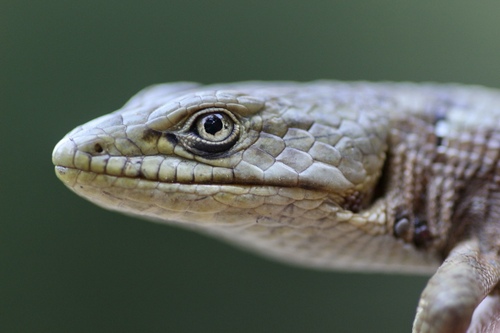
Cape Sand Snake

Cape Sand Snake

Psammophis leightoni

Silhouette: SeismicShrimp · PhyloPic

LCLeast ConcernNTVUENCR
Daily sighting probability ~20% · Possible
at West Coast National Park

In 3 days ~50% in a week ~80%

16 Verified sightings at West Coast National Park From 2019 to 2026
45 In all 3 parks
February Best month
☀️ Diurnal When it's spotted

About the Cape Sand Snake

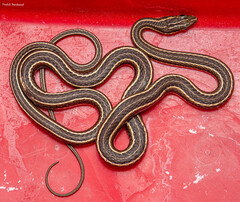
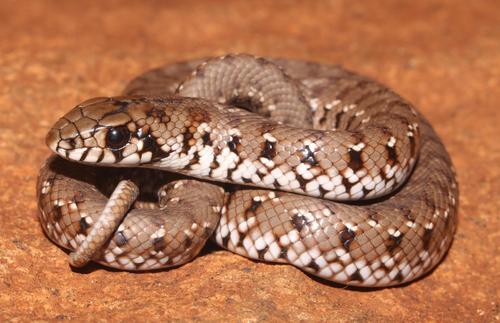
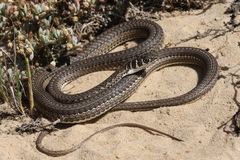
Psammophis leightoni, also called commonly the Cape sand racer, Cape sand snake, fork-marked sand snake, and Namib sand snake, is a species of mildly venomous snake in the family Psammophiidae. The species is native to the western part of southern Africa.

The specific name, leightoni, is in honor of British herpetologist Gerald Rowley Leighton. P. leightoni is a slender snake. It has eight upper labials, the fourth and fifth of which contact the eye. The smooth dorsal scales are arranged in 17 rows at midbody. Males grow to be longer than females. Maximum recorded snout-to-vent lengths (SVL) are 96 cm (38 in) for a male, and 80 cm (31 in) for a female.

P. leightoni is found in fynbos, veld, and the Karoo, Kalahari and Namib desert biomes of South Africa, Botswana and Namibia, and in a small section of coastal southern Angola. P. leightoni preys predominately upon small lizards and small rodents, but will also eat other snakes.

P. leightoni is oviparous. Clutch size is about eight eggs, and each hatchling has a total length (including tail) of 22–24 cm (8.7–9.4 in). The... Wikipedia →

Global Distribution

Parks Where Found

# Park Country Daily sighting probability
1 West Coast National Park 🇿🇦 South Africa
~20%
2 Namib-Naukluft National Park 🇳🇦 Namibia
~20%
3 Kgalagadi Transfrontier Park 🇿🇦 South Africa
~10%

Before you go

What are the chances of seeing a Cape Sand Snake in West Coast National Park?

Possible

About 20% of wildlife watchers report a Cape Sand Snake sighting in West Coast National Park on a given day, based on 16 verified sightings from GBIF citizen-science data from 2019 to 2026. It is the 11th most-seen of the 23 reptiles we can rate there. Over three days the chance rises to about 50%, and over a week to about 80%, if each day is a fresh chance.

When is the best time to see a Cape Sand Snake in West Coast National Park?

February and November–December

In those months about 40% of wildlife watchers report a Cape Sand Snake in West Coast National Park on a given day, against under 5% in May–July and September, the lowest months. Those are among West Coast National Park's driest months, with about 10 mm of rain a month against 70 mm in June.

What time of day is best to see a Cape Sand Snake?

Between 10 am and 1 pm

Across all the parks we cover, that three-hour window holds the most Cape Sand Snake sightings with a recorded time, and about 9 in 10 of them come between 6 am and 6 pm: it is a daytime animal.

Is West Coast National Park the best place to see a Cape Sand Snake?

Yes

Of the 3 parks where we can rate Cape Sand Snake sightings, West Coast National Park has the highest daily chance: about 20%. Next come Namib-Naukluft National Park (Namibia, about 20%) and Kgalagadi Transfrontier Park (South Africa, about 10%).

Which relatives of the Cape Sand Snake live in West Coast National Park?

Same genus: Psammophis

The closest relatives of the Cape Sand Snake that you can see in West Coast National Park (genus Psammophis, Sand Racers) are Cross-marked Grass Snake (about 10%) and Karoo Sand Snake (about 10%), with each one's daily chance of a sighting.

Where does the Cape Sand Snake sighting chance come from?

GBIF citizen-science records

It is estimated from how often the Cape Sand Snake is recorded against all the reptiles logged in West Coast National Park (16 verified sightings from 2019 to 2026), calibrated against known sighting rates. Figures are rounded to the nearest 10% because citizen-science data supports honest approximations, not decimals, and months with records from fewer than five people show "—". How it works.

← Back to West Coast National Park