About the Boreal Chickadee
The boreal chickadee (Poecile hudsonicus) is a small passerine songbird in the tit family Paridae. It is found in the boreal forests of Alaska, Canada and the northern United States and remains within this range all year. This bird is known for its high pitched trill patterns used in communication with other birds and food storage habits in preparation for winter months.
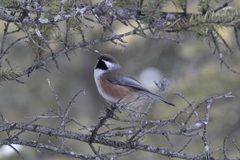
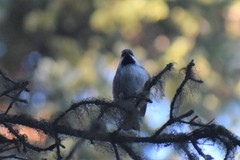
Adults are 12.5–14.5 cm (4.9–5.7 in) long with a weight of 7–12.4 g (0.25–0.44 oz). They have grey-brown upperparts with a brown cap and greyish wings and tail; their face is mainly grey with white on the sides. Their underparts are white with brown on the flanks and a black throat. They have a short dark bill, short wings and a long notched tail. Their flight consists of brief gliding patterns followed by fast and bouncy wing beats as they travel through the air.
The call is a husky tsee-day-day, as well as a high pitched trill sound, dididididididi a variant on the call which gives chickadees their name. This call is composed of five distinct note-type categories consisting of A, B, C, D and D-hybrid with the beginning and end note both displaying a high frequency pitch... Wikipedia →