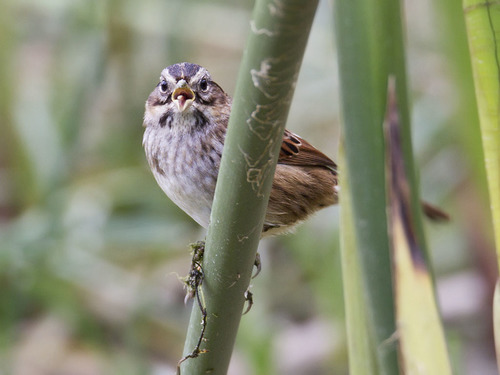
Gray Jay

Gray Jay

Perisoreus canadensis

Silhouette: Andy Wilson · PhyloPic

LCLeast ConcernNTVUENCR
Daily sighting probability ~20% · Possible
at Wood Buffalo National Park

In 3 days ~60% in a week ~90%

30 Verified sightings at Wood Buffalo National Park From 2019 to 2026
10,796 In all 19 parks
September Best month
☀️ Diurnal When it's spotted

About the Gray Jay

The Canada jay (Perisoreus canadensis), also known as the grey jay, gray jay, camp robber, moose bird, gorby, or whisky jack, is a passerine bird of the family Corvidae. It is found in boreal forests of North America, north to the tree line, and in the Rocky Mountains subalpine zone south to New Mexico and Arizona. A fairly large songbird, the Canada jay has pale grey underparts, darker grey upperparts, and a grey-white head with a darker grey nape. It is one of three members of the genus Perisoreus, a genus more closely related to the magpie genus Cyanopica than to other birds known as jays. The Canada jay itself has nine recognized subspecies.

Canada jays live year-round on permanent territories in coniferous forests, surviving in winter months on food cached throughout their territory in warmer periods. The birds form monogamous mating pairs, with pairs accompanied on their territories by a third juvenile from the previous season. Canada jays adapt to human activity in their territories and are known to approach humans for food, inspiring a list of colloquial names including "lumberjack", "camp robber", and "venison-hawk". The International Union for Conservation of Nature (IUCN) considers the Canada jay a least-concern species, but populations in southern ranges may be affected adversely by global warming.

The species is associated with mythological figures of several First Nations cultures, including Wisakedjak, a benevolent figure whose name was anglicized to Whiskyjack. In 2016, an online poll and expert panel conducted by Canadian Geographic magazine selected the Canada jay as the national bird of Canada, although the designation is not formally recognized. Wikipedia →

Sounds

Call0:39

United States · 2021

© Steve Hampton · XC666139 · CC BY-NC-SA 4.0

Song0:44

United States · 2009

© Andrew Spencer · XC28872 · CC BY-NC-ND 2.5

Call0:18

United States · 2020

© Bruce Lagerquist · XC603584 · CC BY-NC-SA 4.0

Global Distribution

Parks Where Found

# Park Country Daily sighting probability
1 Denali National Park 🇺🇸 United States
~60%
2 Kluane National Park 🇨🇦 Canada
~60%
3 Wrangell-St. Elias National Park 🇺🇸 United States
~50%
4 Banff National Park 🇨🇦 Canada
~30%
5 Jasper National Park 🇨🇦 Canada
~30%
6 Katmai National Park 🇺🇸 United States
~30%
7 Wood Buffalo National Park 🇨🇦 Canada
~20%
8 Riding Mountain National Park 🇨🇦 Canada
~20%
9 Isle Royale National Park 🇺🇸 United States
~20%
10 Gros Morne National Park 🇨🇦 Canada
~20%
11 Yellowstone National Park 🇺🇸 United States
~20%
12 Glacier National Park 🇺🇸 United States
~20%
13 Olympic National Park 🇺🇸 United States
~20%
14 Grand Teton National Park 🇺🇸 United States
~10%
15 Redwood National Park 🇺🇸 United States
~10%
16 Rocky Mountain National Park 🇺🇸 United States
~10%
17 Voyageurs National Park 🇺🇸 United States
<5%
18 Cape Breton Highlands National Park 🇨🇦 Canada
<5%
19 Great Bear Rainforest 🇨🇦 Canada
<5%

Cities Where Found

# City Country Daily sighting probability
1 Anchorage 🇺🇸 United States
<5%
2 Edmonton 🇨🇦 Canada
<5%
3 Calgary 🇨🇦 Canada
<5%
4 Portland 🇺🇸 United States
<5%

Before you go

What are the chances of seeing a Gray Jay in Wood Buffalo National Park?

Possible

About 20% of wildlife watchers report a Gray Jay sighting in Wood Buffalo National Park on a given day, based on 30 verified sightings from GBIF citizen-science data from 2019 to 2026. It is the 6th most-seen of the 59 birds we can rate there. Over three days the chance rises to about 60%, and over a week to about 90%, if each day is a fresh chance.

What time of day is best to see a Gray Jay?

Between 11 am and 2 pm

Across all the parks we cover, that three-hour window holds the most Gray Jay sightings with a recorded time, and about 9 in 10 of them come between 6 am and 6 pm: it is a daytime animal.

Where does the Gray Jay sighting chance come from?

GBIF citizen-science records

It is estimated from how often the Gray Jay is recorded against all the birds logged in Wood Buffalo National Park (30 verified sightings from 2019 to 2026), calibrated against known sighting rates. Figures are rounded to the nearest 10% because citizen-science data supports honest approximations, not decimals, and months with records from fewer than five people show "—". How it works.

← Back to Wood Buffalo National Park