Ceylon Spurfowl

Ceylon Spurfowl

Galloperdix bicalcarata

Silhouette: Sheatherius · PhyloPic

LCLeast ConcernNTVUENCR Endemic
Daily sighting probability <5% · Rare
at Yala National Park

In 3 days <5%

7 Verified sightings at Yala National Park From 2019 to 2026
761 In all 3 parks
June Best month
🌙 Nocturnal When it's spotted

About the Ceylon Spurfowl

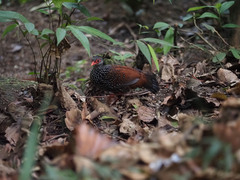
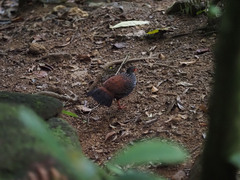
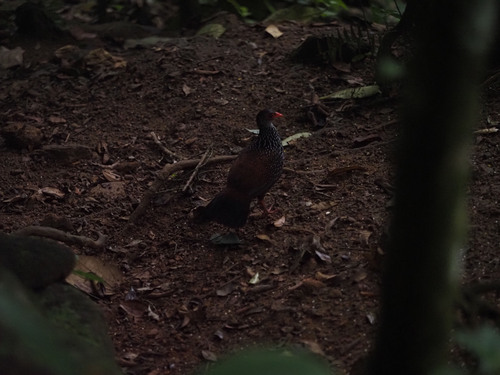
The Sri Lanka spurfowl (Galloperdix bicalcarata) is a member of the pheasant family which is endemic to the dense rainforests of Sri Lanka. In Sri Lanka, this bird is known as haban kukula - හබන් කුකුලා in Sinhala. It is a very secretive bird, and despite its size is difficult to see as it slips through dense undergrowth. Often the only indication of its presence is its distinctive ringing call, consisting of series of three-syllabled whistles. Kitulgala and Sinharaja are sites where there is a chance of seeing this bird.

This spurfowl is one of three species of bird in the genus Galloperdix. It is a ground nesting bird, which lays 2-5 eggs in a scrape. Sri Lanka spurfowl is ~ 37 cm long bird. Both sexes have brown upperparts, wings and tail.

The males exhibit vivid crimson red legs and bare facial skin and striking black and white dorsal plumage that extends to its head. There is also extensive white ocellation on the sepia wings and upperback. The legs of both sexes have multiple metatarsal spurs, which give rise to the specific name. The female has chestnut underparts and a plain brown back and wings. She is more prominently crested than the male.

Sri Lanka spurfowl is a seasonally terrestrial species, like most of its near relatives. It scratches vigorously amongst the leaf litter of the forest floor for invertebrates, especially mollusks and insects. It will also take various seeds, fallen fruit and spiders. Wikipedia →
Sounds

Call0:46

Sri Lanka · 2015

© Simon Elliott · XC587978 · CC BY-NC-ND 4.0

Song0:10

Sri Lanka · 2016

© Jim Holmes · XC346196 · CC BY-NC-SA 4.0

Call0:08

Sri Lanka · 2018

© Michael Hurben · XC426324 · CC BY-NC-SA 4.0

Global Distribution

Parks Where Found

# Park Country Daily sighting probability
1 Sinharaja Forest Reserve 🇱🇰 Sri Lanka
~40%
2 Horton Plains National Park 🇱🇰 Sri Lanka
<5%
3 Yala National Park 🇱🇰 Sri Lanka
<5%

Before you go

What are the chances of seeing a Ceylon Spurfowl in Yala National Park?

Rare

Under 5% of wildlife watchers report a Ceylon Spurfowl sighting in Yala National Park on a given day, based on 7 verified sightings from GBIF citizen-science data from 2019 to 2026. It is the 219th most-seen of the 220 birds we can rate there. Over three days the chance rises to under 5%, if each day is a fresh chance.

When is the best time to see a Ceylon Spurfowl in Yala National Park?

Any time of year

In every month with enough records, under 5% of wildlife watchers report a Ceylon Spurfowl in Yala National Park on a given day, so our monthly data shows no clear season.

What time of day is best to see a Ceylon Spurfowl?

Between 2 and 5 am

Across all the parks we cover, that three-hour window holds the most Ceylon Spurfowl sightings with a recorded time, and about 8 in 10 of them come between 6 pm and 6 am: it is mostly seen at night.

Is Yala National Park the best place to see a Ceylon Spurfowl?

3rd of 3

Of the 3 parks where we can rate Ceylon Spurfowl sightings, Yala National Park ranks 3rd at under 5%. The best odds are in Sinharaja Forest Reserve (Sri Lanka, about 40%) and Horton Plains National Park (Sri Lanka, under 5%).

Which relatives of the Ceylon Spurfowl live in Yala National Park?

Same family: Phasianidae

The closest relatives of the Ceylon Spurfowl that you can see in Yala National Park (family Phasianidae, Pheasants, Grouse, and Allies) are Common Peafowl (about 90%) and Sri Lanka Junglefowl (about 70%), with each one's daily chance of a sighting.

Where does the Ceylon Spurfowl sighting chance come from?

GBIF citizen-science records

It is estimated from how often the Ceylon Spurfowl is recorded against all the birds logged in Yala National Park (7 verified sightings from 2019 to 2026), calibrated against known sighting rates. Figures are rounded to the nearest 10% because citizen-science data supports honest approximations, not decimals, and months with records from fewer than five people show "—". How it works.

← Back to Yala National Park