Banded Cat-eyed Snake

Banded Cat-eyed Snake

Leptodeira annulata

Silhouette: PhyloPic

LCLeast ConcernNTVUENCR
Daily sighting probability ~10% · With luck
at Yasuní National Park

In 3 days ~20% in a week ~50%

5 Verified sightings at Yasuní National Park From 2019 to 2026
42 In all 4 parks
February Best month
🌙 Nocturnal When it's spotted

About the Banded Cat-eyed Snake

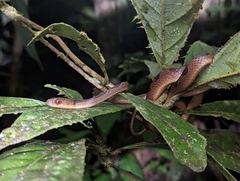
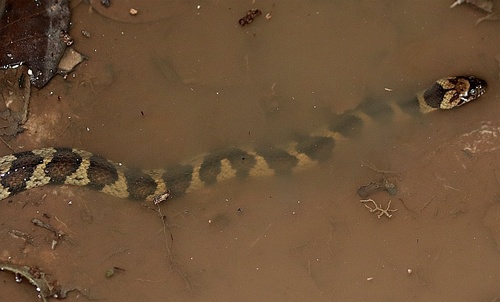
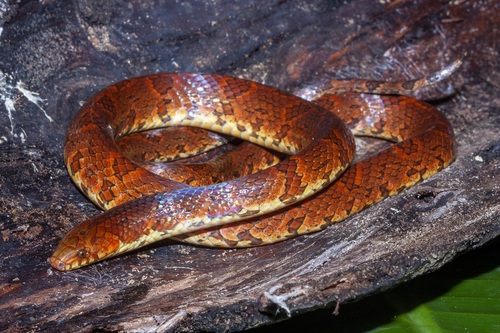
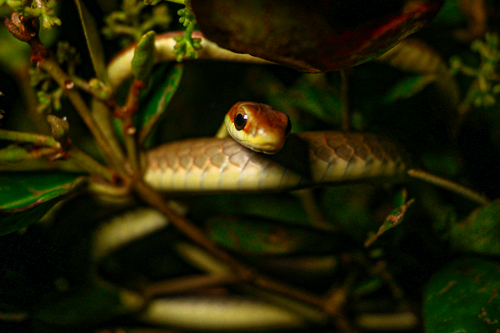
Leptodeira annulata, also known commonly as the banded cat-eyed snake, is a species of mildly venomous, rear-fanged, snake in the subfamily Dipsadinae of the family Colubridae. The species is endemic to the New World. Additional common names for L. annulata include: cat-eyed night snake, come sapo, culebra de pantano, culebra destenida, machete savane, mapana de agua, mapana tigre, and ranera.

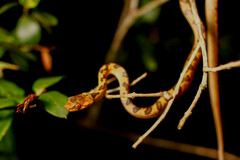
L. annulata is found in Mexico, Central America, and South America, including the offshore islands of Margarita, and Trinidad and Tobago. Adults of L. annulata have a total length (tail included) of about 750 mm (30 in) and are very slender. The head is distinct from the neck, and the large eyes have vertically elliptic pupils. The back is yellowish or brown with a series of dark brown or blackish spots often confluent into an undulous or zigzag stripe.

L. annulata has a pair of enlarged, grooved teeth at the rear of each upper jaw (maxilla), and produces a mild venom.. The venom affects the snake's natural prey (mainly small frogs and small lizards). The snake tends not to bite humans when handled, but when it does, the venom... Wikipedia →

Global Distribution

Parks Where Found

# Park Country Daily sighting probability
1 Serra dos Órgãos National Park 🇧🇷 Brazil
~20%
2 Manu National Park 🇵🇪 Peru
~20%
3 Tambopata National Reserve 🇵🇪 Peru
~10%
4 Yasuní National Park 🇪🇨 Ecuador
~10%

Before you go

What are the chances of seeing a Banded Cat-eyed Snake in Yasuní National Park?

With luck

About 10% of wildlife watchers report a Banded Cat-eyed Snake sighting in Yasuní National Park on a given day, based on 5 verified sightings from GBIF citizen-science data from 2019 to 2026. It is the 43rd most-seen of the 49 reptiles we can rate there. Over three days the chance rises to about 20%, and over a week to about 50%, if each day is a fresh chance.

When is the best time to see a Banded Cat-eyed Snake in Yasuní National Park?

February and November–December

In those months about 20% of wildlife watchers report a Banded Cat-eyed Snake in Yasuní National Park on a given day, against under 5% in January and March–October, the lowest months.

What time of day is best to see a Banded Cat-eyed Snake?

Between 8 and 11 pm

Across all the parks we cover, that three-hour window holds the most Banded Cat-eyed Snake sightings with a recorded time, and about 7 in 10 of them come between 6 pm and 6 am: it is mostly seen at night.

Which relatives of the Banded Cat-eyed Snake live in Yasuní National Park?

Same family: Colubridae

The closest relatives of the Banded Cat-eyed Snake that you can see in Yasuní National Park (family Colubridae, Colubrid Snakes) are Blunthead Tree Snake (about 30%), Diurnal Vine Snake (about 20%) and Catesby's Snail-eater (about 20%), with each one's daily chance of a sighting.

Where does the Banded Cat-eyed Snake sighting chance come from?

GBIF citizen-science records

It is estimated from how often the Banded Cat-eyed Snake is recorded against all the reptiles logged in Yasuní National Park (5 verified sightings from 2019 to 2026), calibrated against known sighting rates. Figures are rounded to the nearest 10% because citizen-science data supports honest approximations, not decimals, and months with records from fewer than five people show "—". How it works.

← Back to Yasuní National Park