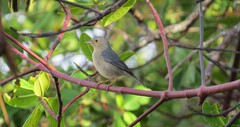
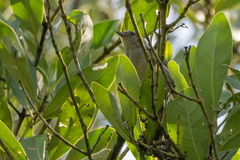
Bicolored Conebill

Bicolored Conebill

Conirostrum bicolor

Silhouette: Sheatherius · PhyloPic

LCNTNear ThreatenedVUENCR
Daily sighting probability <5% · Rare
at Yasuní National Park

In 3 days <5%

6 Verified sightings at Yasuní National Park From 2019 to 2026
185 In all 3 parks
February Best month
☀️ Diurnal When it's spotted

About the Bicolored Conebill

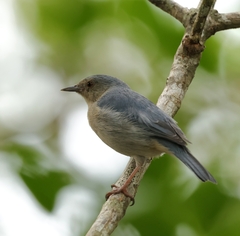
The bicolored conebill (Conirostrum bicolor) is a small passerine bird. This member of the tanager family is a resident breeder in South America from Colombia, Venezuela and Trinidad south and east to the Guianas, northeast Peru and Brazil.

The bicolored conebill is 11.4 cm long and weighs 11 g. The adult is grey-blue above and buff-tinged grey below, with red eyes, pink legs and a sharp, pointed bill. The primary flight feathers are bluish with brown edgings. The sexes are similar, although the female may be a little duller, but immature birds are greenish above and have pale yellow underparts. Birds sometimes breed in immature plumage.

It is similar to the pearly-breasted conebill, alongside which it occurs in the Amazon. It also resembles the female hooded tanager, but is much smaller and more delicate-looking than that species. The bicolored conebill has a disjunct range made of two populations, one restricted to the coasts of northern South America, from the Atlantic coast of Colombia to the shores of southern Brazil, and another found along the Amazon river. The Amazonian population is found from the mouth of the river, albeit scarcely... Wikipedia →

Sounds

Song0:41

Brazil · 2018

© Odemir Freitas Junior · XC1064898 · CC BY-NC-SA 4.0

Call0:46

Brazil · 2018

© Marcelo Jordani Feliti · XC425356 · CC BY-NC-SA 4.0

Call?0:13

Venezuela · 2009

© Hans Matheve · XC163399 · CC BY-NC-ND 3.0

Global Distribution

Parks Where Found

# Park Country Daily sighting probability
1 Caroni Swamp 🇹🇹 Trinidad and Tobago
~30%
2 Amacayacu National Natural Park 🇨🇴 Colombia
<5%
3 Yasuní National Park 🇪🇨 Ecuador
<5%

Cities Where Found

# City Country Daily sighting probability
1 Vitória 🇧🇷 Brazil
~20%
2 Fortaleza 🇧🇷 Brazil
~20%
3 Santos 🇧🇷 Brazil
<5%
4 Maracaibo 🇻🇪 Venezuela
<5%
5 Rio de Janeiro 🇧🇷 Brazil
<5%
6 Barranquilla 🇨🇴 Colombia
<5%

Before you go

What are the chances of seeing a Bicolored Conebill in Yasuní National Park?

Rare

Under 5% of wildlife watchers report a Bicolored Conebill sighting in Yasuní National Park on a given day, based on 6 verified sightings from GBIF citizen-science data from 2019 to 2026. It is the 520th most-seen of the 533 birds we can rate there. Over three days the chance rises to under 5%, if each day is a fresh chance.

When is the best time to see a Bicolored Conebill in Yasuní National Park?

Any time of year

In every month with enough records, under 5% of wildlife watchers report a Bicolored Conebill in Yasuní National Park on a given day, so our monthly data shows no clear season.

What time of day is best to see a Bicolored Conebill?

Between 8 and 11 am

Across all the parks we cover, that three-hour window holds the most Bicolored Conebill sightings with a recorded time, and about 9 in 10 of them come between 6 am and 6 pm: it is a daytime animal.

Is Yasuní National Park the best place to see a Bicolored Conebill?

3rd of 3

Of the 3 parks where we can rate Bicolored Conebill sightings, Yasuní National Park ranks 3rd at under 5%. The best odds are in Caroni Swamp (Trinidad and Tobago, about 30%) and Amacayacu National Natural Park (Colombia, under 5%).

Which relatives of the Bicolored Conebill live in Yasuní National Park?

Same family: Thraupidae

The closest relatives of the Bicolored Conebill that you can see in Yasuní National Park (family Thraupidae, Tanagers and Allies) are Blue-gray Tanager (about 40%), Palm Tanager (about 40%) and Red-capped Cardinal (about 30%), with each one's daily chance of a sighting.

Where does the Bicolored Conebill sighting chance come from?

GBIF citizen-science records

It is estimated from how often the Bicolored Conebill is recorded against all the birds logged in Yasuní National Park (6 verified sightings from 2019 to 2026), calibrated against known sighting rates. Figures are rounded to the nearest 10% because citizen-science data supports honest approximations, not decimals, and months with records from fewer than five people show "—". How it works.

← Back to Yasuní National Park