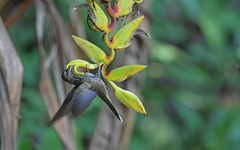
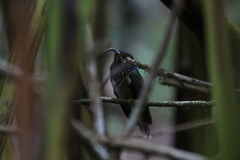
Buff-tailed Sicklebill

Buff-tailed Sicklebill

Eutoxeres condamini

Silhouette: Emma Hughes · PhyloPic

LCLeast ConcernNTVUENCR
Daily sighting probability <5% · Rare
at Yasuní National Park

In 3 days <5%

10 Verified sightings at Yasuní National Park From 2019 to 2026
197 In all 3 parks
October Best month
☀️ Diurnal When it's spotted

About the Buff-tailed Sicklebill

Epimachus albertisi, a bird-of-paradise from New Guinea, is also sometimes called "buff-tailed sicklebill". The buff-tailed sicklebill (Eutoxeres condamini) is a species of hermit hummingbird from the lower Andes and adjacent west Amazonian lowlands from southern Colombia and northern Ecuador to Peru and Bolivia.

With a total length of 5–6 in (13–15 cm) and weighing 0.28–0.44 oz (7.9–12.5 g), it is a relatively large hummingbird. Males and females are virtually identical, differing only in size (especially wing measurements), with the females being some 20% smaller.

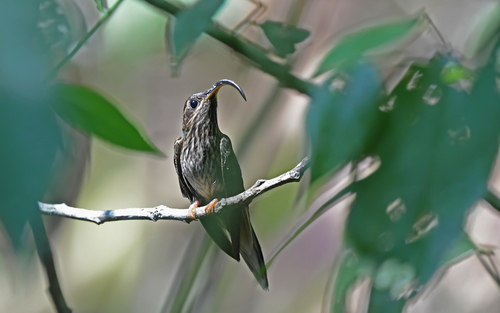
Its upperparts are iridescent dull greenish, while the underparts are whitish, densely streaked with dusky. The neck-side has a relatively faint blue patch. The tips of the rectrices (tail feathers) are white, and there is a naked stripe on top of the head (but this is usually concealed). The most conspicuous features, however, are those the common name refers to: the bill is strongly decurved, and the outer three rectrices on each side are deep buff, best visible from below.

Immature birds have light-tipped remiges (pinions), hardly any blue on the neck, and lack the naked crown stripe. Hatchlings have... Wikipedia →
Sounds

Song0:50

Ecuador · 1991

© Paul Coopmans · XC264459 · CC BY-NC-SA 4.0

Call0:08

Ecuador · 2008

© Andrew Spencer · XC17770 · CC BY-NC-ND 2.5

Song0:21

Ecuador · 2006

© Peter Boesman · XC223016 · CC BY-NC-ND 4.0

Global Distribution

Parks Where Found

# Park Country Daily sighting probability
1 Manu National Park 🇵🇪 Peru
<5%
2 Yasuní National Park 🇪🇨 Ecuador
<5%
3 Tambopata National Reserve 🇵🇪 Peru
<5%

Before you go

What are the chances of seeing a Buff-tailed Sicklebill in Yasuní National Park?

Rare

Under 5% of wildlife watchers report a Buff-tailed Sicklebill sighting in Yasuní National Park on a given day, based on 10 verified sightings from GBIF citizen-science data from 2019 to 2026. It is the 512th most-seen of the 533 birds we can rate there. Over three days the chance rises to under 5%, if each day is a fresh chance.

When is the best time to see a Buff-tailed Sicklebill in Yasuní National Park?

Any time of year

In every month with enough records, under 5% of wildlife watchers report a Buff-tailed Sicklebill in Yasuní National Park on a given day, so our monthly data shows no clear season.

What time of day is best to see a Buff-tailed Sicklebill?

Between 7 and 10 am

Across all the parks we cover, that three-hour window holds the most Buff-tailed Sicklebill sightings with a recorded time, and about 8 in 10 of them come between 6 am and 6 pm: it is a daytime animal.

Is Yasuní National Park the best place to see a Buff-tailed Sicklebill?

Among the best

Of the 3 parks where we can rate Buff-tailed Sicklebill sightings, Yasuní National Park ranks 2nd at under 5%, level with the leaders once rounded. The best odds are in Manu National Park (Peru, under 5%).

Where does the Buff-tailed Sicklebill sighting chance come from?

GBIF citizen-science records

It is estimated from how often the Buff-tailed Sicklebill is recorded against all the birds logged in Yasuní National Park (10 verified sightings from 2019 to 2026), calibrated against known sighting rates. Figures are rounded to the nearest 10% because citizen-science data supports honest approximations, not decimals, and months with records from fewer than five people show "—". How it works.

← Back to Yasuní National Park