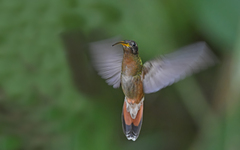

Rufous-breasted Hermit

Rufous-breasted Hermit

Glaucis hirsutus

Silhouette: Ferran Sayol · PhyloPic

LCLeast ConcernNTVUENCR
Daily sighting probability ~10% · With luck
at Yasuní National Park

In 3 days ~20% in a week ~40%

229 Verified sightings at Yasuní National Park From 2019 to 2026
2,359 In all 18 parks
September Best month
☀️ Diurnal When it's spotted

About the Rufous-breasted Hermit

The rufous-breasted hermit or hairy hermit (Glaucis hirsutus) is a hummingbird that breeds from Panama south to Bolivia, and on Trinidad, Tobago and Grenada. It is a widespread and generally common species, though local populations may change in numbers and disappear altogether in marginal habitat.

The rufous-breasted hermit was formally described in 1788 by the German naturalist Johann Friedrich Gmelin in his revised and expanded edition of Carl Linnaeus's Systema Naturae. He placed it with all the other hummingbirds in the genus Trochilus and coined the binomial name Trochilus hirsutus. Gmelin's description was based on that of the German naturalist Georg Marcgrave in his Historia Naturalis Brasiliae that had been published 140 years earlier in 1648. The rufous-breasted hermit is now placed with two other species in the genus Glaucis that was introduced in 1831 by the German zoologist Friedrich Boie. The genus name is from the Ancient Greek glaukos meaning "blue-grey", "glaucous" or "pale green". The specific epithet hirsutus is Latin meaning "hairy" or "bristled". The type locality is northeast Brazil.

Two subspecies are recognised: Wikipedia →

Sounds

Call0:37

French Guiana · 2024

© Wim Jacobs · XC906796 · CC BY-NC-SA 4.0

Flight call0:10

Ecuador · 2005

© John V. Moore · XC257787 · CC BY-NC-SA 4.0

Song0:15

Brazil · 2007

© Richard C. Hoyer · XC16811 · CC BY-NC-ND 2.5

Global Distribution

Parks Where Found

# Park Country Daily sighting probability
1 Main Ridge Forest Reserve 🇹🇹 Trinidad and Tobago
~70%
2 Serra dos Órgãos National Park 🇧🇷 Brazil
~40%
3 Henri Pittier National Park 🇻🇪 Venezuela
~20%
4 Manu National Park 🇵🇪 Peru
~20%
5 Yasuní National Park 🇪🇨 Ecuador
~10%
6 San Lorenzo Protected Forest 🇵🇦 Panama
~10%
7 Tambopata National Reserve 🇵🇪 Peru
~10%
8 Tayrona National Natural Park 🇨🇴 Colombia
~10%
9 Amacayacu National Natural Park 🇨🇴 Colombia
<5%
10 Cuyabeno Wildlife Reserve 🇪🇨 Ecuador
<5%
11 Darién National Park 🇵🇦 Panama
<5%
12 Tijuca National Park 🇧🇷 Brazil
<5%
13 Soberanía National Park 🇵🇦 Panama
<5%
14 Chagres National Park 🇵🇦 Panama
<5%
15 Parque Natural Metropolitano 🇵🇦 Panama
<5%
16 Bastimentos Island National Marine Park 🇵🇦 Panama
<5%
17 Los Nevados National Natural Park 🇨🇴 Colombia
<5%
18 La Amistad International Park (Panama) 🇵🇦 Panama
<5%

Cities Where Found

# City Country Daily sighting probability
1 Belém 🇧🇷 Brazil
~20%
2 João Pessoa 🇧🇷 Brazil
~20%
3 Recife 🇧🇷 Brazil
~10%
4 Maceió 🇧🇷 Brazil
<5%
5 Rio de Janeiro 🇧🇷 Brazil
<5%
6 Salvador 🇧🇷 Brazil
<5%
7 Caracas 🇻🇪 Venezuela
<5%

Before you go

What are the chances of seeing a Rufous-breasted Hermit in Yasuní National Park?

With luck

About 10% of wildlife watchers report a Rufous-breasted Hermit sighting in Yasuní National Park on a given day, based on 229 verified sightings from GBIF citizen-science data from 2019 to 2026. It is the 203rd most-seen of the 533 birds we can rate there. Over three days the chance rises to about 20%, and over a week to about 40%, if each day is a fresh chance.

When is the best time to see a Rufous-breasted Hermit in Yasuní National Park?

September

In that month about 20% of wildlife watchers report a Rufous-breasted Hermit in Yasuní National Park on a given day, against under 5% in January–February, May and August, the lowest months.

What time of day is best to see a Rufous-breasted Hermit?

Between 9 am and noon

Across all the parks we cover, that three-hour window holds the most Rufous-breasted Hermit sightings with a recorded time, and about 9 in 10 of them come between 6 am and 6 pm: it is a daytime animal.

Where does the Rufous-breasted Hermit sighting chance come from?

GBIF citizen-science records

It is estimated from how often the Rufous-breasted Hermit is recorded against all the birds logged in Yasuní National Park (229 verified sightings from 2019 to 2026), calibrated against known sighting rates. Figures are rounded to the nearest 10% because citizen-science data supports honest approximations, not decimals, and months with records from fewer than five people show "—". How it works.

← Back to Yasuní National Park