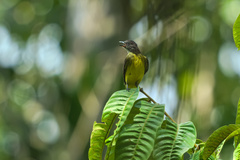
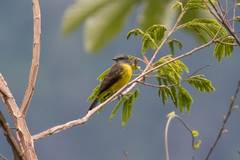
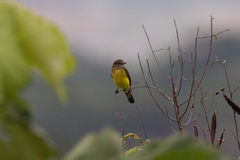
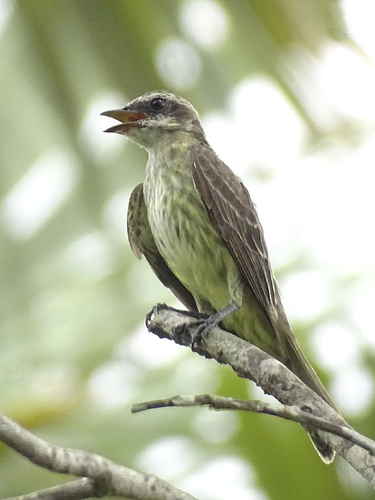
Dusky-chested Flycatcher

Dusky-chested Flycatcher

Myiozetetes luteiventris

Silhouette: Emily Willoughby · PhyloPic

LCLeast ConcernNTVUENCR
Daily sighting probability <5% · Rare
at Yasuní National Park

In 3 days ~10% in a week ~20%

90 Verified sightings at Yasuní National Park From 2019 to 2026
246 In all 4 parks
March Best month
☀️ Diurnal When it's spotted

About the Dusky-chested Flycatcher

The dusky-chested flycatcher (Myiozetetes luteiventris) is a species of bird in the family Tyrannidae, the tyrant flycatchers. It is found in Bolivia, Brazil, Colombia, Ecuador, French Guiana, Guyana, Peru, Suriname, and Venezuela.

The dusky-chested flycatcher was originally described as Elaenia luteiventris. It was later moved to genus Myiozetetes but during the twentieth century was treated by some authors in genus Tyrannopsis. By the late 1900s it was again generally recognized in its present genus.

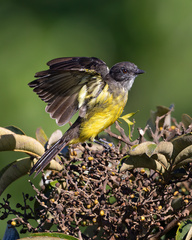
The dusky-chested flycatcher is the smallest member of genus Myiozetetes. It is 14 to 15 cm (5.5 to 5.9 in) long and weighs about 16.5 g (0.58 oz). The sexes have almost the same plumage. Adult males of the nominate subspecies have a grayish olive-brown crown and face with a mostly hidden yellow-orange patch in the center of the crown. Females have a smaller patch or none at all. Adults of both sexes have dark olive-brown upperparts. Their wings are dark olive-brown with faint and variable rufous... Wikipedia →

Sounds

Call0:30

Ecuador · 2010

© Manuel Sánchez-Nivicela · XC1155381 · CC BY-NC-ND 4.0

Song1:19

Ecuador · 2014

© Leonardo Ordóñez-Delgado · XC975164 · CC BY-NC-ND 4.0

Call1:02

Brazil · 2018

© Kenny Uéslei · XC860550 · CC BY-NC-SA 4.0

Global Distribution

Parks Where Found

# Park Country Daily sighting probability
1 Amacayacu National Natural Park 🇨🇴 Colombia
~10%
2 Yasuní National Park 🇪🇨 Ecuador
<5%
3 Tambopata National Reserve 🇵🇪 Peru
<5%
4 Manu National Park 🇵🇪 Peru
<5%

Before you go

What are the chances of seeing a Dusky-chested Flycatcher in Yasuní National Park?

Rare

Under 5% of wildlife watchers report a Dusky-chested Flycatcher sighting in Yasuní National Park on a given day, based on 90 verified sightings from GBIF citizen-science data from 2019 to 2026. It is the 316th most-seen of the 533 birds we can rate there. Over three days the chance rises to about 10%, and over a week to about 20%, if each day is a fresh chance.

When is the best time to see a Dusky-chested Flycatcher in Yasuní National Park?

March

In that month about 10% of wildlife watchers report a Dusky-chested Flycatcher in Yasuní National Park on a given day, against under 5% in April to February, the lowest months.

What time of day is best to see a Dusky-chested Flycatcher?

Between 7 and 10 am

Across all the parks we cover, that three-hour window holds the most Dusky-chested Flycatcher sightings with a recorded time, and about 8 in 10 of them come between 6 am and 6 pm: it is a daytime animal.

Is Yasuní National Park the best place to see a Dusky-chested Flycatcher?

2nd of 4

Of the 4 parks where we can rate Dusky-chested Flycatcher sightings, Yasuní National Park ranks 2nd at under 5%. The best odds are in Amacayacu National Natural Park (Colombia, about 10%).

Which relatives of the Dusky-chested Flycatcher live in Yasuní National Park?

Same genus: Myiozetetes

The closest relatives of the Dusky-chested Flycatcher that you can see in Yasuní National Park (genus Myiozetetes, Myiozetetes Flycatchers) are Social Flycatcher (about 30%) and Gray-capped Flycatcher (about 20%), with each one's daily chance of a sighting.

Where does the Dusky-chested Flycatcher sighting chance come from?

GBIF citizen-science records

It is estimated from how often the Dusky-chested Flycatcher is recorded against all the birds logged in Yasuní National Park (90 verified sightings from 2019 to 2026), calibrated against known sighting rates. Figures are rounded to the nearest 10% because citizen-science data supports honest approximations, not decimals, and months with records from fewer than five people show "—". How it works.

← Back to Yasuní National Park