Many-banded Aracari

Many-banded Aracari

Pteroglossus pluricinctus

Silhouette: Edwin Price · PhyloPic

LCLeast ConcernNTVUENCR
Daily sighting probability ~40% · Likely
at Yasuní National Park

In 3 days ~80% in a week >90%

1,437 Verified sightings at Yasuní National Park From 2019 to 2026
1,989 In all 4 parks
April Best month
☀️ Diurnal When it's spotted

About the Many-banded Aracari

The many-banded aracari or many-banded araçari (Pteroglossus pluricinctus) is a near-passerine bird in the toucan family Ramphastidae. It is found in Brazil, Colombia, Ecuador, Peru, and Venezuela. The many-banded aracari is monotypic.

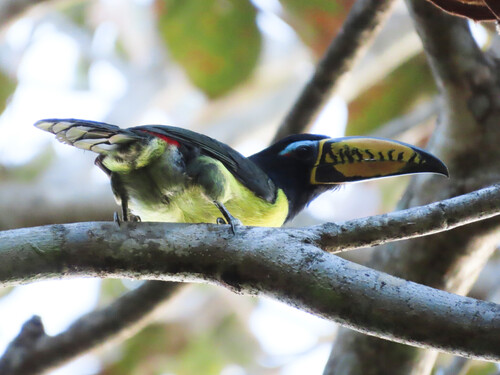
The many-banded aracari is 43 to 46 cm (17 to 18 in) long including the 11 to 12.5 cm (4.3 to 4.9 in) bill. It weighs 215 to 302 g (7.6 to 11 oz). Males' and females' bills are alike in color; the female's is shorter. The bill has an orange-yellow line at its base. Its maxilla is orange-yellow with a wide black stripe on the culmen and a black base. Its mandible is black. Adult males have a mostly black head, throat, and neck but for bare blue-green to green skin around the eye and a chestnut patch behind it. Their back is dark green and their rump is red. Their underparts are yellow with two bands, the upper one black and the lower one black and red. Their thighs are a mix of chestnut, green, and yellow. Adult females have little or no chestnut behind the eye and their black breast band is usually wider than the male's. Immatures are overall duller than adults, especially the yellow. Their bill is gray... Wikipedia →

Sounds

Song0:50

Colombia · 2022

© Frank Lambert · XC1040526 · CC BY-NC-ND 4.0

Call0:43

Ecuador · 2025

© Marc Anderson · XC984881 · CC BY-NC-ND 4.0

Call0:25

Ecuador · 2007

© Patricio Mena Valenzuela · XC856923 · CC BY-NC-SA 4.0

Global Distribution

Parks Where Found

# Park Country Daily sighting probability
1 Cuyabeno Wildlife Reserve 🇪🇨 Ecuador
~50%
2 Yasuní National Park 🇪🇨 Ecuador
~40%
3 Amacayacu National Natural Park 🇨🇴 Colombia
~20%
4 Sierra de la Macarena National Park 🇨🇴 Colombia
~10%

Zoos & Centres Where Found

# Zoo / Centre Country
1 Dallas World Aquarium 🇺🇸 United States In captivity

Before you go

What are the chances of seeing a Many-banded Aracari in Yasuní National Park?

Likely

About 40% of wildlife watchers report a Many-banded Aracari sighting in Yasuní National Park on a given day, based on 1,437 verified sightings from GBIF citizen-science data from 2019 to 2026. It is the 16th most-seen of the 533 birds we can rate there. Over three days the chance rises to about 80%, and over a week to over 90%, if each day is a fresh chance.

When is the best time to see a Many-banded Aracari in Yasuní National Park?

April–June, August and October

In those months about 50% of wildlife watchers report a Many-banded Aracari in Yasuní National Park on a given day, against about 30% in July and December, the lowest months.

What time of day is best to see a Many-banded Aracari?

Between 6 and 9 am

Across all the parks we cover, that three-hour window holds the most Many-banded Aracari sightings with a recorded time, and about 9 in 10 of them come between 6 am and 6 pm: it is a daytime animal.

Is Yasuní National Park the best place to see a Many-banded Aracari?

2nd of 4

Of the 4 parks where we can rate Many-banded Aracari sightings, Yasuní National Park ranks 2nd at about 40%. The best odds are in Cuyabeno Wildlife Reserve (Ecuador, about 50%).

Which relatives of the Many-banded Aracari live in Yasuní National Park?

Same genus: Pteroglossus

The closest relatives of the Many-banded Aracari that you can see in Yasuní National Park (genus Pteroglossus, Aracaris) are Chestnut-eared Aracari (about 20%), Ivory-billed Aracari (about 10%) and Lettered Aracari (about 10%), with each one's daily chance of a sighting.

Where does the Many-banded Aracari sighting chance come from?

GBIF citizen-science records

It is estimated from how often the Many-banded Aracari is recorded against all the birds logged in Yasuní National Park (1,437 verified sightings from 2019 to 2026), calibrated against known sighting rates. Figures are rounded to the nearest 10% because citizen-science data supports honest approximations, not decimals, and months with records from fewer than five people show "—". How it works.

← Back to Yasuní National Park