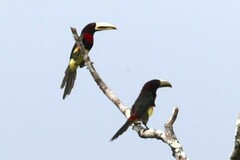
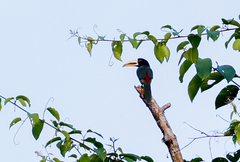
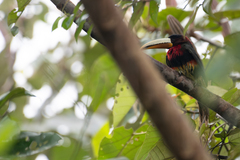

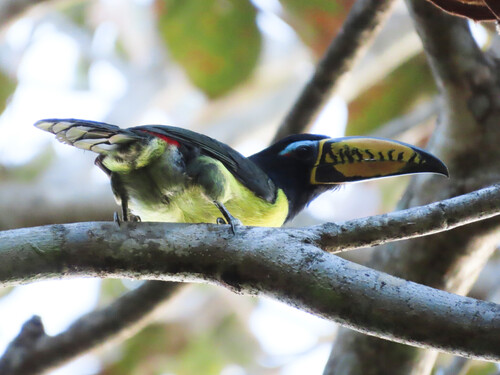
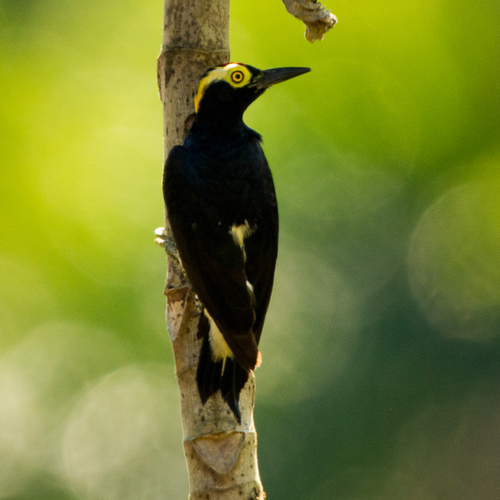
Ivory-billed Aracari

Ivory-billed Aracari

Pteroglossus azara

Silhouette: Edwin Price · PhyloPic

LCLeast ConcernNTVUENCR
Daily sighting probability ~10% · With luck
at Yasuní National Park

In 3 days ~30% in a week ~60%

422 Verified sightings at Yasuní National Park From 2019 to 2026
908 In all 6 parks
October Best month
☀️ Diurnal When it's spotted

About the Ivory-billed Aracari

The ivory-billed aracari or ivory-billed araçari (Pteroglossus azara) is a bird in the toucan family Ramphastidae. It is found in Brazil, Colombia, Ecuador, Peru, and Venezuela. The ivory-billed aracari was formally described in 1819 by the French ornithologist Louis Vieillot under the binomial name Ramphastos azara. Vieillot based his account on "Le Toucan-Aracari, Azara" from Brazil that had been described and illustrated in 1807 by the French naturalist François Levaillant. The epithet azara was chosen to honour the Spanish soldier and naturalist Félix de Azara. The ivory-billed aracari is now one of 13 species placed in the genus Pteroglossus that was introduced in 1811 by the German zoologist Johann Karl Wilhelm Illiger.

Three subspecies are recognised: The subspecies P. a. mariae has sometimes been considered as a separate species, the brown-mandibled aracari. The ivory-billed aracari is 36 to 45 cm (14 to 18 in) long and weighs 120 to 160 g (4.2 to 5.6 oz). The two subspecies... Wikipedia →

Sounds

Call0:29

Ecuador · 1994

© Robert S. Ridgely · XC274972 · CC BY-NC-SA 4.0

Song0:15

Ecuador · 2022

© Jerome Fischer · XC700352 · CC BY-NC-SA 4.0

Call0:48

Ecuador · 1996

© Paul Coopmans · XC264516 · CC BY-NC-SA 4.0

Global Distribution

Parks Where Found

# Park Country Daily sighting probability
1 Yasuní National Park 🇪🇨 Ecuador
~10%
2 Cuyabeno Wildlife Reserve 🇪🇨 Ecuador
~10%
3 Tambopata National Reserve 🇵🇪 Peru
~10%
4 Amacayacu National Natural Park 🇨🇴 Colombia
<5%
5 Manu National Park 🇵🇪 Peru
<5%
6 Anavilhanas National Park 🇧🇷 Brazil
<5%

Zoos & Centres Where Found

# Zoo / Centre Country
1 Philadelphia Zoo 🇺🇸 United States In captivity
2 Parque de las Leyendas 🇵🇪 Peru In captivity
3 Ecozoológico San Martín 🇪🇨 Ecuador In captivity

Before you go

What are the chances of seeing an Ivory-billed Aracari in Yasuní National Park?

With luck

About 10% of wildlife watchers report an Ivory-billed Aracari sighting in Yasuní National Park on a given day, based on 422 verified sightings from GBIF citizen-science data from 2019 to 2026. It is the 127th most-seen of the 533 birds we can rate there. Over three days the chance rises to about 30%, and over a week to about 60%, if each day is a fresh chance.

When is the best time to see an Ivory-billed Aracari in Yasuní National Park?

September and October

In those months about 20% of wildlife watchers report an Ivory-billed Aracari in Yasuní National Park on a given day, against about 10% in November to August, the lowest months.

What time of day is best to see an Ivory-billed Aracari?

Between 7 and 10 am

Across all the parks we cover, that three-hour window holds the most Ivory-billed Aracari sightings with a recorded time, and about 9 in 10 of them come between 6 am and 6 pm: it is a daytime animal.

Is Yasuní National Park the best place to see an Ivory-billed Aracari?

Yes

Of the 6 parks where we can rate Ivory-billed Aracari sightings, Yasuní National Park has the highest daily chance: about 10%. Next come Cuyabeno Wildlife Reserve (Ecuador, about 10%) and Tambopata National Reserve (Peru, about 10%).

Which relatives of the Ivory-billed Aracari live in Yasuní National Park?

Same genus: Pteroglossus

The closest relatives of the Ivory-billed Aracari that you can see in Yasuní National Park (genus Pteroglossus, Aracaris) are Many-banded Aracari (about 40%), Chestnut-eared Aracari (about 20%) and Lettered Aracari (about 10%), with each one's daily chance of a sighting.

Where does the Ivory-billed Aracari sighting chance come from?

GBIF citizen-science records

It is estimated from how often the Ivory-billed Aracari is recorded against all the birds logged in Yasuní National Park (422 verified sightings from 2019 to 2026), calibrated against known sighting rates. Figures are rounded to the nearest 10% because citizen-science data supports honest approximations, not decimals, and months with records from fewer than five people show "—". How it works.

← Back to Yasuní National Park