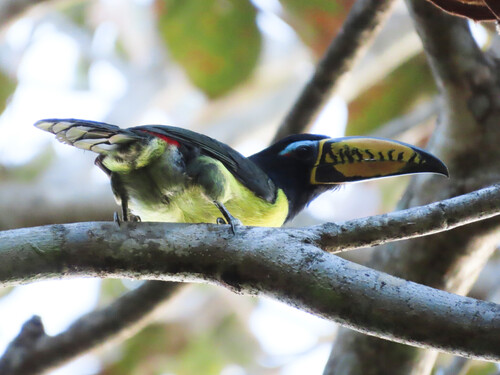
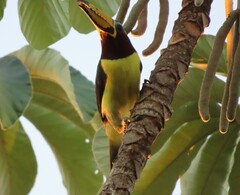
Lettered Aracari

Lettered Aracari

Pteroglossus inscriptus

Silhouette: Edwin Price · PhyloPic

LCLeast ConcernNTVUENCR
Daily sighting probability ~10% · With luck
at Yasuní National Park

In 3 days ~30% in a week ~60%

405 Verified sightings at Yasuní National Park From 2019 to 2026
1,036 In all 7 parks
May Best month
☀️ Diurnal When it's spotted

About the Lettered Aracari

The lettered aracari or lettered araçari (Pteroglossus inscriptus) is a near-passerine bird in the toucan family Ramphastidae. It is found in Bolivia, Brazil, Colombia, Ecuador, and Peru. BirdLife International's Handbook of the Birds of the World treats it as a species, "Humboldt's araçari". The SACC is soliciting a proposal to adopt that treatment.

This article follows the IOC et al. two-subspecies model. The lettered aracari is 33 to 35.5 cm (13 to 14 in) long. The nominate subspecies weighs about 100 to 130 g (3.5 to 4.6 oz) and P. i. humboldti about 110 to 185 g (3.9 to 6.5 oz). In both the male is larger than the female and has a longer bill. Their bills have a complex pattern. The nominate's has a mostly yellow maxilla... Wikipedia →

Sounds

Call0:18

Colombia · 2021

© Mauricio Cuellar Ramirez (@Birding.travel) · XC647187 · CC BY-NC-SA 4.0

Alarm call0:09

Brazil · 2017

© Dante Buzzetti · XC586094 · CC BY-NC-SA 4.0

Song0:07

Brazil · 2024

© JAYRSON ARAUJO DE OLIVEIRA · XC901344 · CC BY-NC-SA 4.0

Global Distribution

Parks Where Found

# Park Country Daily sighting probability
1 Chapada dos Guimarães National Park 🇧🇷 Brazil
~30%
2 Cuyabeno Wildlife Reserve 🇪🇨 Ecuador
~20%
3 Yasuní National Park 🇪🇨 Ecuador
~10%
4 Sierra de la Macarena National Park 🇨🇴 Colombia
~10%
5 Tambopata National Reserve 🇵🇪 Peru
~10%
6 Amacayacu National Natural Park 🇨🇴 Colombia
~10%
7 Manu National Park 🇵🇪 Peru
<5%

Cities Where Found

# City Country Daily sighting probability
1 Belém 🇧🇷 Brazil
~10%

Zoos & Centres Where Found

# Zoo / Centre Country
1 Zoológico de Brasília 🇧🇷 Brazil In captivity
2 Warsaw Zoo 🇵🇱 Poland In captivity
3 Dallas World Aquarium 🇺🇸 United States In captivity
4 herpetarium warszawskiego ZOO 🇵🇱 Poland In captivity
5 akwarium warszawskiego ZOO 🇵🇱 Poland In captivity

Before you go

What are the chances of seeing a Lettered Aracari in Yasuní National Park?

With luck

About 10% of wildlife watchers report a Lettered Aracari sighting in Yasuní National Park on a given day, based on 405 verified sightings from GBIF citizen-science data from 2019 to 2026. It is the 130th most-seen of the 533 birds we can rate there. Over three days the chance rises to about 30%, and over a week to about 60%, if each day is a fresh chance.

When is the best time to see a Lettered Aracari in Yasuní National Park?

January–February, May and October

In those months about 20% of wildlife watchers report a Lettered Aracari in Yasuní National Park on a given day, against under 5% in April and June, the lowest months.

What time of day is best to see a Lettered Aracari?

Between 6 and 9 am

Across all the parks we cover, that three-hour window holds the most Lettered Aracari sightings with a recorded time, and about 9 in 10 of them come between 6 am and 6 pm: it is a daytime animal.

Is Yasuní National Park the best place to see a Lettered Aracari?

3rd of 7

Of the 7 parks where we can rate Lettered Aracari sightings, Yasuní National Park ranks 3rd at about 10%. The best odds are in Chapada dos Guimarães National Park (Brazil, about 30%) and Cuyabeno Wildlife Reserve (Ecuador, about 20%).

Which relatives of the Lettered Aracari live in Yasuní National Park?

Same genus: Pteroglossus

The closest relatives of the Lettered Aracari that you can see in Yasuní National Park (genus Pteroglossus, Aracaris) are Many-banded Aracari (about 40%), Chestnut-eared Aracari (about 20%) and Ivory-billed Aracari (about 10%), with each one's daily chance of a sighting.

Where does the Lettered Aracari sighting chance come from?

GBIF citizen-science records

It is estimated from how often the Lettered Aracari is recorded against all the birds logged in Yasuní National Park (405 verified sightings from 2019 to 2026), calibrated against known sighting rates. Figures are rounded to the nearest 10% because citizen-science data supports honest approximations, not decimals, and months with records from fewer than five people show "—". How it works.

← Back to Yasuní National Park