Rhinoceros Dung Beetle

Rhinoceros Dung Beetle

Oxysternon conspicillatum

Daily sighting probability ~10% · With luck
at Yasuní National Park

In 3 days ~40% in a week ~60%

16 Verified sightings at Yasuní National Park From 2019 to 2026
40 In all 3 parks
December Best month
☀️ Diurnal When it's spotted

About the Rhinoceros Dung Beetle

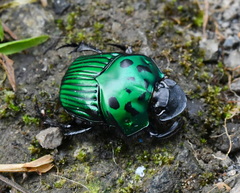
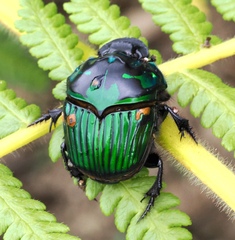
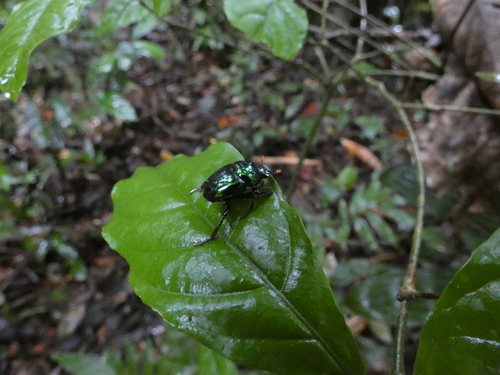
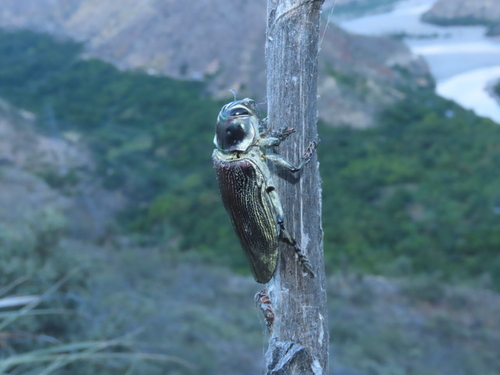
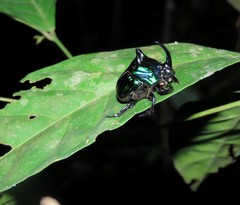
Oxysternon conspicillatum is a species of dung beetle in the family Scarabaeidae. It is found in both evergreen and semi-deciduous mesic forests, including disturbed habitats, ranging from near sea level to an altitude of 3,000 m (9,800 ft) in the Amazon basin and Chocó of tropical South America and Panama, possibly extending as far west as the border region with Costa Rica. Both adults and young of this common and widespread beetle primarily feed on dung, but the species has also been recorded feeding on dead animals.

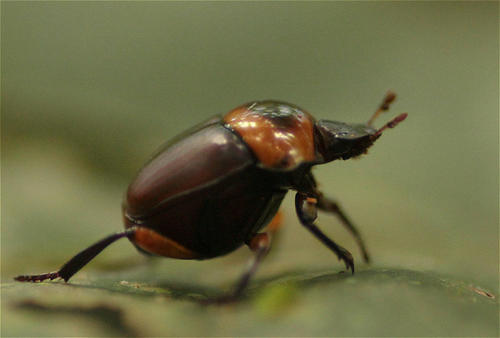
O. conspicillatum has been studied as a potential source for antimicrobial agents, with the possible use of its host defense peptides in the development of new antibiotics. Adult O. conspicillatum have a length of 1.6–3.1 cm (0.63–1.22 in). The species exhibits some sexual dimorphism; large ("major") males have a large black horn on their head and two spikes on their pronotum while females' lack these. However, small ("minor") males are more female-like in their appearance, with the smallest essentially lacking a horn and pronotum spikes.

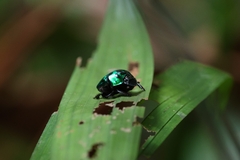
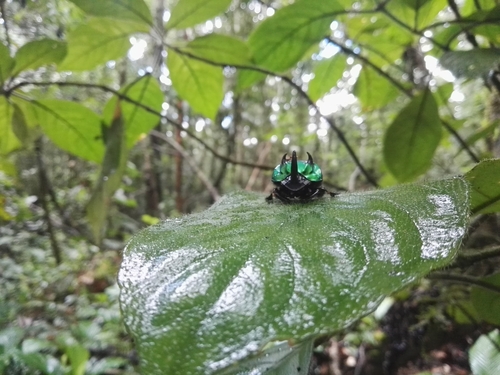
The species typically is metallic green, but occasionally it can be metallic dark blue or blue-green. Blue individuals... Wikipedia →
Global Distribution

Parks Where Found

# Park Country Daily sighting probability
1 Yasuní National Park 🇪🇨 Ecuador
~10%
2 Manu National Park 🇵🇪 Peru
~10%
3 Tambopata National Reserve 🇵🇪 Peru
~10%

Cities Where Found

# City Country Daily sighting probability
1 Medellín 🇨🇴 Colombia
~10%

Before you go

What are the chances of seeing a Rhinoceros Dung Beetle in Yasuní National Park?

With luck

About 10% of wildlife watchers report a Rhinoceros Dung Beetle sighting in Yasuní National Park on a given day, based on 16 verified sightings from GBIF citizen-science data from 2019 to 2026. It is the 43rd most-seen of the 203 insects we can rate there. Over three days the chance rises to about 40%, and over a week to about 60%, if each day is a fresh chance.

When is the best time to see a Rhinoceros Dung Beetle in Yasuní National Park?

December

In that month about 30% of wildlife watchers report a Rhinoceros Dung Beetle in Yasuní National Park on a given day, against under 5% in January and August–September, the lowest months.

What time of day is best to see a Rhinoceros Dung Beetle?

Between 9 am and noon

Across all the parks we cover, that three-hour window holds the most Rhinoceros Dung Beetle sightings with a recorded time, and about 9 in 10 of them come between 6 am and 6 pm: it is a daytime animal.

Is Yasuní National Park the best place to see a Rhinoceros Dung Beetle?

Yes

Of the 3 parks where we can rate Rhinoceros Dung Beetle sightings, Yasuní National Park has the highest daily chance: about 10%. Next come Manu National Park (Peru, about 10%) and Tambopata National Reserve (Peru, about 10%).

Which relatives of the Rhinoceros Dung Beetle live in Yasuní National Park?

Same family: Scarabaeidae

The closest relatives of the Rhinoceros Dung Beetle that you can see in Yasuní National Park (family Scarabaeidae, Scarabs) are Canthon luteicollis (about 20%) and Canthon fulgidus (about 10%), with each one's daily chance of a sighting.

Where does the Rhinoceros Dung Beetle sighting chance come from?

GBIF citizen-science records

It is estimated from how often the Rhinoceros Dung Beetle is recorded against all the insects logged in Yasuní National Park (16 verified sightings from 2019 to 2026), calibrated against known sighting rates. Figures are rounded to the nearest 10% because citizen-science data supports honest approximations, not decimals, and months with records from fewer than five people show "—". How it works.

← Back to Yasuní National Park