Suriname Toad

Suriname Toad

Pipa pipa

Silhouette: Dein Freund der Baum (vectorized by T. Michael Keesey) · PhyloPic

LCLeast ConcernNTVUENCR
Daily sighting probability ~10% · With luck
at Yasuní National Park

In 3 days ~30% in a week ~50%

7 Verified sightings at Yasuní National Park From 2019 to 2026
22 In all 2 parks
June Best month
☀️ Diurnal When it's spotted

About the Suriname Toad

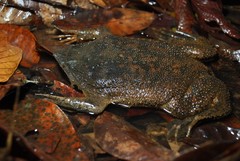
The common Surinam toad, the Suriname toad, or star-fingered toad (Pipa pipa), is a fully-aquatic species of frog, in the family Pipidae, with a widespread range across much of tropical South America and the island of Trinidad. The females of this species are well-known for "incubating" their eggs on their backs, in honeycomb-like depressions directly within the skin, releasing fully-formed froglets after a period of 4–5 months. Pipa pipa is an ambush predator, lying in-wait underwater for prey to inevitably wander too close, swiftly inhaling the unsuspecting creature using suction feeding. Additionally, the Surinam toad's rather flat body shape, combined with rather dark, dull coloration, serves as effective camouflage in the murky waters they inhabit, perfectly mimicking a dead leaf or piece of rotting wood as they await their next meal.

P. pipa is a strictly aquatic frog and the largest member of its genus. The species has an exceptionally depressed body, almost entirely flat and with a broad, flat, triangular head, without a tongue. The body is similar in appearance to a mottled brown leaf. The feet are broadly webbed with the front toes having small, star-like... Wikipedia →

Sounds

Recording1:30

Suriname · 1970

© M.S. Hoogmoed · XC882833 · CC BY 4.0

Global Distribution

Parks Where Found

# Park Country Daily sighting probability
1 Tambopata National Reserve 🇵🇪 Peru
~10%
2 Yasuní National Park 🇪🇨 Ecuador
~10%

Zoos & Centres Where Found

# Zoo / Centre Country
1 California Academy of Sciences 🇺🇸 United States In captivity
2 Brookfield Zoo 🇺🇸 United States In captivity
3 Toledo Zoo 🇺🇸 United States In captivity
4 Ueno Zoological Gardens (West Garden) 🇯🇵 Japan In captivity
5 Reptile Gardens 🇺🇸 United States In captivity
6 Adventure Aquarium 🇺🇸 United States In captivity
7 Haus des Meeres 🇦🇹 Austria In captivity
8 Dallas World Aquarium 🇺🇸 United States In captivity
9 AOAO Sapporo 🇯🇵 Japan In captivity
10 Greater Cleveland Aquarium 🇺🇸 United States In captivity

Before you go

What are the chances of seeing a Suriname Toad in Yasuní National Park?

With luck

About 10% of wildlife watchers report a Suriname Toad sighting in Yasuní National Park on a given day, based on 7 verified sightings from GBIF citizen-science data from 2019 to 2026. It is the 35th most-seen of the 49 amphibians we can rate there. Over three days the chance rises to about 30%, and over a week to about 50%, if each day is a fresh chance.

When is the best time to see a Suriname Toad in Yasuní National Park?

June

In that month about 30% of wildlife watchers report a Suriname Toad in Yasuní National Park on a given day, against under 5% in February, April–May and July–December, the lowest months.

What time of day is best to see a Suriname Toad?

Between 10 am and 1 pm

Across all the parks we cover, that three-hour window holds the most Suriname Toad sightings with a recorded time, and about 8 in 10 of them come between 6 am and 6 pm: it is a daytime animal.

Is Yasuní National Park the best place to see a Suriname Toad?

Among the best

Of the 2 parks where we can rate Suriname Toad sightings, Yasuní National Park ranks 2nd at about 10%, level with the leaders once rounded. The best odds are in Tambopata National Reserve (Peru, about 10%).

Where does the Suriname Toad sighting chance come from?

GBIF citizen-science records

It is estimated from how often the Suriname Toad is recorded against all the amphibians logged in Yasuní National Park (7 verified sightings from 2019 to 2026), calibrated against known sighting rates. Figures are rounded to the nearest 10% because citizen-science data supports honest approximations, not decimals, and months with records from fewer than five people show "—". How it works.

← Back to Yasuní National Park