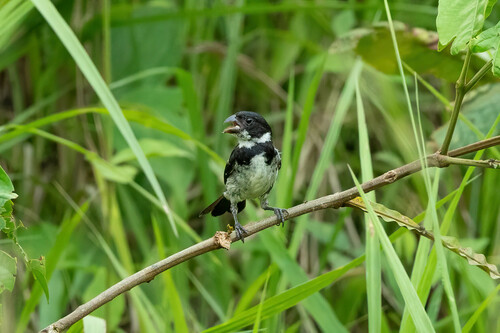
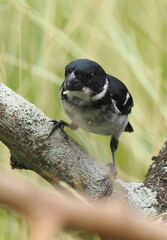
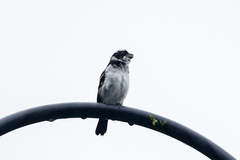
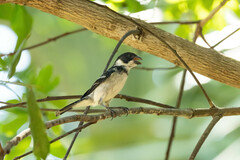
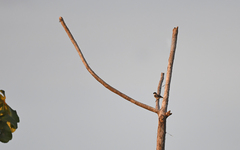

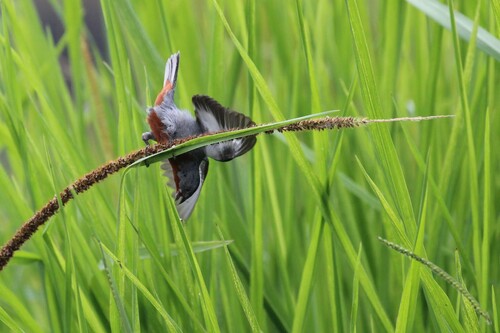
Wing-barred Seedeater

Wing-barred Seedeater

Sporophila americana

Silhouette: Sheatherius · PhyloPic

LCLeast ConcernNTVUENCR
Daily sighting probability <5% · Rare
at Yasuní National Park

In 3 days <5% in a week ~10%

46 Verified sightings at Yasuní National Park From 2019 to 2026
167 In all 5 parks
August Best month
☀️ Diurnal When it's spotted

About the Wing-barred Seedeater

The wing-barred seedeater (Sporophila americana) is a passerine bird from coastal regions of north-eastern South America in north-eastern Venezuela, Tobago, the Guianas, Amapá and north-eastern Pará (with a single record from Maranhão), Brazil, and along the Amazon River upstream to around Manaus. Formerly, it included the mainly Central American Sporophila corvina and the west Amazonian S. murallae as subspecies, in which case the combined species had the common name Variable Seedeater. Following the split, this common name is now restricted to S. corvina.

It has a total length of approximately 11 cm (4+1⁄4 in). Adult males have a relatively heavy black bill. The upperparts are black, except for a greyish rump (actually white finely streaked black, but only visible up-close) and two distinct white wing-bars (the lower often reduced). The underparts are white, except for a broad black pectoral collar (sometimes reduced and incomplete) and blackish mottling to the upper flanks. The far duller female has a brownish bill, dull buffy-olive upperparts and pale olive-ochre underparts. Juveniles resemble adult females.

It is found in open or semi-open grassy... Wikipedia →

Sounds

Song0:23

Brazil · 2019

© Fernando Igor de Godoy · XC705284 · CC BY-NC-SA 4.0

Call0:09

Brazil · 1996

© Dante Buzzetti · XC690830 · CC BY-NC-SA 4.0

Song0:28

French Guiana · 2019

© Brice de la Croix · XC480013 · CC BY-NC-SA 4.0

Global Distribution

Parks Where Found

# Park Country Daily sighting probability
1 Amacayacu National Natural Park 🇨🇴 Colombia
~10%
2 Cuyabeno Wildlife Reserve 🇪🇨 Ecuador
<5%
3 Yasuní National Park 🇪🇨 Ecuador
<5%
4 Anavilhanas National Park 🇧🇷 Brazil
<5%
5 Podocarpus National Park 🇪🇨 Ecuador
<5%

Cities Where Found

# City Country Daily sighting probability
1 Manaus 🇧🇷 Brazil
<5%
2 Belém 🇧🇷 Brazil
<5%

Before you go

What are the chances of seeing a Wing-barred Seedeater in Yasuní National Park?

Rare

Under 5% of wildlife watchers report a Wing-barred Seedeater sighting in Yasuní National Park on a given day, based on 46 verified sightings from GBIF citizen-science data from 2019 to 2026. It is the 386th most-seen of the 533 birds we can rate there. Over three days the chance rises to under 5%, and over a week to about 10%, if each day is a fresh chance.

When is the best time to see a Wing-barred Seedeater in Yasuní National Park?

Any time of year

In every month with enough records, under 5% of wildlife watchers report a Wing-barred Seedeater in Yasuní National Park on a given day, so our monthly data shows no clear season.

What time of day is best to see a Wing-barred Seedeater?

Between 3 and 6 pm

Across all the parks we cover, that three-hour window holds the most Wing-barred Seedeater sightings with a recorded time, and about 8 in 10 of them come between 6 am and 6 pm: it is a daytime animal.

Is Yasuní National Park the best place to see a Wing-barred Seedeater?

3rd of 5

Of the 5 parks where we can rate Wing-barred Seedeater sightings, Yasuní National Park ranks 3rd at under 5%. The best odds are in Amacayacu National Natural Park (Colombia, about 10%) and Cuyabeno Wildlife Reserve (Ecuador, under 5%).

Which relatives of the Wing-barred Seedeater live in Yasuní National Park?

Same genus: Sporophila

The closest relatives of the Wing-barred Seedeater that you can see in Yasuní National Park (genus Sporophila, Typical Seedeaters and Seed-Finches) are Chestnut-bellied Seed-Finch (about 10%) and Chestnut-bellied Seedeater (about 10%), with each one's daily chance of a sighting.

Where does the Wing-barred Seedeater sighting chance come from?

GBIF citizen-science records

It is estimated from how often the Wing-barred Seedeater is recorded against all the birds logged in Yasuní National Park (46 verified sightings from 2019 to 2026), calibrated against known sighting rates. Figures are rounded to the nearest 10% because citizen-science data supports honest approximations, not decimals, and months with records from fewer than five people show "—". How it works.

← Back to Yasuní National Park