


Completed


Pronghorn
Antilocapra americana
Silhouette: Xavier Giroux-Bougard · PhyloPic
- KingdomAnimalia (Animals)
- PhylumChordata (Chordates)
- ClassMammalia (Mammals)
- OrderArtiodactyla (Even-toed Ungulates and Cetaceans)
- FamilyAntilocapridae (Pronghorns)
- GenusAntilocapra (American Antelopes)
- SpeciesAntilocapra americana (Pronghorn)
In 3 days >90%
1,089 Verified sightings at Yellowstone National Park From 2019 to 2026
1,703 In all 7 parks
September Best month
☀️ Diurnal When it's spotted
About the Pronghorn
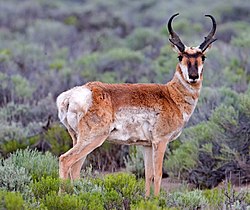
The pronghorn (UK:, US: ) (Antilocapra americana) is a species of artiodactyl (even-toed, hoofed) mammal indigenous to interior western and central North America. Though not an antelope, it is known colloquially in North America as the American antelope, prong buck, pronghorn antelope, and prairie antelope, because it closely resembles the antelopes of the Old World and fills a similar ecological niche due to parallel evolution. It is the only surviving member of the family Antilocapridae.
During the Pleistocene epoch, about 11 other antilocaprid species existed in North America, many with long or spectacularly twisted horns. Three other genera (Capromeryx, Stockoceros and Tetrameryx) existed when humans entered North America, but are now extinct.
The pronghorn's closest living relatives are the giraffe and okapi. The antilocaprids are part of the infraorder Pecora, making them distant relatives of deer, bovids, and moschids. The pronghorn is the fastest land mammal in the Americas, with running speeds up to 55 mph (88.5 km/h). It is the symbol of the American Society of Mammalogists.
The animal gets its name from its horn sheaths that branch and have a forward-pointing... Wikipedia →
Sounds
Recording0:58
United States · 2025
© melimez · iNaturalist · CC BY 4.0
Recent sightings of Pronghorn in Yellowstone National Park
LIVEiNaturalistGlobal Distribution
Parks Where Found
| # | Park | Country | Daily sighting probability |
|---|---|---|---|
| 1 | Badlands National Park | 🇺🇸 United States | |
| 2 | Yellowstone National Park | 🇺🇸 United States | |
| 3 | Grand Teton National Park | 🇺🇸 United States | |
| 4 | El Vizcaíno Biosphere Reserve | 🇲🇽 Mexico | |
| 5 | Death Valley National Park | 🇺🇸 United States | |
| 6 | Zion National Park | 🇺🇸 United States | |
| 7 | Rocky Mountain National Park | 🇺🇸 United States |
Cities Where Found
| # | City | Country | Daily sighting probability |
|---|---|---|---|
| 1 | Denver | 🇺🇸 United States |
Zoos & Centres Where Found
| # | Zoo / Centre | Country | |
|---|---|---|---|
| 1 | San Diego Zoo | 🇺🇸 United States | |
| 2 | San Diego Zoo Safari Park | 🇺🇸 United States | |
| 3 | Minnesota Zoo | 🇺🇸 United States | |
| 4 | Living Desert Zoo and Gardens | 🇺🇸 United States | |
| 5 | Columbus Zoo and Aquarium | 🇺🇸 United States | |
| 6 | Kansas City Zoo | 🇺🇸 United States | |
| 7 | Los Angeles Zoo | 🇺🇸 United States | |
| 8 | Bearizona | 🇺🇸 United States | |
| 9 | Wildlife West Nature Park | 🇺🇸 United States | |
| 10 | Phoenix Zoo | 🇺🇸 United States | |
| 11 | Bear Country USA | 🇺🇸 United States | |
| 12 | Dakota Zoo | 🇺🇸 United States | |
| 13 | Oklahoma City Zoo and Botanical Garden | 🇺🇸 United States | |
| 14 | Forestry Farm Park and Zoo | 🇨🇦 Canada | |
| 15 | El Paso Zoo | 🇺🇸 United States | |
| 16 | Northeastern Wisconsin Zoo | 🇺🇸 United States | |
| 17 | Zoo Idaho | 🇺🇸 United States | |
| 18 | ZooAmerica | 🇺🇸 United States | |
| 19 | Heritage Park Zoological Sanctuary | 🇺🇸 United States | |
| 20 | High Park Zoo | 🇨🇦 Canada | |
| 21 | Oklahoma Aquarium | 🇺🇸 United States | |
| 22 | OdySea Aquarium | 🇺🇸 United States | |
| 23 | Sobela Ocean Aquarium | 🇺🇸 United States | |
| 24 | Kung Fu Corals | 🇺🇸 United States | |
| 25 | Selig Zoo | 🇺🇸 United States | |
| 26 | Universal City Zoo | 🇺🇸 United States |
Closest Relatives at Yellowstone National Park






Before you go
What are the chances of seeing a Pronghorn in Yellowstone National Park?
Likely
About 60% of wildlife watchers report a Pronghorn sighting in Yellowstone National Park on a given day, based on 1,089 verified sightings from GBIF citizen-science data from 2019 to 2026. It is the 5th most-seen of the 32 mammals we can rate there. Over three days the chance rises to over 90%, if each day is a fresh chance.
When is the best time to see a Pronghorn in Yellowstone National Park?
March–April and September
In those months about 70% of wildlife watchers report a Pronghorn in Yellowstone National Park on a given day, against about 40% in February, the lowest month.
What time of day is best to see a Pronghorn?
Between 10 am and 1 pm
Across all the parks we cover, that three-hour window holds the most Pronghorn sightings with a recorded time, and about 7 in 10 of them come between 6 am and 6 pm: it is a daytime animal.
Is Yellowstone National Park the best place to see a Pronghorn?
2nd of 7
Of the 7 parks where we can rate Pronghorn sightings, Yellowstone National Park ranks 2nd at about 60%. The best odds are in Badlands National Park (United States, about 80%). All parks ranked.
Which relatives of the Pronghorn live in Yellowstone National Park?
Same order: Artiodactyla
The closest relatives of the Pronghorn that you can see in Yellowstone National Park (order Artiodactyla, Even-toed Ungulates and Cetaceans) are American Bison (about 90%), Elk (wapiti) (about 80%) and Mule Deer (about 50%), with each one's daily chance of a sighting.
Where does the Pronghorn sighting chance come from?
GBIF citizen-science records
It is estimated from how often the Pronghorn is recorded against all the mammals logged in Yellowstone National Park (1,089 verified sightings from 2019 to 2026), calibrated against known sighting rates. Figures are rounded to the nearest 10% because citizen-science data supports honest approximations, not decimals, and months with records from fewer than five people show "—". How it works.
