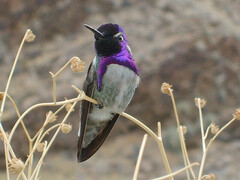
Costa's Hummingbird

Costa's Hummingbird

Calypte costae

Silhouette: Margot Michaud · PhyloPic

LCLeast ConcernNTVUENCR
Daily sighting probability <5% · Rare
at Zion National Park

In 3 days <5%

14 Verified sightings at Zion National Park From 2019 to 2026
5,221 In all 9 parks
May Best month
☀️ Diurnal When it's spotted

About the Costa's Hummingbird

Costa's hummingbird (Calypte costae) is a species of hummingbird in the family Trochilidae. It breeds in the arid, semi-arid and Mediterranean climate zones of the Southwestern United States and northwestern Mexico, mainly in Southern California and the Baja California Peninsula. Like many hummingbirds in the region, it can be found on the Pacific coast, often visiting backyard hummingbird feeders and gardens with flowering plants, as well as in more wild ecosystems, such as the conifer and oak forests, chaparral, and high desert habitats found further inland. When not in the US, the species often winters in western Mexico.

Costa's hummingbird was formally described by the French ornithologist Jules Bourcier in 1839, and given the binomial name Ornismya costae; Bourcier chose the specific epithet to honour French nobleman (and fellow ornithologist) Louis Marie Pantaleon Costa, Marquis de Beauregard (1806–1864). The type locality is Magdalena Bay, on the Pacific west coast, of the Mexican state of Baja California Sur. Costa's hummingbird is presently placed in the genus Calypte, introduced in 1856 by John Gould. The species is monotypic, with no subspecies being currently... Wikipedia →

Sounds

Call0:38

United States · 2020

© Pat Goltz · XC1149559 · CC BY-NC-SA 4.0

Flight call0:22

United States · 2022

© Paul Marvin · XC703968 · CC BY-NC-SA 4.0

Call0:10

United States · 2021

© Linzy L. · XC670289 · CC BY-NC-SA 4.0

Global Distribution

Parks Where Found

# Park Country Daily sighting probability
1 Bahía de Loreto National Park 🇲🇽 Mexico
~50%
2 Cabo Pulmo National Park 🇲🇽 Mexico
~40%
3 Joshua Tree National Park 🇺🇸 United States
~30%
4 Saguaro National Park 🇺🇸 United States
~30%
5 El Vizcaíno Biosphere Reserve 🇲🇽 Mexico
~20%
6 Death Valley National Park 🇺🇸 United States
~20%
7 Zion National Park 🇺🇸 United States
<5%
8 Great Bear Rainforest 🇨🇦 Canada
<5%
9 Channel Islands National Park 🇺🇸 United States
<5%

Cities Where Found

# City Country Daily sighting probability
1 Las Vegas 🇺🇸 United States
~40%
2 Phoenix 🇺🇸 United States
~30%
3 Mesa 🇺🇸 United States
~10%
4 Tijuana 🇲🇽 México
<5%
5 San Diego 🇺🇸 United States
<5%
6 Los Angeles 🇺🇸 United States
<5%
7 San Francisco 🇺🇸 United States
<5%
8 Dallas 🇺🇸 United States
<5%

Zoos & Centres Where Found

# Zoo / Centre Country
1 San Diego Zoo 🇺🇸 United States In captivity
2 Arizona-Sonora Desert Museum 🇺🇸 United States In captivity

Before you go

What are the chances of seeing a Costa's Hummingbird in Zion National Park?

Rare

Under 5% of wildlife watchers report a Costa's Hummingbird sighting in Zion National Park on a given day, based on 14 verified sightings from GBIF citizen-science data from 2019 to 2026. It is the 154th most-seen of the 183 birds we can rate there. Over three days the chance rises to under 5%, if each day is a fresh chance.

When is the best time to see a Costa's Hummingbird in Zion National Park?

Any time of year

In every month with enough records, under 5% of wildlife watchers report a Costa's Hummingbird in Zion National Park on a given day, so our monthly data shows no clear season.

What time of day is best to see a Costa's Hummingbird?

Between 6 and 9 am

Across all the parks we cover, that three-hour window holds the most Costa's Hummingbird sightings with a recorded time, and about 8 in 10 of them come between 6 am and 6 pm: it is a daytime animal.

Where does the Costa's Hummingbird sighting chance come from?

GBIF citizen-science records

It is estimated from how often the Costa's Hummingbird is recorded against all the birds logged in Zion National Park (14 verified sightings from 2019 to 2026), calibrated against known sighting rates. Figures are rounded to the nearest 10% because citizen-science data supports honest approximations, not decimals, and months with records from fewer than five people show "—". How it works.

← Back to Zion National Park