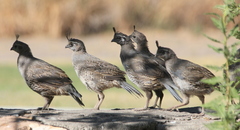
California Quail

California Quail

Callipepla californica

Silhouette: Ferran Sayol · PhyloPic

LCLeast ConcernNTVUENCR
Daily sighting probability ~20% · Possible
at Abel Tasman National Park

In 3 days ~50% in a week ~80%

164 Verified sightings at Abel Tasman National Park From 2019 to 2026
2,664 In all 12 parks
January Best month
🌅 Crepuscular When it's spotted

About the California Quail

The California quail (Callipepla californica), also known as the California valley quail or Valley quail, is a small ground-dwelling bird in the New World quail family, inhabiting western North America. It is the state bird of California.

Their closest relative is Gambel's quail, which has a more southerly distribution and a longer crest at 2.5 in (6.4 cm), a brighter head... Wikipedia →

Sounds

Call0:27

United States · 2025

© Ed Pandolfino · XC985689 · CC BY-NC-SA 4.0

Aberrant0:07

United States · 2021

© Bruce Lagerquist · XC636976 · CC BY-NC-SA 4.0

Song0:36

Canada · 1989

© Peter Ward and Ken Hall · XC603752 · CC BY-NC-SA 4.0

Global Distribution

Parks Where Found

# Park Country Daily sighting probability
1 Cabo Pulmo National Park 🇲🇽 Mexico
~30%
2 Bahía de Loreto National Park 🇲🇽 Mexico
~30%
3 Nahuel Huapi National Park 🇦🇷 Argentina
~30%
4 Sequoia and Kings Canyon National Parks 🇺🇸 United States
~30%
5 Abel Tasman National Park 🇳🇿 New Zealand
~20%
6 El Vizcaíno Biosphere Reserve 🇲🇽 Mexico
~20%
7 Redwood National Park 🇺🇸 United States
~20%
8 Channel Islands National Park 🇺🇸 United States
<5%
9 Yosemite National Park 🇺🇸 United States
<5%
10 Arthur's Pass National Park 🇳🇿 New Zealand
<5%
11 Olympic National Park 🇺🇸 United States
<5%
12 Death Valley National Park 🇺🇸 United States
<5%

Cities Where Found

# City Country Daily sighting probability
1 Salt Lake City 🇺🇸 United States
~20%
2 Sacramento 🇺🇸 United States
~20%
3 Santiago 🇨🇱 Chile
~20%
4 Los Angeles 🇺🇸 United States
<5%
5 Auckland 🇳🇿 New Zealand
<5%
6 San Diego 🇺🇸 United States
<5%
7 San Francisco 🇺🇸 United States
<5%
8 Seattle 🇺🇸 United States
<5%
9 Portland 🇺🇸 United States
<5%

Zoos & Centres Where Found

# Zoo / Centre Country
1 Ecological Center of Sonora 🇲🇽 Mexico In captivity
2 Yaroslavl Zoo 🇷🇺 Russia In captivity
3 Hanover Zoo 🇩🇪 Germany In captivity
4 Budapest Zoo & Botanical Garden 🇭🇺 Hungary In captivity
5 Seville Zoo 🇪🇸 Spain In captivity
6 Bioparque Educativo Quillón 🇨🇱 Chile In captivity
7 Reserva Zoológica Oasys MiniHollywood 🇪🇸 Spain In captivity
8 Paphos Zoo 🇨🇾 Cyprus In captivity
9 Helsingborgs Djur- och Lekpark 🇸🇪 Sweden In captivity
10 Oceanarium Bournemouth 🇬🇧 United Kingdom In captivity
11 California Wildlife Center, Malibu 🇺🇸 United States In captivity
12 CuriOdyssey 🇺🇸 United States In captivity

Before you go

What are the chances of seeing a California Quail in Abel Tasman National Park?

Possible

About 20% of wildlife watchers report a California Quail sighting in Abel Tasman National Park on a given day, based on 164 verified sightings from GBIF citizen-science data from 2019 to 2026. It is the 23rd most-seen of the 69 birds we can rate there. Over three days the chance rises to about 50%, and over a week to about 80%, if each day is a fresh chance.

When is the best time to see a California Quail in Abel Tasman National Park?

December and January

In those months about 40% of wildlife watchers report a California Quail in Abel Tasman National Park on a given day, against about 10% in February–May and July, the lowest months.

What time of day is best to see a California Quail?

Between 6 and 9 pm

Across all the parks we cover, that three-hour window holds the most California Quail sightings with a recorded time, and about 7 in 10 of them come between 6 am and 6 pm: it is most active around dawn and dusk.

Where does the California Quail sighting chance come from?

GBIF citizen-science records

It is estimated from how often the California Quail is recorded against all the birds logged in Abel Tasman National Park (164 verified sightings from 2019 to 2026), calibrated against known sighting rates. Figures are rounded to the nearest 10% because citizen-science data supports honest approximations, not decimals, and months with records from fewer than five people show "—". How it works.

← Back to Abel Tasman National Park