



Completed
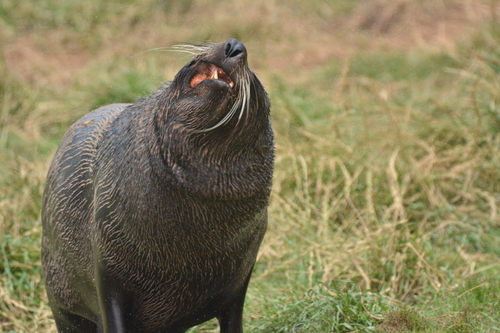
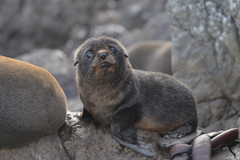


Long-nosed Fur Seal
Arctocephalus forsteri
Silhouette: Pseudopanax and GoEThe · PhyloPic
- KingdomAnimalia (Animals)
- PhylumChordata (Chordates)
- ClassMammalia (Mammals)
- OrderCarnivora (Carnivorans)
- FamilyOtariidae (Eared Seals)
- GenusArctocephalus (Southern Fur Seals)
- SpeciesArctocephalus forsteri (Long-nosed Fur Seal)
In 3 days ~80% in a week >90%
76 Verified sightings at Abel Tasman National Park From 2019 to 2026
557 In all 5 parks
June Best month
☀️ Diurnal When it's spotted
About the Long-nosed Fur Seal
Arctocephalus forsteri (common names include the Australasian fur seal, South Australian fur seal, New Zealand fur seal, Antipodean fur seal, or long-nosed fur seal) is a species of fur seal found mainly around southern Australia and New Zealand. The name New Zealand fur seal is used by English speakers in New Zealand; kekeno is used in the Māori language. As of 2014, the common name long-nosed fur seal has been proposed for the population of seals inhabiting Australia.
Although the Australian and New Zealand populations show some genetic differences, their morphologies are very similar, and thus they remain classed as a single species. After the arrival of humans in New Zealand, and particularly after the arrival of Europeans in Australia and New Zealand, hunting reduced the population to near-extinction.
Males have been reported as large as 160 kg (350 lb); their average weight is about 126 kg (278 lb). Males can be 2 m (6 ft 7 in) long. Females are between 30 and 50 kg (66–110 lbs) on average, and can be as long as 1.5 m (4 ft 11 in). Newborn pups are 3.3–3.9 kg (7.3–8.6 lbs) on average, and between 40 and 55 cm (1.3–1.8 ft) long. At 290 days old males are about... Wikipedia →
Sounds
Recording0:20
New Zealand · 2026
© Joseph Knight · iNaturalist · CC BY-NC 4.0
Recent sightings of Long-nosed Fur Seal in Abel Tasman National Park
LIVEiNaturalistGlobal Distribution
Parks Where Found
| # | Park | Country | Daily sighting probability |
|---|---|---|---|
| 1 | Fiordland National Park | 🇳🇿 New Zealand | |
| 2 | Flinders Chase | 🇦🇺 Australia | |
| 3 | Abel Tasman National Park | 🇳🇿 New Zealand | |
| 4 | Rottnest Island | 🇦🇺 Australia | |
| 5 | Rakiura National Park | 🇳🇿 New Zealand |
Zoos & Centres Where Found
| # | Zoo / Centre | Country | |
|---|---|---|---|
| 1 | Giza Zoo | 🇪🇬 Egypt | |
| 2 | Taronga Zoo | 🇦🇺 Australia | |
| 3 | Melbourne Zoo | 🇦🇺 Australia | |
| 4 | Auckland Zoo | 🇳🇿 New Zealand | |
| 5 | Mystic Aquarium & Institute for Exploration | 🇺🇸 United States | |
| 6 | Sea Life Sunshine Coast | 🇦🇺 Australia |
Closest Relatives at Abel Tasman National Park
No species of the same family or order lives in Abel Tasman National Park, so these are its closest relatives here: other mammals.


Before you go
What are the chances of seeing a Long-nosed Fur Seal in Abel Tasman National Park?
Likely
About 40% of wildlife watchers report a Long-nosed Fur Seal sighting in Abel Tasman National Park on a given day, based on 76 verified sightings from GBIF citizen-science data from 2019 to 2026. Over three days the chance rises to about 80%, and over a week to over 90%, if each day is a fresh chance.
When is the best time to see a Long-nosed Fur Seal in Abel Tasman National Park?
June
In that month about 60% of wildlife watchers report a Long-nosed Fur Seal in Abel Tasman National Park on a given day, against about 40% in January–February, April–May and July–November, the lowest months.
What time of day is best to see a Long-nosed Fur Seal?
Between noon and 3 pm
Across all the parks we cover, that three-hour window holds the most Long-nosed Fur Seal sightings with a recorded time, and about 9 in 10 of them come between 6 am and 6 pm: it is a daytime animal.
Is Abel Tasman National Park the best place to see a Long-nosed Fur Seal?
3rd of 5
Of the 5 parks where we can rate Long-nosed Fur Seal sightings, Abel Tasman National Park ranks 3rd at about 40%. The best odds are in Fiordland National Park (New Zealand, about 60%) and Flinders Chase (Australia, about 60%). All parks ranked.
Where does the Long-nosed Fur Seal sighting chance come from?
GBIF citizen-science records
It is estimated from how often the Long-nosed Fur Seal is recorded against all the mammals logged in Abel Tasman National Park (76 verified sightings from 2019 to 2026), calibrated against known sighting rates. Figures are rounded to the nearest 10% because citizen-science data supports honest approximations, not decimals, and months with records from fewer than five people show "—". How it works.
