Eastern Phantom Crane Fly

Eastern Phantom Crane Fly

Bittacomorpha clavipes

Daily sighting probability ~10% · With luck
at Acadia National Park

In 3 days ~20% in a week ~30%

8 Verified sightings at Acadia National Park From 2019 to 2026
26 In all 4 parks
June Best month
☀️ Diurnal When it's spotted

About the Eastern Phantom Crane Fly

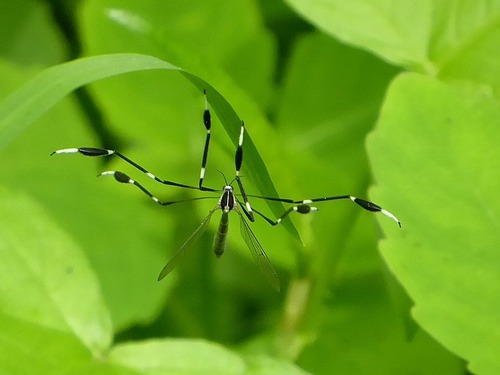
Bittacomorpha clavipes, the eastern phantom crane fly, is a species of phantom crane fly in the family Ptychopteridae. The eastern phantom crane fly is not to be confused with the other phantom crane flies, Bittacomorphella jonesi and Bittacomorpha occidentalis — the pygmy phantom crane fly and the western phantom crane fly.

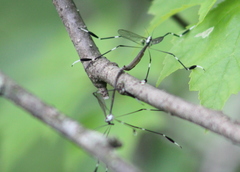
The eastern phantom crane fly is distributed across Eastern North America, east of the Rocky Mountains, from late spring to early fall, in the fairly dense vegetation along the shady edges of wetlands. The eastern phantom crane fly is not large. The body is approximately a half inch long and its legs are thin and black with white sheaths near the tips.

When flying, Bittacomorpha uses the wings scarcely at all, relying in great measure upon wind currents for transportation. The legs are exceedingly light, as the exoskeleton is light and delicate, and encloses practically no tissue that can serve to increase their weight. As they expose a large surface, they offer great resistance to the air without adding appreciably to the insect’s weight.

A characteristic and unique feature of the family is a lobe at the base of the haltere called the... Wikipedia →
Global Distribution

Parks Where Found

# Park Country Daily sighting probability
1 Gros Morne National Park 🇨🇦 Canada
~10%
2 Acadia National Park 🇺🇸 United States
~10%
3 Merritt Island National Wildlife Refuge 🇺🇸 United States
<5%
4 Great Smoky Mountains National Park 🇺🇸 United States
<5%

Cities Where Found

# City Country Daily sighting probability
1 Boston 🇺🇸 United States
<5%
2 Washington 🇺🇸 United States
<5%
3 Montreal 🇨🇦 Canada
<5%
4 New York City 🇺🇸 United States
<5%
5 Minneapolis [Saint Paul] 🇺🇸 United States
<5%
6 Toronto 🇨🇦 Canada
<5%

Before you go

What are the chances of seeing an Eastern Phantom Crane Fly in Acadia National Park?

With luck

About 10% of wildlife watchers report an Eastern Phantom Crane Fly sighting in Acadia National Park on a given day, based on 8 verified sightings from GBIF citizen-science data from 2019 to 2026. It is the 245th most-seen of the 405 insects we can rate there. Over three days the chance rises to about 20%, and over a week to about 30%, if each day is a fresh chance.

When is the best time to see an Eastern Phantom Crane Fly in Acadia National Park?

May–June and September

In those months about 10% of wildlife watchers report an Eastern Phantom Crane Fly in Acadia National Park on a given day, against under 5% in July–August and October–April, the lowest months.

What time of day is best to see an Eastern Phantom Crane Fly?

Between 1 and 4 pm

Across all the parks we cover, that three-hour window holds the most Eastern Phantom Crane Fly sightings with a recorded time, and about 9 in 10 of them come between 6 am and 6 pm: it is a daytime animal.

Is Acadia National Park the best place to see an Eastern Phantom Crane Fly?

Among the best

Of the 4 parks where we can rate Eastern Phantom Crane Fly sightings, Acadia National Park ranks 2nd at about 10%, level with the leaders once rounded. The best odds are in Gros Morne National Park (Canada, about 10%).

Which relatives of the Eastern Phantom Crane Fly live in Acadia National Park?

Same order: Diptera

The closest relatives of the Eastern Phantom Crane Fly that you can see in Acadia National Park (order Diptera, Flies) are Margined Calligrapher (about 20%), Eastern Calligrapher (about 20%) and Common Drone Fly (about 20%), with each one's daily chance of a sighting.

Where does the Eastern Phantom Crane Fly sighting chance come from?

GBIF citizen-science records

It is estimated from how often the Eastern Phantom Crane Fly is recorded against all the insects logged in Acadia National Park (8 verified sightings from 2019 to 2026), calibrated against known sighting rates. Figures are rounded to the nearest 10% because citizen-science data supports honest approximations, not decimals, and months with records from fewer than five people show "—". How it works.

← Back to Acadia National Park