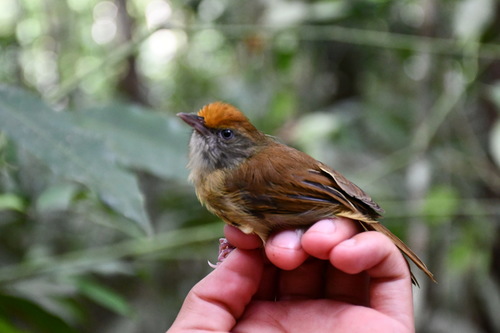
Dusky-capped Greenlet

Dusky-capped Greenlet

Hylophilus hypoxanthus

Silhouette: Jiekun He · PhyloPic

Daily sighting probability <5% · Rare
at Amacayacu National Natural Park

In 3 days ~10% in a week ~30%

32 Verified sightings at Amacayacu National Natural Park From 2019 to 2026
865 In all 5 parks
October Best month
☀️ Diurnal When it's spotted

About the Dusky-capped Greenlet

The dusky-capped greenlet (Pachysylvia hypoxantha) is a species of bird in the family Vireonidae, the vireos, greenlets, and shrike-babblers. It is found in Bolivia, Brazil, Colombia, Ecuador, Peru, and Venezuela. The dusky-capped greenlet was originally described in 1868 as Hylophilus hypoxanthus. For a time early in the twentieth century it was considered a subspecies of the golden-fronted greenlet (P. aurantiifrons) but beginning in the 1930s it attained its status as a full species.

The dusky-capped greenlet has these six subspecies: Pachysylvia hypoxantha hypoxantha (Pelzeln, 1868) Pachysylvia hypoxantha fuscicapillus (Sclater, PL & Salvin, 1880) Pachysylvia hypoxantha flaviventris (Cabanis, 1873) Pachysylvia hypoxantha icterica (Bond, J, 1953)

Pachysylvia hypoxantha albigula Chapman, 1921 Pachysylvia hypoxantha inornata Snethlage, E, 1914 Some mid-twentieth century authors treated P. h. inornata as a subspecies of the brown-headed greenlet (Hylophilus brunneiceps). Subspecies P. h. flaviventris was described as a full species and often treated that way until the mid-twentieth century.

The dusky-capped greenlet is 11.5 to 12 cm... Wikipedia →

Sounds

Recording0:10

Brazil · 2020

© Anderson Sandro · iNaturalist · CC BY-NC 4.0

Recording0:09

Brazil · 2024

© mapoflife_rapidassessments · iNaturalist · CC BY-NC 4.0

Recording0:02

Ecuador · 2022

© David Torres · iNaturalist · CC BY-NC 4.0

Global Distribution

Parks Where Found

# Park Country Daily sighting probability
1 Tambopata National Reserve 🇵🇪 Peru
~10%
2 Yasuní National Park 🇪🇨 Ecuador
~10%
3 Manu National Park 🇵🇪 Peru
~10%
4 Amacayacu National Natural Park 🇨🇴 Colombia
<5%
5 Anavilhanas National Park 🇧🇷 Brazil
<5%

Before you go

What are the chances of seeing a Dusky-capped Greenlet in Amacayacu National Natural Park?

Rare

Under 5% of wildlife watchers report a Dusky-capped Greenlet sighting in Amacayacu National Natural Park on a given day, based on 32 verified sightings from GBIF citizen-science data from 2019 to 2026. It is the 256th most-seen of the 436 birds we can rate there. Over three days the chance rises to about 10%, and over a week to about 30%, if each day is a fresh chance.

When is the best time to see a Dusky-capped Greenlet in Amacayacu National Natural Park?

January, June, August and October

In those months about 10% of wildlife watchers report a Dusky-capped Greenlet in Amacayacu National Natural Park on a given day, against under 5% in February–May, July, September and November–December, the lowest months.

What time of day is best to see a Dusky-capped Greenlet?

Between 6 and 9 am

Across all the parks we cover, that three-hour window holds the most Dusky-capped Greenlet sightings with a recorded time, and about 9 in 10 of them come between 6 am and 6 pm: it is a daytime animal.

Is Amacayacu National Natural Park the best place to see a Dusky-capped Greenlet?

4th of 5

Of the 5 parks where we can rate Dusky-capped Greenlet sightings, Amacayacu National Natural Park ranks 4th at under 5%. The best odds are in Tambopata National Reserve (Peru, about 10%), Yasuní National Park (Ecuador, about 10%) and Manu National Park (Peru, about 10%).

Where does the Dusky-capped Greenlet sighting chance come from?

GBIF citizen-science records

It is estimated from how often the Dusky-capped Greenlet is recorded against all the birds logged in Amacayacu National Natural Park (32 verified sightings from 2019 to 2026), calibrated against known sighting rates. Figures are rounded to the nearest 10% because citizen-science data supports honest approximations, not decimals, and months with records from fewer than five people show "—". How it works.

← Back to Amacayacu National Natural Park