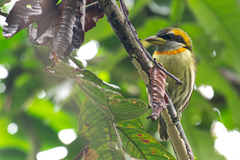

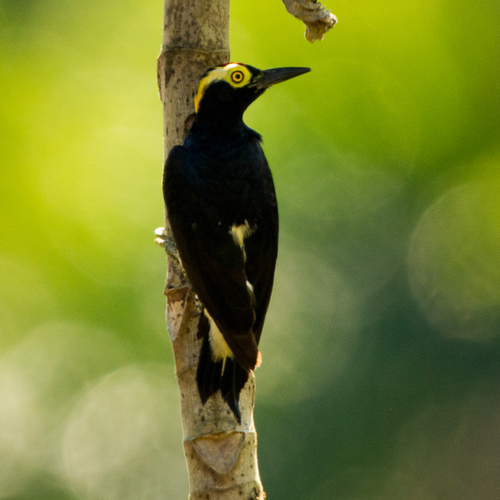
Lemon-throated Barbet

Lemon-throated Barbet

Eubucco richardsoni

Silhouette: Sheatherius · PhyloPic

LCLeast ConcernNTVUENCR
Daily sighting probability <5% · Rare
at Amacayacu National Natural Park

In 3 days <5% in a week ~10%

7 Verified sightings at Amacayacu National Natural Park From 2019 to 2026
1,092 In all 7 parks
September Best month
☀️ Diurnal When it's spotted

About the Lemon-throated Barbet

The lemon-throated barbet (Eubucco richardsoni) is a species of bird in the New World barbet family Capitonidae. It is found in Bolivia, Brazil, Colombia, Ecuador, and Peru. Clements groups richardsoni and nigriceps as "lemon-throated" and the other two as "flame-throated" within the species. The Cornell Lab of Ornithology's Birds of the World treats the two groups separately within its account of the lemon-throated barbet sensu lato. At various times, including as recently as 2014, aurantiicollis has been treated as a separate species called flame-throated barbet.

The "lemon-throated" barbet is approximately 15.5 cm (6.1 in) long and weighs 24.5 to 34 g (0.86 to 1.20 oz). The male of the nominate subspecies has a red crown, gray-blue nape, and green upperparts. Its throat is yellow, the breast orange-red... Wikipedia →

Sounds

Song0:29

Brazil · 2026

© JAYRSON ARAUJO DE OLIVEIRA · XC1182526 · CC BY-NC-SA 4.0

Call0:29

Brazil · 2015

© GABRIEL LEITE · XC284978 · CC BY-NC-SA 4.0

Recording1:02

Colombia · 2001

© Mauricio Álvarez-Rebolledo (Colección de Sonidos Ambientales - Instituto Humboldt) · XC525537 · CC BY-NC-SA 4.0

Global Distribution

Parks Where Found

# Park Country Daily sighting probability
1 Manu National Park 🇵🇪 Peru
~10%
2 Yasuní National Park 🇪🇨 Ecuador
~10%
3 Tambopata National Reserve 🇵🇪 Peru
~10%
4 Cuyabeno Wildlife Reserve 🇪🇨 Ecuador
<5%
5 Sierra de la Macarena National Park 🇨🇴 Colombia
<5%
6 Amacayacu National Natural Park 🇨🇴 Colombia
<5%
7 Podocarpus National Park 🇪🇨 Ecuador
<5%

Before you go

What are the chances of seeing a Lemon-throated Barbet in Amacayacu National Natural Park?

Rare

Under 5% of wildlife watchers report a Lemon-throated Barbet sighting in Amacayacu National Natural Park on a given day, based on 7 verified sightings from GBIF citizen-science data from 2019 to 2026. It is the 419th most-seen of the 436 birds we can rate there. Over three days the chance rises to under 5%, and over a week to about 10%, if each day is a fresh chance.

When is the best time to see a Lemon-throated Barbet in Amacayacu National Natural Park?

Any time of year

In every month with enough records, under 5% of wildlife watchers report a Lemon-throated Barbet in Amacayacu National Natural Park on a given day, so our monthly data shows no clear season.

What time of day is best to see a Lemon-throated Barbet?

Between 9 am and noon

Across all the parks we cover, that three-hour window holds the most Lemon-throated Barbet sightings with a recorded time, and about 8 in 10 of them come between 6 am and 6 pm: it is a daytime animal.

Is Amacayacu National Natural Park the best place to see a Lemon-throated Barbet?

6th of 7

Of the 7 parks where we can rate Lemon-throated Barbet sightings, Amacayacu National Natural Park ranks 6th at under 5%. The best odds are in Manu National Park (Peru, about 10%), Yasuní National Park (Ecuador, about 10%) and Tambopata National Reserve (Peru, about 10%).

Which relatives of the Lemon-throated Barbet live in Amacayacu National Natural Park?

Same family: Capitonidae

The closest relatives of the Lemon-throated Barbet that you can see in Amacayacu National Natural Park (family Capitonidae, New World Barbets) are Gilded Barbet (about 40%) and Scarlet-crowned Barbet (about 30%), with each one's daily chance of a sighting.

Where does the Lemon-throated Barbet sighting chance come from?

GBIF citizen-science records

It is estimated from how often the Lemon-throated Barbet is recorded against all the birds logged in Amacayacu National Natural Park (7 verified sightings from 2019 to 2026), calibrated against known sighting rates. Figures are rounded to the nearest 10% because citizen-science data supports honest approximations, not decimals, and months with records from fewer than five people show "—". How it works.

← Back to Amacayacu National Natural Park