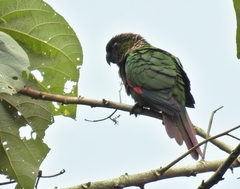
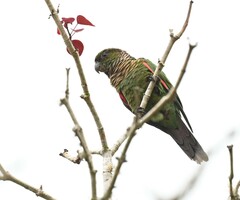
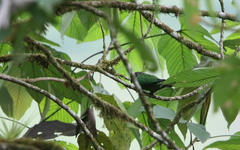

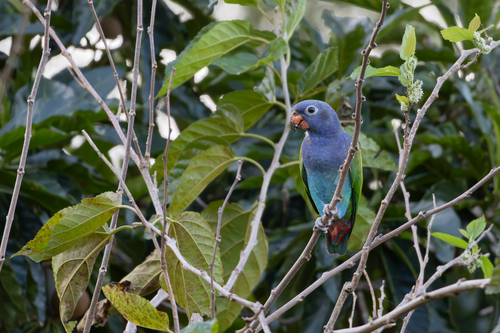
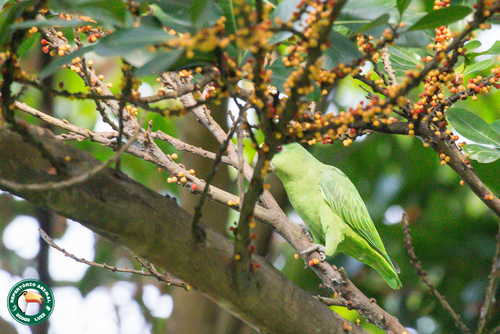
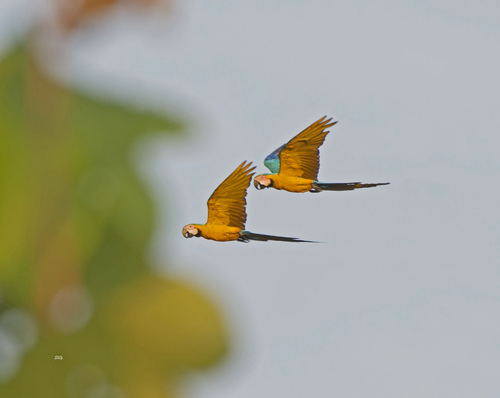
Maroon-tailed Parakeet

Maroon-tailed Parakeet

Pyrrhura melanura

Silhouette: Sheatherius · PhyloPic

LCLeast ConcernNTVUENCR
Daily sighting probability ~10% · With luck
at Amacayacu National Natural Park

In 3 days ~20% in a week ~40%

71 Verified sightings at Amacayacu National Natural Park From 2019 to 2026
317 In all 4 parks
January Best month
☀️ Diurnal When it's spotted

About the Maroon-tailed Parakeet

The maroon-tailed parakeet (Pyrrhura melanura) is a species of bird in subfamily Arinae of the family Psittacidae, the African and New World parrots. It is found in Brazil, Colombia, Ecuador, Peru, and Venezuela. The International Ornithological Committee and the Clements taxonomy assign these five subspecies to the maroon-tailed parakeet:

Note that the range map excludes these two taxa. This article follows the five-subspecies model. The maroon-tailed parakeet is 23 to 25 cm (9.1 to 9.8 in) long and weighs about 83 g (2.9 oz). The sexes are the same. Adults of the nominate subspecies P. m. melanura have a mostly green head with a brown crown and nape. Their upperparts are green. Their throat, the sides of their neck, and their breast are dark green with buffy whitish feather edges that... Wikipedia →

Sounds

Call0:36

Ecuador · 2024

© Manuel Sánchez-Nivicela · XC1163908 · CC BY-NC-ND 4.0

Flight call0:15

Ecuador · 2025

© Marc Anderson · XC1032654 · CC BY-NC-ND 4.0

Alarm call0:12

Ecuador · 2001

© Patricio Mena Valenzuela · XC275209 · CC BY-NC-SA 4.0

Global Distribution

Parks Where Found

# Park Country Daily sighting probability
1 Amacayacu National Natural Park 🇨🇴 Colombia
~10%
2 Cuyabeno Wildlife Reserve 🇪🇨 Ecuador
~10%
3 Yasuní National Park 🇪🇨 Ecuador
~10%
4 Sierra de la Macarena National Park 🇨🇴 Colombia
<5%

Zoos & Centres Where Found

# Zoo / Centre Country
1 Espace zoologique de Saint-Martin-la-Plaine 🇫🇷 France In captivity
2 Loro Parque 🇪🇸 Spain In captivity
3 Jungle Island 🇺🇸 United States In captivity
4 Ecozoológico San Martín 🇪🇨 Ecuador In captivity

Before you go

What are the chances of seeing a Maroon-tailed Parakeet in Amacayacu National Natural Park?

With luck

About 10% of wildlife watchers report a Maroon-tailed Parakeet sighting in Amacayacu National Natural Park on a given day, based on 71 verified sightings from GBIF citizen-science data from 2019 to 2026. It is the 191st most-seen of the 436 birds we can rate there. Over three days the chance rises to about 20%, and over a week to about 40%, if each day is a fresh chance.

When is the best time to see a Maroon-tailed Parakeet in Amacayacu National Natural Park?

January and September

In those months about 20% of wildlife watchers report a Maroon-tailed Parakeet in Amacayacu National Natural Park on a given day, against under 5% in April–May, July–August and October–December, the lowest months.

What time of day is best to see a Maroon-tailed Parakeet?

Between 8 and 11 am

Across all the parks we cover, that three-hour window holds the most Maroon-tailed Parakeet sightings with a recorded time, and about 9 in 10 of them come between 6 am and 6 pm: it is a daytime animal.

Is Amacayacu National Natural Park the best place to see a Maroon-tailed Parakeet?

Yes

Of the 4 parks where we can rate Maroon-tailed Parakeet sightings, Amacayacu National Natural Park has the highest daily chance: about 10%. Next come Cuyabeno Wildlife Reserve (Ecuador, about 10%) and Yasuní National Park (Ecuador, about 10%).

Which relatives of the Maroon-tailed Parakeet live in Amacayacu National Natural Park?

Same family: Psittacidae

The closest relatives of the Maroon-tailed Parakeet that you can see in Amacayacu National Natural Park (family Psittacidae, New World and African Parrots) are Tui Parakeet (about 40%), Dusky-headed Parakeet (about 30%) and Blue-headed Parrot (about 30%), with each one's daily chance of a sighting.

Where does the Maroon-tailed Parakeet sighting chance come from?

GBIF citizen-science records

It is estimated from how often the Maroon-tailed Parakeet is recorded against all the birds logged in Amacayacu National Natural Park (71 verified sightings from 2019 to 2026), calibrated against known sighting rates. Figures are rounded to the nearest 10% because citizen-science data supports honest approximations, not decimals, and months with records from fewer than five people show "—". How it works.

← Back to Amacayacu National Natural Park