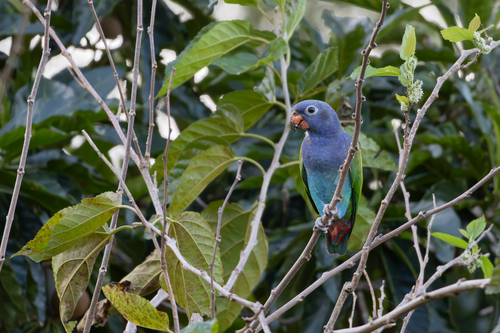
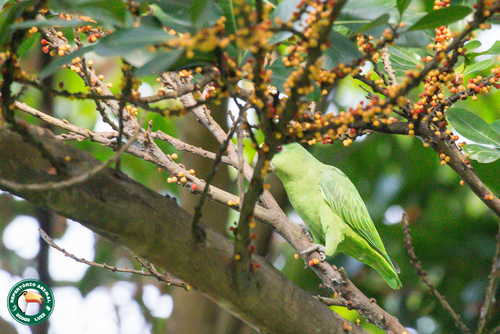
Dusky-headed Parakeet

Dusky-headed Parakeet

Aratinga weddellii

Silhouette: Myriam_Ramirez · PhyloPic

LCLeast ConcernNTVUENCR
Daily sighting probability ~30% · Possible
at Amacayacu National Natural Park

In 3 days ~70% in a week ~90%

270 Verified sightings at Amacayacu National Natural Park From 2019 to 2026
3,559 In all 5 parks
August Best month
☀️ Diurnal When it's spotted

About the Dusky-headed Parakeet

The dusky-headed parakeet (Aratinga weddellii), also known as Weddell's conure or dusky-headed conure in aviculture, is a small green Neotropical parrot with dusty grey head found in wooded habitats in the western Amazon basin of South America. Its range extends from southeastern Colombia south through eastern Ecuador, eastern Peru, and southwest Amazonian Brazil, to central Bolivia. It prefers semiopen habitats such as várzea, forest edge, and forest remnants, but can also be found in coffee plantations. It is generally common and its habitat preference makes it less vulnerable than many other Amazonian species. Consequently, it is considered to be of least concern by BirdLife International and IUCN.

This long-tailed species is generally green in color (both lutino and blue mutations are rare, but do exist in captivity) with a gray-brown head, a blue-tipped tail, and remiges that are dark gray from below, mainly blue from above. The bill is black, and it has a broad, bare, white (sometimes yellow-tinged) eye-ring. With a typical length of 25–28 cm (10–11 in) and a weight around 100 grams, it is slightly smaller than the sun conure. Many people call these conures mini-macaws because they have skin near their beaks and eyes, similar to the macaw.

It is social, and usually found in pairs or small groups. It may even flock with different species of conures. When food is plentiful, it may form flocks of up to 100 members. It eats fruit, seeds, and flowers, and searches decaying wood for insect larvae. It also ingests mineral-rich soil, e.g., from a clay lick, as a supplement. A pair raises their offspring together, nesting in woodpecker holes in trees or arboreal termite nests.

Consuming clay is believed to provide a mineral supplement and neutralise toxins in their diet. Their predators (along with many other neotropical parrots) include many birds of prey, monkeys, and in some cases, jaguars.

They do well in captivity. They are fairly easy to breed if provided with a durable nest box, and will lay up to three clutches per year. They are known to be quiet, compared to other conure species, but still very energetic and playful, like most conures. These conures' lifespans range from 25 to 50 years, though their typical lifespans are usually 35–40 years.

Recently, they have been sighted as a colony in the coastal districts of Lima, Perú. They probably came as pets, and have settled in this city. Wikipedia →

Sounds

Flight call0:07

Ecuador · 2026

© Daan van der Hoeven · XC1156524 · CC BY-NC-SA 4.0

Call0:34

Ecuador · 2025

© Marc Anderson · XC980745 · CC BY-NC-ND 4.0

Call0:36

Bolivia · 2023

© Richard E. Webster · XC861206 · CC BY-NC-SA 4.0

Global Distribution

Parks Where Found

# Park Country Daily sighting probability
1 Amacayacu National Natural Park 🇨🇴 Colombia
~30%
2 Manu National Park 🇵🇪 Peru
~30%
3 Yasuní National Park 🇪🇨 Ecuador
~30%
4 Tambopata National Reserve 🇵🇪 Peru
~20%
5 Cuyabeno Wildlife Reserve 🇪🇨 Ecuador
~10%

Cities Where Found

# City Country Daily sighting probability
1 Santa Cruz de la Sierra 🇧🇴 Bolivia
~10%

Zoos & Centres Where Found

# Zoo / Centre Country
1 Biocentro Güembé 🇧🇴 Bolivia In captivity
2 Bioparque Municipal Vesty Pakos 🇧🇴 Bolivia In captivity
3 Parque de las Leyendas 🇵🇪 Peru In captivity
4 Loro Parque 🇪🇸 Spain In captivity
5 Stone Zoo 🇺🇸 United States In captivity
6 Agroflori Parque de las Aves 🇧🇴 Bolivia In captivity
7 Selva Viva Park 🇵🇪 Peru In captivity

Before you go

What are the chances of seeing a Dusky-headed Parakeet in Amacayacu National Natural Park?

Possible

About 30% of wildlife watchers report a Dusky-headed Parakeet sighting in Amacayacu National Natural Park on a given day, based on 270 verified sightings from GBIF citizen-science data from 2019 to 2026. It is the 17th most-seen of the 436 birds we can rate there. Over three days the chance rises to about 70%, and over a week to about 90%, if each day is a fresh chance.

When is the best time to see a Dusky-headed Parakeet in Amacayacu National Natural Park?

August and November

In those months about 50% of wildlife watchers report a Dusky-headed Parakeet in Amacayacu National Natural Park on a given day, against about 20% in March, June, October and December, the lowest months.

What time of day is best to see a Dusky-headed Parakeet?

Between 7 and 10 am

Across all the parks we cover, that three-hour window holds the most Dusky-headed Parakeet sightings with a recorded time, and about 8 in 10 of them come between 6 am and 6 pm: it is a daytime animal.

Is Amacayacu National Natural Park the best place to see a Dusky-headed Parakeet?

Yes

Of the 5 parks where we can rate Dusky-headed Parakeet sightings, Amacayacu National Natural Park has the highest daily chance: about 30%. Next come Manu National Park (Peru, about 30%) and Yasuní National Park (Ecuador, about 30%).

Where does the Dusky-headed Parakeet sighting chance come from?

GBIF citizen-science records

It is estimated from how often the Dusky-headed Parakeet is recorded against all the birds logged in Amacayacu National Natural Park (270 verified sightings from 2019 to 2026), calibrated against known sighting rates. Figures are rounded to the nearest 10% because citizen-science data supports honest approximations, not decimals, and months with records from fewer than five people show "—". How it works.

← Back to Amacayacu National Natural Park