Nocturnal Curassow

Nocturnal Curassow

Nothocrax urumutum

Silhouette: Sheatherius · PhyloPic

LCLeast ConcernNTVUENCR
Daily sighting probability ~10% · With luck
at Amacayacu National Natural Park

In 3 days ~20% in a week ~40%

43 Verified sightings at Amacayacu National Natural Park From 2019 to 2026
166 In all 3 parks
January Best month
☀️🌙 Day & Night When it's spotted

About the Nocturnal Curassow

The nocturnal curassow (Nothocrax urumutum) is a species of bird in the family Cracidae, the chachalacas, guans, and curassows. It is found in Brazil, Colombia, Ecuador, Peru, and Venezuela. The nocturnal curassow was originally placed in genus Crax but genetic data confirm that Nothocrax is a valid genus. It is the only member of its genus and has no subspecies.

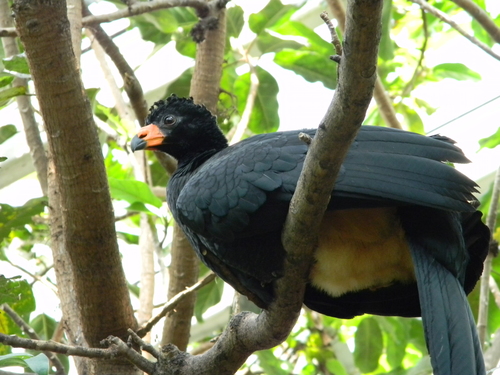
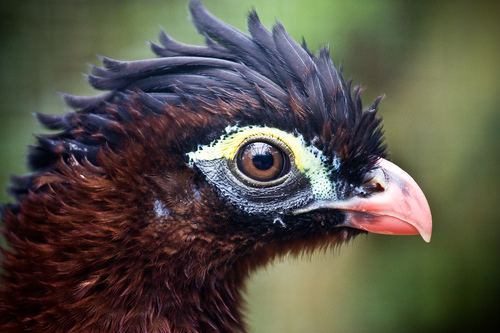
The nocturnal curassow is the smallest curassow at 50 to 57.5 cm (1.6 to 1.9 ft) long. One bird weighed 1,250 g (2.8 lb). It is also unique with its mostly rufous and chestnut plumage, as other curassows are mostly black. Its crest is flat and blackish, its ventral area buffy, and the tips of its tail feathers are paler than the rest. Its brownish-orange eye is surrounded by bare skin, greenish-yellow above and black below. The bill is reddish-orange and the legs gray.

The nocturnal curassow is found in middle and upper Amazonia, from far southern Venezuela, southeastern Colombia, eastern Ecuador, and northeastern Peru into western and central Brazil. It inhabits terra firme forest and flooded forests (both permanent and seasonal). It favors low... Wikipedia →

Sounds

Song1:00

Brazil · 2022

© GABRIEL LEITE · XC721232 · CC BY-NC-SA 4.0

Call0:18

Peru · 2012

© Fabrice Schmitt · XC216024 · CC BY-NC-SA 4.0

Song0:41

Colombia · 2019

© Iván Lau · XC588343 · CC BY-NC-SA 4.0

Global Distribution

Parks Where Found

# Park Country Daily sighting probability
1 Amacayacu National Natural Park 🇨🇴 Colombia
~10%
2 Yasuní National Park 🇪🇨 Ecuador
<5%
3 Cuyabeno Wildlife Reserve 🇪🇨 Ecuador
<5%

Zoos & Centres Where Found

# Zoo / Centre Country
1 Zoológico de Goiânia 🇧🇷 Brazil In captivity
2 Rio de Janeiro Zoological Garden 🇧🇷 Brazil In captivity
3 Selwo Marina 🇪🇸 Spain In captivity
4 Zoo de Lourosa 🇵🇹 Portugal In captivity
5 Dallas World Aquarium 🇺🇸 United States In captivity
6 Zooparque Itatiba 🇧🇷 Brazil In captivity

Before you go

What are the chances of seeing a Nocturnal Curassow in Amacayacu National Natural Park?

With luck

About 10% of wildlife watchers report a Nocturnal Curassow sighting in Amacayacu National Natural Park on a given day, based on 43 verified sightings from GBIF citizen-science data from 2019 to 2026. It is the 230th most-seen of the 436 birds we can rate there. Over three days the chance rises to about 20%, and over a week to about 40%, if each day is a fresh chance.

When is the best time to see a Nocturnal Curassow in Amacayacu National Natural Park?

January

In that month about 20% of wildlife watchers report a Nocturnal Curassow in Amacayacu National Natural Park on a given day, against under 5% in February–April, June–August and October–December, the lowest months.

What time of day is best to see a Nocturnal Curassow?

Between 10 am and 1 pm

Across all the parks we cover, that three-hour window holds the most Nocturnal Curassow sightings with a recorded time, and about half of them come between 6 am and 6 pm: it is seen both by day and at night.

Is Amacayacu National Natural Park the best place to see a Nocturnal Curassow?

Yes

Of the 3 parks where we can rate Nocturnal Curassow sightings, Amacayacu National Natural Park has the highest daily chance: about 10%. Next come Yasuní National Park (Ecuador, under 5%) and Cuyabeno Wildlife Reserve (Ecuador, under 5%).

Which relatives of the Nocturnal Curassow live in Amacayacu National Natural Park?

Same family: Cracidae

The closest relatives of the Nocturnal Curassow that you can see in Amacayacu National Natural Park (family Cracidae, Guans, Chachalacas, and Curassows) are Speckled Chachalaca (about 30%), Spix's Guan (about 10%) and Blue-throated Piping-Guan (about 10%), with each one's daily chance of a sighting.

Where does the Nocturnal Curassow sighting chance come from?

GBIF citizen-science records

It is estimated from how often the Nocturnal Curassow is recorded against all the birds logged in Amacayacu National Natural Park (43 verified sightings from 2019 to 2026), calibrated against known sighting rates. Figures are rounded to the nearest 10% because citizen-science data supports honest approximations, not decimals, and months with records from fewer than five people show "—". How it works.

← Back to Amacayacu National Natural Park