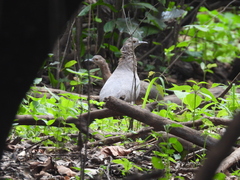
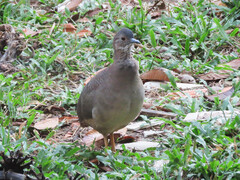
Undulated Tinamou

Undulated Tinamou

Crypturellus undulatus

Silhouette: J. N. Wiegers · PhyloPic

LCLeast ConcernNTVUENCR
Daily sighting probability ~50% · Likely
at Amacayacu National Natural Park

In 3 days ~90% in a week >90%

504 Verified sightings at Amacayacu National Natural Park From 2019 to 2026
5,776 In all 9 parks
June Best month
☀️ Diurnal When it's spotted

About the Undulated Tinamou

The undulated tinamou (Crypturellus undulatus) is a species of ground bird found in a wide range of wooded habitats in eastern and northern South America. Its generic name Crypturellus is formed from three Latin or Greek words - kruptos meaning "covered" or "hidden", oura meaning "tail", and ellus meaning "diminutive". Therefore, Crypturellus means small, hidden tail. The specific name undulatus originates from the Latin word unda, meaning "wave", and means "furnished with wave-like markings".

All Crypturellus are in the family Tinamidae, thus are classed as ratites, making them relatives of the cassowary, emu, kiwi, ostrich and rhea. Unlike these larger birds, however, tinamous still have the ability to fly, albeit somewhat weakly and not for prolonged periods (typically flying up, to perch on branches, when fleeing threats). It is thought that all ratites evolved from prehistoric flying birds, hence their distant populations in Australia and Oceania; the tinamou is the closest, smallest living relative of these birds.

Crypturellus undulatus manapiare is only known, with certainty, from the vicinity of the Ventuari River in northern... Wikipedia →

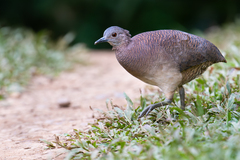
Sounds

Song0:44

Brazil · 2026

© JAYRSON ARAUJO DE OLIVEIRA · XC1163685 · CC BY-NC-SA 4.0

Duet0:49

Brazil · 2025

© Joost van Bruggen · XC1050647 · CC BY-NC-ND 4.0

Uncertain0:20

Brazil · 2021

© Adelina Maria Kühl · XC680557 · CC BY-NC-SA 4.0

Global Distribution

Parks Where Found

# Park Country Daily sighting probability
1 Amacayacu National Natural Park 🇨🇴 Colombia
~50%
2 Chapada dos Guimarães National Park 🇧🇷 Brazil
~40%
3 Tambopata National Reserve 🇵🇪 Peru
~40%
4 Parque Estadual Encontro das Águas 🇧🇷 Brazil
~40%
5 Manu National Park 🇵🇪 Peru
~30%
6 Cuyabeno Wildlife Reserve 🇪🇨 Ecuador
~30%
7 Yasuní National Park 🇪🇨 Ecuador
~20%
8 Emas National Park 🇧🇷 Brazil
~20%
9 Sierra de la Macarena National Park 🇨🇴 Colombia
~10%

Cities Where Found

# City Country Daily sighting probability
1 Campo Grande 🇧🇷 Brazil
<5%

Before you go

What are the chances of seeing an Undulated Tinamou in Amacayacu National Natural Park?

Likely

About 50% of wildlife watchers report an Undulated Tinamou sighting in Amacayacu National Natural Park on a given day, based on 504 verified sightings from GBIF citizen-science data from 2019 to 2026. It is the 3rd most-seen of the 436 birds we can rate there. Over three days the chance rises to about 90%, and over a week to over 90%, if each day is a fresh chance.

When is the best time to see an Undulated Tinamou in Amacayacu National Natural Park?

June

In that month about 80% of wildlife watchers report an Undulated Tinamou in Amacayacu National Natural Park on a given day, against about 40% in April and September–October, the lowest months.

What time of day is best to see an Undulated Tinamou?

Between 3 and 6 pm

Across all the parks we cover, that three-hour window holds the most Undulated Tinamou sightings with a recorded time, and about 8 in 10 of them come between 6 am and 6 pm: it is a daytime animal.

Which relatives of the Undulated Tinamou live in Amacayacu National Natural Park?

Same genus: Crypturellus

The closest relatives of the Undulated Tinamou that you can see in Amacayacu National Natural Park (genus Crypturellus, Crypturellus Tinamous) are Cinereous Tinamou (about 20%), Little Tinamou (about 10%) and Variegated Tinamou (about 10%), with each one's daily chance of a sighting.

Where does the Undulated Tinamou sighting chance come from?

GBIF citizen-science records

It is estimated from how often the Undulated Tinamou is recorded against all the birds logged in Amacayacu National Natural Park (504 verified sightings from 2019 to 2026), calibrated against known sighting rates. Figures are rounded to the nearest 10% because citizen-science data supports honest approximations, not decimals, and months with records from fewer than five people show "—". How it works.

← Back to Amacayacu National Natural Park