





Completed

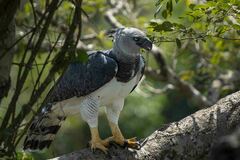

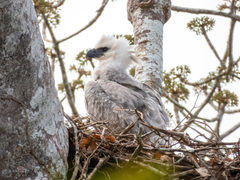
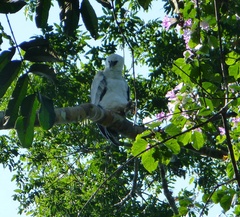

Harpy Eagle
Harpia harpyja
Silhouette: Sheatherius · PhyloPic
- KingdomAnimalia (Animals)
- PhylumChordata (Chordates)
- ClassAves (Birds)
- OrderAccipitriformes (Hawks, Eagles, Kites, and Allies)
- FamilyAccipitridae (Hawks, Eagles, and Kites)
- GenusHarpia
- SpeciesHarpia harpyja (Harpy Eagle)
In 3 days ~10% in a week ~30%
22 Verified sightings at Amboró National Park From 2019 to 2026
765 In all 7 parks
May Best month
☀️ Diurnal When it's spotted
About the Harpy Eagle
The harpy eagle (Harpia harpyja) is a large neotropical species of eagle. It is also called the American harpy eagle to distinguish it from the Papuan eagle, which is sometimes known as the New Guinea harpy eagle or Papuan harpy eagle. It is the largest bird of prey throughout its range, and among the largest extant species of eagles in the world. It usually inhabits tropical lowland rainforests in the upper (emergent) canopy layer. Destruction of its natural habitat has caused it to vanish from many parts of its former range, and it is nearly extirpated from much of Central America. It is the only member of the genus Harpia, which, together with Harpyopsis, Macheiramphus and Morphnus, forms the subfamily Harpiinae.
The harpy eagle was first described by Carl Linnaeus in his landmark 1758 10th edition of Systema Naturae as Vultur harpyja, after the mythological beast harpy. It is now the only species placed in the genus Harpia that was introduced in 1816 by the French ornithologist Louis Pierre Vieillot. The harpy eagle is most closely related to the crested eagle (Morphnus guianensis), the Papuan eagle (Harpyopsis novaeguineae) and the bat hawk (Macheiramphus alcinus... Wikipedia →
Recent sightings of Harpy Eagle in Amboró National Park
LIVEiNaturalistGlobal Distribution
Parks Where Found
| # | Park | Country | Daily sighting probability |
|---|---|---|---|
| 1 | Darién National Park | 🇵🇦 Panama | |
| 2 | Sierra de la Macarena National Park | 🇨🇴 Colombia | |
| 3 | Amboró National Park | 🇧🇴 Bolivia | |
| 4 | Cuyabeno Wildlife Reserve | 🇪🇨 Ecuador | |
| 5 | Yasuní National Park | 🇪🇨 Ecuador | |
| 6 | Manu National Park | 🇵🇪 Peru | |
| 7 | Tambopata National Reserve | 🇵🇪 Peru |
Zoos & Centres Where Found
Closest Relatives at Amboró National Park


Before you go
What are the chances of seeing a Harpy Eagle in Amboró National Park?
Rare
Under 5% of wildlife watchers report a Harpy Eagle sighting in Amboró National Park on a given day, based on 22 verified sightings from GBIF citizen-science data from 2019 to 2026. It is the 136th most-seen of the 273 birds we can rate there. Over three days the chance rises to about 10%, and over a week to about 30%, if each day is a fresh chance.
When is the best time to see a Harpy Eagle in Amboró National Park?
May and September
In those months about 10% of wildlife watchers report a Harpy Eagle in Amboró National Park on a given day, against under 5% in July–August and October–April, the lowest months. June has too few records to rate.
What time of day is best to see a Harpy Eagle?
Between 9 am and noon
Across all the parks we cover, that three-hour window holds the most Harpy Eagle sightings with a recorded time, and about 9 in 10 of them come between 6 am and 6 pm: it is a daytime animal.
Is Amboró National Park the best place to see a Harpy Eagle?
3rd of 7
Of the 7 parks where we can rate Harpy Eagle sightings, Amboró National Park ranks 3rd at under 5%. The best odds are in Darién National Park (Panama, about 20%) and Sierra de la Macarena National Park (Colombia, about 20%).
Which relatives of the Harpy Eagle live in Amboró National Park?
Same family: Accipitridae
The closest relatives of the Harpy Eagle that you can see in Amboró National Park (family Accipitridae, Hawks, Eagles, and Kites) are Black-chested Buzzard-Eagle (about 20%), Plumbeous Kite (about 10%) and Roadside Hawk (about 10%), with each one's daily chance of a sighting.
Where does the Harpy Eagle sighting chance come from?
GBIF citizen-science records
It is estimated from how often the Harpy Eagle is recorded against all the birds logged in Amboró National Park (22 verified sightings from 2019 to 2026), calibrated against known sighting rates. Figures are rounded to the nearest 10% because citizen-science data supports honest approximations, not decimals, and months with records from fewer than five people show "—". How it works.
