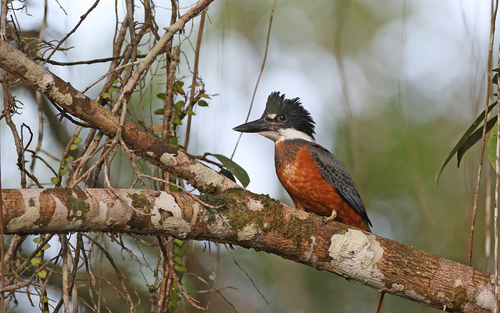
Amazonian Trogon

Amazonian Trogon

Trogon ramonianus

Silhouette: Keith Murdock (photo), John E. McCormack, Michael G. Harvey, Brant C. Faircloth, Nicholas G. Crawford, Travis C. Glenn, Robb T. Brumfield & T. Michael Keesey · PhyloPic

Daily sighting probability <5% · Rare
at Anavilhanas National Park

In 3 days <5% in a week ~10%

6 Verified sightings at Anavilhanas National Park From 2019 to 2026
671 In all 7 parks
July Best month
☀️ Diurnal When it's spotted

About the Amazonian Trogon

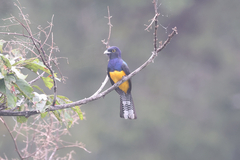
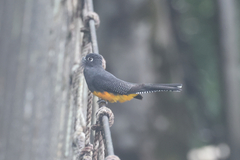
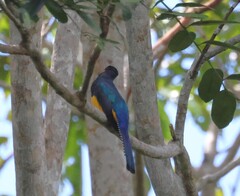
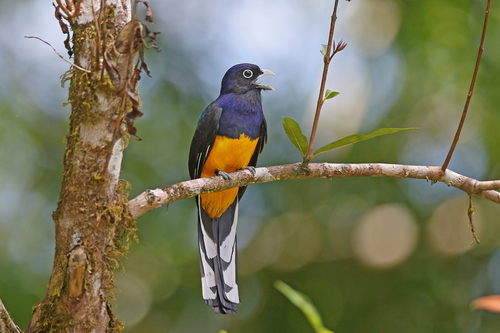
The Amazonian trogon (Trogon ramonianus), is a species of bird in the family Trogonidae, the trogons and quetzals. It is found in Bolivia, Brazil, Colombia, Ecuador, Peru, and Venezuela. Until the early 2000s, what are now the Amazonian trogon and the gartered trogon (T. caligatus) were considered subspecies of the violaceous trogon (T. violaceous). The International Ornithological Committee (IOC), the Clements taxonomy, and the South American Classification Committee of the American Ornithological Society (AOS-SACC) have implemented the split making them separate species and renaming T. violaceous the Guianan trogon. However, BirdLife International's Handbook of the Birds of the World (HBW) retains them as subspecies. The two subspecies are so similar that some authors maintain that the Amazonian trogon is monotypic.

Trogons have distinctive male and female plumages, with soft, often colorful, feathers. The Amazonian trogon is about 23 to 25 cm (9.1 to 9.8 in) long; three males weighed 44 to... Wikipedia →

Sounds

Song0:10

Ecuador · 2021

© Manuel Sánchez-Nivicela · XC1154477 · CC BY-NC-ND 4.0

Duet0:46

Brazil · 2025

© JAYRSON ARAUJO DE OLIVEIRA · XC1035787 · CC BY-NC-SA 4.0

Song1:10

Ecuador · 2023

© rudy gelis · XC827208 · CC BY-NC-SA 4.0

Global Distribution

Parks Where Found

# Park Country Daily sighting probability
1 Cuyabeno Wildlife Reserve 🇪🇨 Ecuador
~10%
2 Yasuní National Park 🇪🇨 Ecuador
~10%
3 Amacayacu National Natural Park 🇨🇴 Colombia
~10%
4 Tambopata National Reserve 🇵🇪 Peru
~10%
5 Manu National Park 🇵🇪 Peru
<5%
6 Anavilhanas National Park 🇧🇷 Brazil
<5%
7 Sierra de la Macarena National Park 🇨🇴 Colombia
<5%

Before you go

What are the chances of seeing an Amazonian Trogon in Anavilhanas National Park?

Rare

Under 5% of wildlife watchers report an Amazonian Trogon sighting in Anavilhanas National Park on a given day, based on 6 verified sightings from GBIF citizen-science data from 2019 to 2026. It is the 258th most-seen of the 291 birds we can rate there. Over three days the chance rises to under 5%, and over a week to about 10%, if each day is a fresh chance.

When is the best time to see an Amazonian Trogon in Anavilhanas National Park?

July

In that month about 10% of wildlife watchers report an Amazonian Trogon in Anavilhanas National Park on a given day, against under 5% in August to June, the lowest months. That is one of Anavilhanas National Park's driest months, with about 100 mm of rain against 340 mm in March.

What time of day is best to see an Amazonian Trogon?

Between 7 and 10 am

Across all the parks we cover, that three-hour window holds the most Amazonian Trogon sightings with a recorded time, and about 7 in 10 of them come between 6 am and 6 pm: it is a daytime animal.

Which relatives of the Amazonian Trogon live in Anavilhanas National Park?

Same genus: Trogon

The closest relatives of the Amazonian Trogon that you can see in Anavilhanas National Park (genus Trogon, New World Trogons) are Green-backed Trogon (about 30%) and Blue-crowned Trogon (about 10%), with each one's daily chance of a sighting.

Where does the Amazonian Trogon sighting chance come from?

GBIF citizen-science records

It is estimated from how often the Amazonian Trogon is recorded against all the birds logged in Anavilhanas National Park (6 verified sightings from 2019 to 2026), calibrated against known sighting rates. Figures are rounded to the nearest 10% because citizen-science data supports honest approximations, not decimals, and months with records from fewer than five people show "—". How it works.

← Back to Anavilhanas National Park